 University of North Texas

Computer Science - Spring
2B Coders
Team Name
2B Coders
Team Members
Carlos Contreras
Mohammad Farhat
Manuel Flores
Boone Wilder
Internal Sponsor/Mentor
Dr. Stephanie Ludi
Abstract
Our project is a web-based, block-based programming space built for novice programmers to learn the basics of coding using Python. Users can drag and drop blocks to build a program and toggle between block-based and text-based views. The webpage runs Python code in-browser using Skulpt. It also includes a login system to allow users to save their work. This project tries to make coding more accessible to beginners.
Acknowledgments
Our project's core idea was based off Pencil Code: https://pencilcode.net
Code Runners
Team Name
Code Runners
Team Members
Daniel Ju
Antonio Proa
Sergei Kiryanov
Jafar Albdeiri
Internal Sponsor/Mentor
Dr. Stephanie Ludi
Abstract
This project is meant to fix the problems associated with using Post-Its to brainstorm ideas for group settings, vote on said ideas, and put them into groups. Some examples include illegible writing, dealing with larger groups of people, and needing a reliable method to store the results for any session. The project aims to provide the user with an environment to facilitate these activities by simplifying the process of creating these virtual post-its, creating voting polls for specific post-its or groups, and creating groups that act as subsections of these post-its. All of this is done with an account system and database to save the results of these workspaces for future reference.
PyBlocks
Team Name
Dream Team
Team Members
Ireoluwatomiwa Adewolu
Amanda English
Gloria Hernández
Purva Suresh
Internal Sponsor/Mentor
Dr. Stephani Ludi
Abstract
PyBlocks is a block coding website aimed at translating block code to Python for new learners. Young coders may also run the code in a terminal to see the output of their creations. The team also worked to ensure accessibility throughout the website and create guided project tutorials to get learners started. Through this effort, the team strives to bridge the gap between new coders and Python using block code.
Food Watch
Team Name
Healthy Byte
Team Members
Kirk Mills
Caden Rivadeneyra
Robert Knoles
Joshua Cramer
Zachary Cooksey
Internal Sponsors/Mentors
Dr. Stephanie Ludi
Saba Jazi
Abstract
Diagnosing food allergies can be challenging; each allergen has to be tested individually, and the results aren't always reliable. It is common to use these tests to rule in or out certain allergens, but this requires one to have some likely candidates to test. Tracking the ingredients in one's meals and associating them with reactions can be challenging, and especially cumbersome when done with pen and paper. Food Watch simplifies meal and reaction tracking by not only digitizing it into an Android app, but also by providing automatically generated reports showing potential allergens--including those that may go unnoticed when manually tracked.
Gait Vision
Team Name
Gait Vision
Team Members
Anson Nguyen
Jose Buenrostro
Nathaniel Schimpf
Van Cung
Trevor Spencer
External Sponsor/Mentor
Ritta Patterson - HSC
Internal Sponsors/Mentors
Dr. Albert - Engineering
Dr. Ludi - Teacher
Saba - TA
Abstract
Gait analysis can be expensive and take a lot of room using panorama cameras around the patient to give a 3D view of the joints and how they interact. Well-off medical offices can afford these conditions but lower-income and smaller offices don’t have the luxury to include these features or do them at a big enough scale to get accurate readings. The motivation behind this project is to create a more financially usable gait analysis system and data analysis. You should be able to use a phone camera and record someone walking perpendicular to you and analyze their walking pattern and judge if they have an impaired gait. (This effort also aims to collect data for under-resourced communities). Our team is developing our own application while building on the foundation established by the graduate team. We aim to enhance and expand upon their existing work.
HyperFix8
Team Members
Nathan Baker
Carlos Garcia
Joel Hunt
Abel Montoya
Andres Montoya
Internal Sponsors/Mentors
Saba Yousefian Jazi
Dr. Stephanie Ludi
Abstract
The motivation for this project is to provide a method for visually impaired individuals to enjoy the wonders of LEGO building. With hundreds, even thousands, of different LEGO sizes and colors, it can be overwhelming for anyone. However, this challenge is especially daunting for those with visual impairments, such as color blindness. While the project primarily aims to assist individuals with visual impairments, it can also prove beneficial and time-saving for anyone needing to recognize and differentiate between various LEGO pieces. The LEGO elements that will be identified come from their classic element sets. These hold the most common pieces and colors found across most sets.
I-7: Calm Quest
Team Name
Capstone Gang
Team Members
Kenneth Chen
Vin Eamboriboon
Skylar Mitchell
Tri Ngo
Eichelle Turner
Internal Sponsor/Mentor
Dr. Stephanie Ludi
Abstract
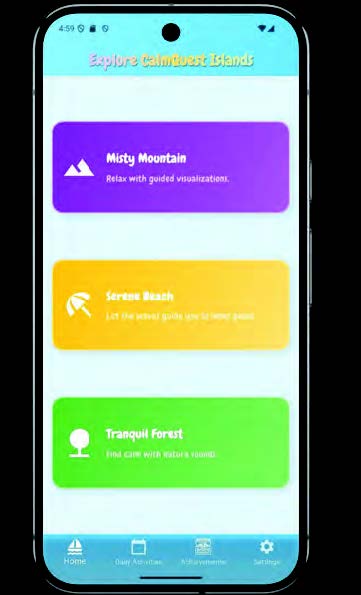
The purpose of this project is to develop a platform in which users are provided with various avenues to practice mindfulness techniques, enhance their emotional awareness, and manage their stress.
Users are encouraged to authentically engage with their emotions through guided content, whilst being offered tools to track and reflect on their emotional state.
KJBK
Team Members
Kyle Minter
Brett Berglund
Kennedy Boynton
Jacob Franks
Internal Sponsor/Mentor
Dr. Stephanie Ludi
Abstract
There are little to no accommodating extensions in VS Code that aid people with visual impairments in their coding experience. Specifically, this extension helps with Python as it relates to the LEGO Mindstorms programming space. This project is also fairly far along in its development, so our inclusions aim to add some quality of life features that make navigating the code file in VS Code easier.
Magiquill
Team Members
Timothy Erbert
Dylan Snyder
Carson Viator
Jean Affa
Kyle Youngquist
External Sponsor/Mentor
Saba Yousefian Jazi
Internal Sponsor/Mentor
Dr. Stephanie Ludi
Abstract
Magiquill is designed to enable users to craft immersive text-based games using an intuitive graphical interface. Centered around an innovative new engine that balances creator freedom with ease of use, the website functions as a one stop shop to both create one's own experiences and explore those made by others.
Next Level Software
Team Members
Ronnee Cady
Jan De La Cruz
Justin Barren
Jacob Lamberson
Cristian Morales
Internal Sponsor/Mentor
Dr. Ruth West
Abstract
This project builds upon an augmented reality (AR) block game originally developed in Unity by the xREZ Team.
Our team was tasked with integrating the game for compatibility with Android devices, ensuring smooth performance and usability on mobile platforms. This involved optimizing the AR framework and adjusting input methods.
Additionally, we implemented new gameplay functionalities to enhance user interaction and engagement. Through this development, we expanded the accessibility of the game while improving its overall experience, demonstrating effective adaptation of AR applications for mobile environments.
Rune Routes
Team Name
Team 10
Team Members
Ibrahim Abubeker
Joseph Leal
Frederick Punabantu
Nidhi Ravala
Monique Simberg
Internal Sponsor/Mentor
Dr. Stephanie Ludi
Abstract
RuneRoutes is an innovative mobile application that transforms everyday travel into a fantasy adventure through an interactive "fog of war" mechanic, encouraging users to physically explore their surroundings. Built using React Native and TypeScript, the app allows users to uncover new areas as they navigate the real world, place custom Points of Interest (POIs) with images and descriptions, and share discoveries with friends.
The application embraces a fantasy theme throughout its design, with the name "Rune Routes" reflecting the magical journey of discovery. Users can personalize their exploration experience by selecting custom character icons created by a design collaborator, adding a role-playing element to the navigation experience. As explorers venture into uncharted territories, they reveal hidden realms on their map, discover points of interest, and build their own legendary path through the world around them.
The application leverages Mapbox API for advanced map visualization and location tracking, while MongoDB Atlas with Terraform provides scalable cloud database infrastructure. A custom raycasting algorithm powers the core exploration mechanic, revealing previously hidden areas as users visit them. Secure authentication via Auth0 enables personalized experiences and social features, including a friends list that promotes collaborative discovery.
TaskPath
Team Name
SHPEHackerz
Team Members
Jessie Salazar
Ryan Arnold
Emilio Pena
Dustin Ruiz
William Euan
Internal Sponsors/Mentors
Dr. Stephanie Ludie
Saba Jazi
Abstract
Significant challenges exist in the ability of neurodiverse children to independently manage tasks, routines, and time-based responsibilities. To address this gap, we have developed TaskPath, a mobile application designed to provide a structured, gamified environment for children while offering visibility and oversight to their caregivers. Using a multi-sprint agile development cycle, this project has integrated core functionalities such as: task creation and assignment, child-specific dashboards, reward systems, task difficulty ratings, a real-time timer, and enhanced report generation, and accessibility features including colorblindness modes and dark mode.
By leveraging technologies such as React Native, Node.js, Firebase, and Jest-based automated testing, TaskPath ensures scalability, accessibility, and cross-platform support.
SoundViz
Team Members
Jaylen Neduelan
Navin Chikkodi
Julian Knight
Nicholas Lester
Jay Yu
Internal Sponsor/Mentor
Dr. Stephanie Ludi
Abstract
SoundViz is a web-based platform that converts mathematical graphs and datasets into interactive audio-visual experiences. The goal of this project is to make graph data more accessible to users, particularly individuals with visual impairments, by providing real-time sonification and visual feedback. Users can upload datasets, generate sonified graph animations, and interact with them through a streamlined, accessible web interface. Throughout the project, we prioritized accessibility features such as screen reader compatibility and keyboard navigation to ensure that the platform is inclusive to all users. The project was built using a React frontend with backend integration for audio generation and file management. SoundViz is now fully deployed and functional, with comprehensive user documentation and an accessible user experience.
Text Adventure Creation Toolkit
Team Name
Team Three
Team Members
Vanshika Ganga
Bennie Minor
Michael Reyes
Nicholas Reyna
Asim Zaman
Internal Sponsors/Mentors
Neelima Cirimavilla
Stephanie Ludi Saba
Yousefian Jazi
Abstract
The Text Adventure Creation Tool is a web-based platform designed to empower users of all technical backgrounds to create, share, and play narrative-driven text adventure games. With a focus on accessibility and ease of use, this tool offers an intuitive interface that requires minimal coding, enabling both novice and experienced creators to build interactive stories featuring objects, rooms, player choices, and inventories. Users can log in to manage their personal game projects, view other user's projects, and export or import games as standalone applications. Central to the platform is its commitment to inclusivity-supporting features like text-to-speech, and alternative input methods to ensure equitable access for individuals with disabilities. Addressing the limitations of outdated adventure game tools, this modern solution revitalizes the genre, promoting creativity, storytelling, and accessibility in interactive game design.
TimeX
Team Name
The Squad
Team Members
Ryan Decker
Nicholas Bruner
Michael Carbajal
Victor Islas
Juahn Kwon
Internal Sponsors/Mentors
Dr. Stephanie Ludi
Saba Jazi
Abstract
TimeX is a task management app that is designed to help users stay on track and remind them of their tasks. TimeX also includes design choices and features to help people with ADHD focus, including a game feature that rewards users for completing tasks. The app allows the user to create tasks with a deadline, displaying the current tasks along with the completed tasks. Users can also create groups with parents/children, allowing parents to remotely create tasks for their children to do. Users can also set a timer for studying, notifications for tasks, chat with users in a group and listen to music.
VR Block Programming
Team Members
Malcolm Case
Kevin Pham
Johnathon Lawton
Dawson Finklea
Tyler Braun
Internal Sponsors/Mentors
Dr. Stephanie Ludi
Saba Jazi
Abstract
As virtual reality increasingly becomes more and more financially accessible, it stands to reason that it will soon become an engaging and practical medium for hands-on learning. Currently, there are many Block-Based Programming applications on the internet that focus on making programming more digestible, but few have gone further to elevate the experience using the immersiveness and versatility of VR. VR provides budding and novice developers with an environment that is visually engaging and intuitively understandable.
We aim to create a Block-Based Programming application for VR to help novice developers, especially young children, to grow as programmers.