 University of North Texas

Mechanical and Energy Engineering - Spring
Automated Hybrid Hydroponic Plant Growing System

Team Members
Mechanical Engineering:
Robyn Soyangco
J.C. Clemente
Kelvin Masinag
Kaitlyn Ceh
Computer Engineering:
Abel Garcia Guzman
Connor Coultas
Computer Science:
Colton Daigneault
Exterior Sponsor/Mentor
Wes Pettinger - The Pettinger Foundation
Internal Sponsors/Mentors
Dr. Yunwei Xu
Dr. Hassan Qandil
Abstract
The Automated Hybrid Hydroponic Plant Growing System focuses on upgrading an automated watering system in a plant container into a more advanced hydroponic system, aiming to enhance efficiency, self-sustainability, and off-grid capabilities. The goal was to provide a more autonomous solution for plant cultivation. Through collaboration, an innovative system was developed to automate the delivery of essential resources to the plants.
The results demonstrate the successful integration of a system designed to improve plant growth and enable off-grid functionality. This upgrade has potential applications in resource-limited environments, offering an efficient method for food production.
Composite Ply Lay-Up End-Effector
Team Members
Tristan Morrison
Colt Castner
Alyssa Esquivel
Smarika Shrestha
Oscar Saavedra
William Bortle
Exterior Sponsors/Mentors
Bell Textron
Karl Hiedemann
Andrew Morton
Peter Rue
Internal Sponsor/Mentor
Ravi Sankar Hardias
Abstract
In the world of composite ply at Bell Textron, most of the process currently is done by hand and is quite a laboring process. Issues arise in the form of time to complete the lay-ups, the precision of placement, and the potential hazard to the workers dealing with harmful chemical resins. Bells solution was to employ an automated robotic cell to do the composite ply lay-ups from start to finish. We specifically were tasked with the mechanical design of the end-effector for the robot. Our design is quite modular, and has the capability to be adapted to any robotic system required. We have made great strides to make the manufacturing as simple as possible while still achieving the precision required, while using a vacuum based system that is non-destructive. The end-effector has been innovated to have a flexible applicator section, allowing it to place plys on curved geometries, something that is typically only done in the industry with rollers. Our design is the first of its kind at Bell Textron and we are excited to see how far our design will go.
Dynamic Building Facade for Energy Efficiency
Team Members
Ignacio Chocano
Dominic Davis
Harvey Ruvalcaba
Joelle Shoemaker
Morgan Smith
Exterior Sponsor/Mentor
John Alexander
Internal Sponsor/Mentor
Dr. Hassan Qandil
Abstract
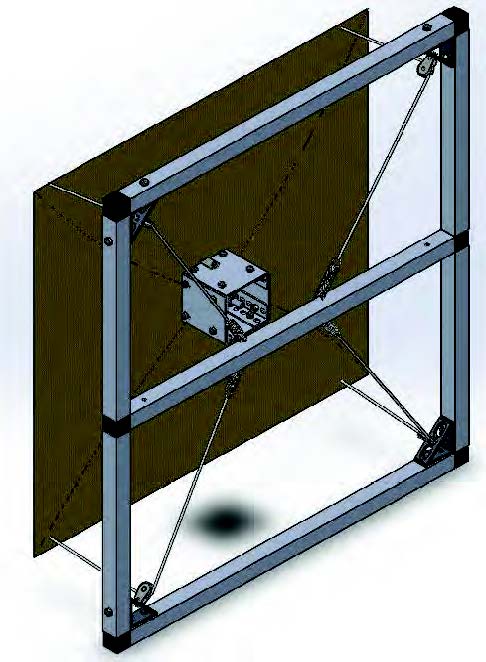
Climate change has influenced industry building efficiency requirements, but current market solutions to succeed under new standards are difficult to implement and retrofit. Our solution is to introduce a user-friendly method to increase the efficiency of a building’s cooling and air-conditioning system. This will be achieved by a modular product customizable to fit or retrofit any building type. By deploying the shade when the effect of the sun on the building is at its peak, the shade will decrease the heat load on the HVAC system and provide energy utility savings, thereby rendering the system more cost effective. As a dynamic façade, it will also provide architecturally aesthetic value to a building. This design is achieved by a tension system of springs, pulleys, and wire pulling the shade to the open position while permitting the use of the springs’ own potential energy to return to the closed position. Moreover, the façade will be secured in the window by clamps to prevent costly damage to infrastructure and private property as well as ensuring the long-term stability of the structure. This is an integral part of product modularity, which includes customizability of five main modules –mounting, motion, power, shading, and sensors; adaptation to different building types expands the product market and allows for the best possible fit. A modular dynamic façade system provides a customized, scalable solution to building efficiency needs.
Human Powered Water Pump
Team Members
Matthew Plusnick
Ashley Madison David
Terry Lowery
Taryn Alonzo
Zachary Knoles
Exterior Sponsor/Mentor
Mr. John Alexander
Internal Sponsors/Mentors
Dr. Xiaohua Li
Dr. Yunwei Xu
Dr. Hassan Quandil
Abstract
Our team is committed to developing a sustainable, human-powered mechanical water pump designed to efficiently extract water from pre-existing wells. The system we aim to create will focus on enhancing the efficiency of groundwater extraction, surpassing the performance of current pump technologies. The pump will be engineered with an emphasis on sustainability, ensuring that it can be maintained by the underprivileged communities which are need of water.
Large Scale Bi-Directional Diamond Wire Saw
Team Members
Aravintha Raj Ravichandran
Micah Traynham
Tori Edsall
Roman Zamora
Alexandro Chavarria
Darius Cojocari
Exterior Sponsors/Mentors
Emerson
Gerardo Gamboa
Campbell Masteller
Internal Sponsor/Mentor
Dr. Hector Siller
Abstract
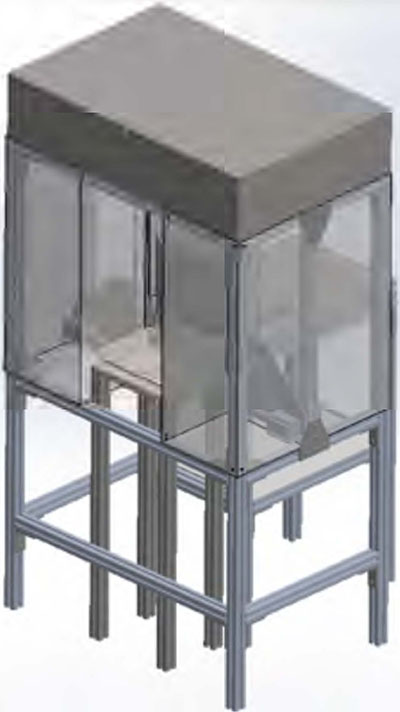
The Bi-Directional Large Scale Diamond Wire Saw project is a specific sof ution tailored exactly to Emerson' s needs. Recently, many issues have been arising for Emerson involving their laser powder bed fusion (LPBF) base plate removal process. Currently, each method of using Wire EDM and Band Saws has its unique drawbacks. Expensive maintenance is required for the former, and manpower is intensive for the latter. The proposed and now researched solution of using a diamond wire saw will cut back on both for Emerson, allowing for the use of their manpower and money elsewhere. The process taken to arrive at our current design has been extensive, and based on the needs of Emerson, our design is comprehensive.
Photovoltaic Panel Autonomous Cleaning System

Team Members
Ryan Tijerina
Jack Neal
Isabel Wetegrove
Samrat Dahal
Majed Alkhaldi
Exterior Sponsors/Mentors
Eagle Star Tech
Osama Marei - Good Faith Energy
Internal Sponsors/Mentors
Dr. Hassan Qandil
Rick Pearson
Robbin Shull
Bobby Grimes
Austin Killam
Marco Zavala
Paturi, Kailash Chandra Shivaji
Abstract
The Photovoltaic Panel Autonomous Cleaning System is designed as a fully automated process to maintain peak panel performance and long-term efficiency. By reducing the need for manual or contracted cleaning services, we strive to produce a safe and cost-efficient system to meet the needs of customers.
This system is integrated within an existing irrigation system for a home by implementing an additional zone area to target the designated panel section. In addition to the zone, we depend directly on the controller to activate the solenoid valves within the piping network. Based on the weather patterns of the customers' location, we are able to determine the optimal cleaning intervals to minimize the water usage. To account for insufficient pressure for larger specialized applications, we are able to add a pump or dedicated water reservoir within the network to strive for customer satisfaction.
Robotic Pancake Maker
Team Members
Axel Martinez
Osvaldo Lopez Reyna
Josh Fambro
Erick Gonzalez
Internal Sponsors/Mentors
Dr. Wasikowski
Sai Sandesh
Mayuri Gevaria
Abstract
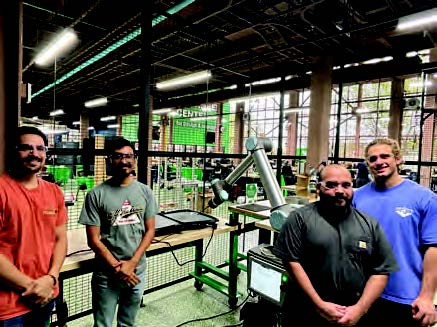
Our Senior Design Project will use a Universal Robot 3 and 10 to autonomously make pancakes from scratch. The main design component of our project is to create swappable end effectors that contain all the necessary tools to cook a completed pancake. Our team has worked all semester long to create high level concepts, including CAD models and applicable math equations. We've learned how to model the Forward Dynamics and Inverse Kinematics of both robots using MATLAB & Simulink. We have designed and created several end effectors to complete our project. All of our equipment is Food Grade Safe. We will be 3D printing our end effectors and assembling our system with the use of Arduino's.
3D Printed Rotorcraft
Team Members
Jesus Sandoval
Bradley Melendez
Mahathi Sriji
Blaine Compton
Exterior Sponsor/Mentor
Nick Ali
Internal Sponsor/Mentor
Dr. Yunwei Xu
Abstract
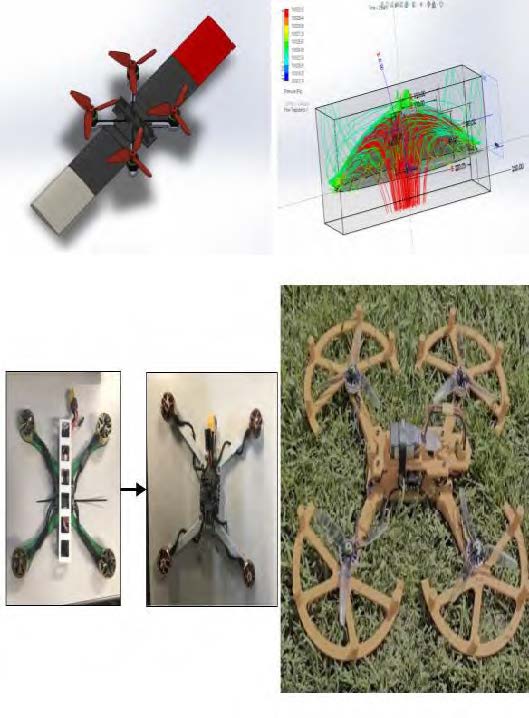
Created a rotorcraft chassis out of 3D printed material and mounted harness, brushless motors, and lightweight propellers to compete in the UTA 3D Printed Aircraft Competition for the longest unpowered flight time. The chassis was designed considering ease of assembly while also preserving simpleness, weight, interchangeability, symmetry, battery and camera mounting, and flight controller and electronics. Printing considerations included infill, material density, thickness, and walls. Material selection between PLA, PETG, ABS, etc. was determined on density, structural and impact resistance (strength and deformation). Considering power shutoff after 8 seconds and a flight ceiling of 60 feet, the team relied on mechanical ability for gliding mechanisms for the UAV to land. The team considered several gliding mechanisms and combinations such as airfoil wings (NACA 23012 for high lift-to-drag ratio), squirrel wings, parachutes, and kites (Rogallo) through design and simulation, particularly for lift. Simulations performed include drop and impact testing, static pressure, stress, displacement, torque, velocity distribution (CFD), deformation (warping), and more. The team was able to create an electronics manual for proving competency for operation of flight and engineering theoretical understanding. PID tuning was implemented using BetaFlight for stabilization optimization.
BOPAT - The Buoyant Observation Platform for Aquatic Testing
Team Members
John Boyle
Garrett Quick
Nathan Visser
Jaden Johnson
Andrew Hess
Exterior Sponsors/Mentors
ENSPIRE
John Alexander
Internal Sponsors/Mentors
Dr. Hamid Sadat
Dr. Kuruvilla John
Abstract
Bad water quality can cause health and safety concerns for humans and wildlife. These dangers can range from unsafe pH/oxygen levels to brain eating amoeba.
BOPAT operates autonomously via solar energy following a predetermined set of coordinates or geo-fenced barrier to collect water quality data using a probe sensor system. This system then transmits the data to the user via a mobile smartphone app allowing them to make informed decisions and adjustments to their water body's health.
Similar products are either privately owned and funded, or are only available for rent. BOPAT is targeted towards residential landowners and environmental research organizations, as a consumer owned product, making this product one of a kind.
Acknowledgments
Special thanks to our AEE members, Gabriel Ramlall, Landon Thomas and Dominique Quizhpi
Study and Design of Solar Canopies for University Parking Lots
Team Members
Aidan Kappler
Morgan Laidlaw
Ryan McNamara
Carson Melead
Jasson Villaseñor
Exterior Sponsors/Mentors
Ira Nicodemus - Holistic Utility Solutions
Omar Elnomros - Good Faith Energy
Internal Sponsors/Mentors
Christopher Hawke - UNT Parking
Mohit Patel - Campus Energy Manager
Scott Jackson - UNT Parking
Abstract
Our purpose was to determine the fiscal feasibility and design of solar canopies for university parking lots. To determine feasibility, we delved into research and simulation and conferred with internal and external experts to validate our study. After 4 months, we determined, with support of our experts, that a three megawatt system would be both fiscally viable and benefitial to the university's public welfare, safety, image, environmental impact, light pollution, and more. To prove this effect, we gained sponsorship to construct a fully functional single car canopy to exemplify the benefits such as shade, lighting, EV charging, and power production.
Our project's key conclusions are that solar canopies make up for their additional cost with their multitude of benefits to the public welfare and are most definitely finacially viable for university parking lots at scales comperable to university power consumption.