 University of North Texas

Mechanical Engineering - Fall
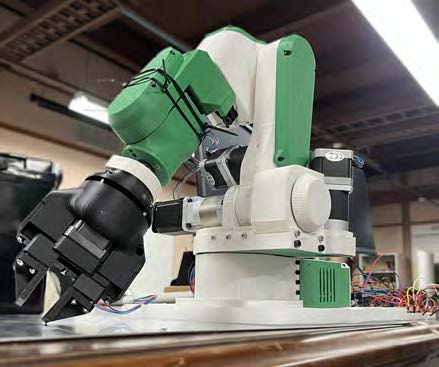
Six Degree of Freedom Service Arm
Team Members
Josue Baruc Arellanes
Chukwuka Azogu
Jennifer Cruz-Reyes
Seth Jackson
Tuleen Obeidat
External Sponsors/Mentors
American Society of Mechanical Engineers (ASME)
Strifetale Robotics
Source Robotics
Internal Sponsors/Mentors
Mechanical Engineering Department
Communications, Controls, and Arm Electrical Teams
Abstract
The team was tasked by ASME and Strifetale Robotics to build an arm to compete in the University Rover Challenge, May 27-30, 2026 at the Mars Desert Research Station in Hanksville, Utah. The rover the arm will be mounted on is UNT's inaugural entry in to the competition and will hopefully inspire future students to reiterate the design in years to come. The arm will be responsible for picking up test tubes, opening drawers, typing, and inserting a flash drive in to a mock lander. In our first semester of design, we designed a robotic arm from the ground up. Our sponsor expressed a lot of concerns with our design and advised that we transition to retrofitting an existing design. We settled on the Parol6 by Source Robotics, an open source project which the company gave us written consent to use. There are some key modifications we then made to fit our goals. We modified the arm to fit and use stronger motors, redesigned the gripper, 3D printed power transmission parts that are traditionally made with metal, and selected ABS as our material in stead of PETG. We also aimed to improve the lifting capability of the arm from a 1kg payload to a 10kg payload and integrate the electronics in to the existing rover electronics, Six out of our seven motors are operational but the most crucial motor does not provide enough torque. We originally planned on not providing a gripper as there is an other senior design team currently working on one. We attempted late in the project to use a motor we already had on hand to produce a working grippere We succeeded in making a working gripper but the additional moment caused by adding it was more than the motor could overcome. Supply chain issues also forced us to 3D print a crucial part of this motor assembly which we believe contributed to the failure. Lastly, we had many misprinted parts or parts that our sponsor took longer than expected to finish and deliver.
Car Crane 3.0
Team Members
Blaize Moses
Danielle Garcia
David Rocha
Forrest Hart
Trevon Richardson
External Sponsors/Mentors
ENSPIRE
John Alexander
Internal Sponsors/Mentors
Dr. Jiho Lee
Silvino P. Bastos
Dr. Hassan Qandil
Abstract
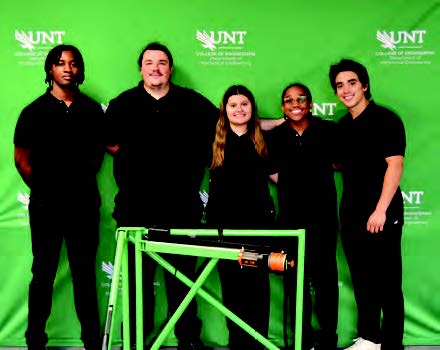
The objective of this project was to create a design that would help individuals with mobility issues in loading a folding mobility scooter into the cargo area of an SUV. The basis of this project was laid down over two previous iterations of this project, and this third iteration continued the legacy with updated requirements.
One of the largest areas this iteration improved was in the frame. By changing the shape, we provided greater stability to the device, while also maintaining its nonpermanence. We also changed the forward leg to one which could be adjusted, based on the updated requirements from our sponsor, so that it will adapt the the varying depth in cargo area of most full-sized SUVs.
In addition, we updated the control system, designing it in such a way the individuals with impairments such as arthritis, common in those with mobility issues, can operate the device, leading to greater independence and quality of life.
UNT FSAE Dynamic Racing Simulator

Team Members
Katherine Selthofer - Team Lead
Caleb Como - Secretary
Jordan Rider - Team Facilitator
Abigail Rojas Contreras - CAD Eng1neer
Andrew Samuel - Lead Researcher
External Sponsors/Mentors
Mark Lanier
Tracy Lynch
John Benavides
Peterbilt
UNT FSAE Student Organization
Internal Sponsors/Mentors
Dr. Hassan Qandil
Robbin Shull
Marco Zavala
Abstract
This project development is for the UNT FSAE team to have a reliable way to access racing practice whlle working on building their SAE formula car. This will also be a showpiece that will attract interest for the organization at events and races to show UNT FSAE's purpose. The project comes with a dynamic chassis that has responsive feedback to the driver, VR and realism capabilities, along with comfort and adjustability for ergonomic purposes. The periormance. cost, and safety between actuators and a motor rig was evaluated, with the motor rig being selected. A CAD model and control system were developed to simulate the required motor forces on the driver, platform durability, and adjustments to the PIO controller to give the driver a comfortable experience. With a finished product, the motion rig responds to the simulator software quickly and accurately lo move the chassis.
Using one of UNT FSAE's previous chassis models, we are able to have a snappy and realistic driving experience that will train their drivers on real tracks to help improve their time during competition season.
Lockwood Ash Marine Engine Rebuild
Team Members
Kyle Rhoades
Alaric Amezcua
Reynaldo Ayala
Vanessa Bristow
Diego Carreon Rodriguez
External Sponsors/Mentors
Wes Pettinger (Sponsor)
Jamie Hurry (Advisor)
Internal Sponsors/Mentors
Angus McColl (CoSponsor)
Bobby Grimes (Faculty Advisor)
Xiaohua Li (Faculty Advisor)
UNT Engineering Manufacturing Facility
Abstract
Lockwood Ash Motor Co. was founded in 1904, although it didn’t manufacture its first outboard engine until 1909. Offering a variety of engines from 1.5 to 24 HP, L.A delivered on the promise of “No Freak Ideas” – to gain the business of hobbyist boaters, the company emphasised reliability and simplicity in their designs, keeping easy maintenance and accessibility in mind. Several communities celebrating antique outboard motor restoration can be found online, offering plenty of resources and networks on how to approach a delicate time piece.
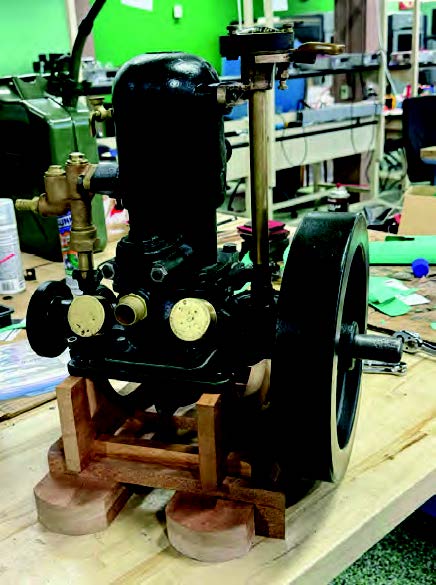
The engine on display is a 1924 single cylinder model delivering 2.5 HP. The African Mahogany display base was designed for stability and elegance, offering a final aesthetic piece to the restoration itself. Several methods of cleaning were employed, and lastly the engine was finished with Pontiac Brewster Green paint to closely resemble the appearance of the time.
PiezoCCTV
Team Members
Payton Ayers
Teni Kasunmu
Hector Montes
David Rogers, Jr.
Daryl Singh
External Sponsors/Mentors
Solar Piezo Clean:
Engr. Maher Maymoun
Ramiz Qamar
Internal Sponsor/Mentor
Dr. Maurizio Manzo
Abstract
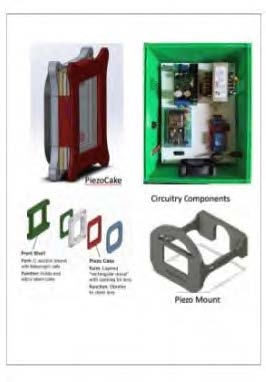
This engineering design introduces a cost-effective, automated cleaning system that removes dust and debris from CCTV camera viewing surfaces using piezoelectric materials that generate electric charge under mechanical stress. Guided by key criteria ergonomic installation and maintenance, enhanced image clarity, and overall cost efficiency- the system employs coordinated mechanical vibrations to eliminate the need for water or traditional cleaning methods, providing a sustainable and maintenance-free solution. Iterative modeling, simulation, and functional testing validate the design's effectiveness in real-world environments, while versatile mounting hardware, integrated power compatibility, and mobile-app connectivity support both residential and commercial use and enable future scalability for universal applications.
Keywords: piezoelectric materials; automated cleaning; mechanical vibration; sustainable design; system integration