 University of North Texas

Computer Engineering - Spring
Smart Alert System
Team Name
Branden
Team Members
Branden Hart
Internal Sponsor/Mentor
Dr. Fernando Mosquera
Abstract
The project is to build a Fire Safety System for Conventional Oven. The system will have three sensors: smoke sensor, flame sensor, and temperature sensor. When the temperature inside the oven exceeds the set temperature plus a margin a beep sound should be generated. When smoke is detected and if it exceeds a certain limit in the oven the exhaust fan should be turned on. If a large flame is detected in the oven, the oven should be turned off. The system should show the alerts and details on an LCD screen. The system needs to be put together on a Printed Circuit Board (PCB) and enclosed in an enclosure.
Power Termination, Diversion and Notification using "COSMIC®"
Team Name
DAGS
Team Members
Grayson Kippes
Alexander Johnson
David Escobedo
Shaun Zulu
External Sponsor/Mentor
Dan Combe
Internal Sponsor/Mentor
Dr. Robin Pottathuparambil
Abstract
Each year in the U.S., 1.1 million burn injuries require medical attention, with 40,000 leading to hospitalization and 10,000 fatalities. Additionally, 3,275 die from smoke inhalation, and carbon monoxide poisoning claims another 500 lives. Current smoke and fire alarms are inadequate. We need systems that cut power to circuits upon detecting CO, smoke, or other gases, redirect power to ventilate hazardous gases, and notify homeowners, businesses, EMS, and authorities of the threat.
The COSMIC garage system aims to reduce exposure to toxic gases by designing a residential garage device equipped with gas sensors, pass-through sockets, and an LCD screen that will be plugged into a wall socket. The complete system is divided into:
- Sensor Subsystem monitors toxic gas levels and sends them to the cloud.
- Breaker Subsystem disconnects the garage from eye sensors during evacuation to keep it open and vent air.
- Mobile Application Subsystem allows users to monitor toxic gas levels, set thresholds, display notifications.
- Cloud Subsystem interfaces all devices wirelessly and stores data regarding sensor readings, alerts, reports, and sending notifications to the app when thresholds are exceeded.
Acknowledgments
Special thanks to Dr. Robin Pottathuparambil, project manager for his mentorship and guidance and to Udayasai Ramineni, lab manager, and Dan Combe project sponsor.
Web-Based PCB Debugger
Team Name
EAAK
Team Members
Elise Enriquez
Amir Fera
Andrei Mendez
Katriel DelBosque
External Sponsor/Mentor
Anora Labs
Internal Sponsor/Mentor
Robin Pottathuparabil
Abstract
This project successfully established a hardware-software infrastructure for debugging printed circuit boards (PCBs) through a web-based application. The developed web-based software debugger allows for the measurement of key electrical parameters-resistance, voltage, and current using programmable test devices. The system was built using a REST API and web framework, with Python FastAPI for backend functionality, MongoDB for data storage, and React for the frontend interface. The debugger operates within the React application, allowing developers to set breakpoints and create test instructions / test functions. It supports testing of voltage and current values, including probing for maximum voltage and current, and displays real-time outputs through a graphical display in React. Test data is stored in the database for further analysis or record-keeping. This completed project provides a robust platform for electronic system debugging and testing.
Acknowledgments
Udayasai Ramineni
Six Degree of Freedom Robotic Arm
Team Name
AIMS
Team Members
Akshay Bhaskaran
Shane Breitstein
Michael Dorsett
Ian Hunt
External Sponsor/Mentor
Anora Labs
Internal Sponsors/Mentors
Dr. Robin Pottathuparambil
Udayasai Ramineni
Abstract
The robotic arm’s purpose is to streamline circuit certification systems by enabling an autonomous robotic arm to pick and place a PCB from an assembly line to a separate testing unit, which will conduct a test and ensure the PCB is functional within certain constraints. The robotic arm utilizes Robot Operating System 2 (ROS2) to handle controls, communicates throughout the system using the CAN bus, and implements a computer vision model to detect PCBs for testing, as well as people for their safety. The robotic arm system is based off of the Arctos DIY robotic arm, enhanced with a custom PCB to help consolidate components on a single board, an emergency stop button, user authentication, LED lights to display the status of the robot, autonomous controls, and manual controls from both a custom UI and through a gaming controller.
Acknowledgments
Special thank you to Dr. Robin Pottathuparambil for his continuous assistance and mentorship.
Smart Door
Team Name
CONTROL ALT ELITE
Team Members
Ali Choudhry
Gavin Edwards
Kolade Olojo
Throy Detorio
Benjamin (Sylvie) Edgar
External Sponsor/Mentor
College of Engineering Dean’s Senior Design Fund
Internal Sponsors/Mentors
Dr. Pradhumna Shrestha
Dr. Ajita Rattani
Abstract
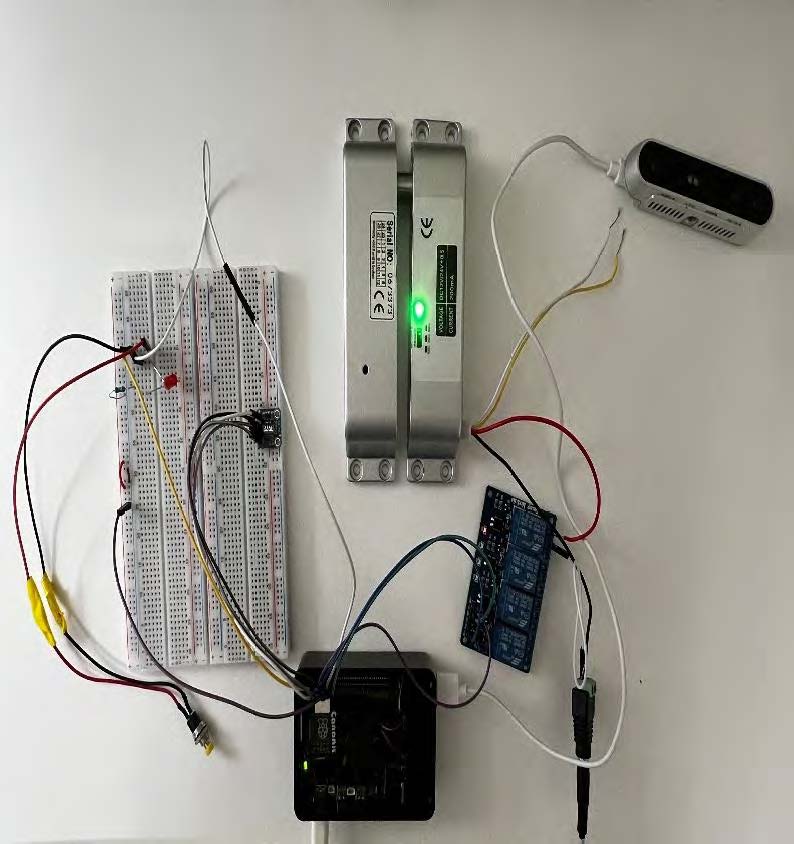
The Smart Door is a system designed to provide greater security, accessibility and improved functionality to the average door. These paradigms are accomplished through AI facial recognition, a depth-sensing camera array, AWS cloud, and an integrated android application. The AI facial recognition feature scans a detected person’s face to determine if the face is registered to a valid user. The depth-sensing camera array ensures that a picture or recording video of a registered user cannot be used to falsify credentials, while AWS stores all important events and notifications. The application allows users to enjoy the streamlined nature of the system, and enables them to manually control the door, add new users, notify users of any events, or even capture live feed. This combination of intelligent access control and cloud-based integration aims to deliver a robust, user-friendly smart security solution.
Smart Power Connector
Team Members
Shaharyaar Samuel
Daniel Yadov
Jaden McGilbra
Osamah Almufleh
Internal Sponsor/Mentor
Dr. Pradhumna Shrestha
Abstract
The Smart Power Connector is an IoT-enabled system designed by team PowerLink to remotely monitor and control multiple devices through a custom-built power strip. Using an ESP32 microcontroller, the system tracks real-time energy usage and toggles individual outlets via relay modules. It communicates with a cloud-based backend on AWS, which manages telemetry and user data through RabbitMQ and MariaDB. A mobile app provides a user-friendly interface for real-time status updates, historical consumption graphs, and device control. The project integrates hardware, software, and embedded systems to deliver an efficient and scalable energy management solution.
Heatmap Monitoring and Alert
Team Name
SmartSync
Team Members
Cesar Muñoz
Avinav Yadav
Natalia Martinez
Daniel Fraire
Internal Sponsor/Mentor
Dr. Pradhumna Shrestha
Abstract
The Heatmap Monitoring and Alert system is designed to provide temperature monitoring in a wide range of environments through the use of different sensors and wireless networks. The system will be able to monitor, report, and respond to high temperature individuals in different areas of a facility. The system will periodically monitor heatmap readings and will activate when movement is detected in a specific area in order to provide energy efficiency. The system will report and store the readings in a database every 30 minutes to maintain the website and the mobile application up to date with recent readings. The system will use wireless data transmission to store data in a central server in order to provide functionality in large facilities. Temperature readings, heatmaps, and recent activity with timestamps in the locations being monitored will be stored in the secure database. The system will use a website and a mobile application to monitor the system. These two interfaces will provide visualizations overlaid on a digital map of the building of areas that have been flagged due to a high temperature reading. They will also provide recent activity logs of specific areas in the environments being read throughout the day. The mobile application will additionally add the capability of sending push notifications to alert users of high temperature readings. These alerts will also include the location and the timestamp of the reading in order to allow users to identify potential safety risk areas. The heatmap monitoring and alert system will optimize management and enhance the safety of facilities by determining high risk areas and alerting users to ensure safety.
Programmable Electrical Switch, Dimmer, & Outlet for Appliances
Team Name
Epsilon
Team Members
Sparsh Singh
Jeffrey Williams
Mykah White
External Sponsor/Mentor
MR Technologies LLC
Internal Sponsor/Mentor
Dr. Robin Pottathuparambil
Abstract
Project Epsilon presents a programmable smart switch, dimmer, and outlet system designed to control common household appliances such as fans and light bulbs. These devices offer a wide range of features including state locking, scheduled on/off timers, and manual operation. They can be controlled via a mobile app, through voice commands using Alexa or Google Assistant, or even locally without an internet connection. Communication between devices and the Cloud is handled through the lightweight and efficient MQTT protocol. The system also includes activity logging and real-time energy usage reports, providing users with greater control and insight into their electrical consumption. Device setup is streamlined using QR code configuration, and the solution supports both iOS and Android platforms. Epsilon focuses on combining reliability, user-centric design, and smart automation to modernize how users interact with electrical systems in residential and commercial settings.
Acknowledgments
Special thanks to Dr. Robin Pottathuparambil and MR Technologies LLC.
Automated Hydroponic Growing System
Team Name
HydroTech
Team Members
Connor Cultas
Abel Garcia Guzman
External Sponsor/Mentor
Wes Pettinger
Internal Sponsor/Mentor
Dr. Robin Pottathuparambil
Abstract
he College of Engineering at the University of North Texas hosted the Automated Hydroponic Growing System senior design project. This project is a collaborative project between three different departments, Mechanical Environmental Engineering, Computer Engineering, and Computer Science. The undergraduate students involved in the Computer Engineering group are Connor Cultas and Abel Garcia Guzman.
The responsibility for the Computer Engineering students is to develop a prototype control box that will control the water automation and will send data to the cloud component of the project that will house the databases. The control box will be connected to individual grow boxes that will each have a PCB to handle the different sensors and automations in each box. Each box will report sunlight, water level, and nutrient information and will have a solenoid that will automate the water dispensing. The control box will connect to Wi-Fi where it will communicate with AWS cloud services as there are databases and functions that are hosted on these services to keep the system running. AWS cloud services will also be connected to a application being developed by the Computer Science group.
The control box and sensors are being developed and managed by Connor Cultas who is the team lead, The cloud services are being managed and developed by Abel Garcia Guzman who is the Reporter for the team.
Acknowledgments
We would like to acknowledge and thank our sponsor, Wes Pettinger, as well as Dr. Robin and Uday