 University of North Texas

Electrical Engineering - Spring
Braille Printer
Team Members
Geoffrey Helm
Cameron Kilpatrick
Internal Sponsors/Mentors
Elias Kougianos
Abstract
Our braille printer idea came about because of a past project that Cameron had worked on, that being a morse code encoder/decoder. Braille seemed like the obvious next step and once we started researching, we realized we could create something more accessible than the prohibitively expensive options currently on the market. Our design utilizes six linear actuators oriented in a staggered manner, that, through the use of a microcontroller and L298N motor drivers, extend up, into a piece of paper at the proper time, as they are all moved under the page by a larger actuator.
Enspire
Team Members
Esmeralda Serna
Bryce Slovacek
Benjamin M. Hand
External Sponsor/Mentor
John Alexander
Internal Sponsor/Mentor
Colleen P. Bailey
Abstract
Digital signage is a powerful communication tool, but it faces challenges related to energy consumption and accessibility. This project addresses these issues by developing a sustainable, off-grid power system for digital signs, enabling remote updates via wireless communication to enhance safety. The Energy Neutral Sign Powered In Remote Areas will revolutionize digital signage by providing an environmentally friendly solution for areas with limited energy resources, offering a greener alternative to traditional signage systems.
FPGA-Acceleration of Post-Quantum Digital Signatures
Team Members
Joshua Ennis
Tai Nguyen
Tristan King
Zachary Vence
Daniel Lee
External Sponsor/Mentor
Professor Jiafeng Xie - Villanova University
Internal Sponsor/Mentor
Professor Kirill Morozov
Abstract
Quantum computing poses a significant threat to current cryptographic systems, as it has the potential to break widely used encryption methods, including those securing sensitive data from military and healthcare sectors. To counteract this, researchers have developed post-quantum cryptography (PQC) algorithms, such as SPHINCS+ (FIPS-205), designed to be secure against quantum attacks. As the standardization of these algorithms progresses, there is an urgent need for efficient hardware solutions to support their implementation. This project addresses this need by developing an FPGA-based hardware accelerator for two of the major components of the SPHINCS+ digital signature scheme. By focusing on a fully hardware-based design, we achieve significant speed improvements and facilitate integration into larger computing systems via Ethernet. The accelerator is implemented on an Arty A7-100T FPGA board.
Frequency Selective Surface
Team Members
Kyla Gray
Kaitlin King
Mithuun Ramesh
Internal Sponsor/Mentor
Dr. Sensong An
Abstract
This project proposes a dual-band reflective Frequency Selective Surface (FSS) system. The FSS is implemented using a periodic unit cell configuration on a Rogers RO4350B lossy substrate, with copper patch geometry. The system is designed to operate in the S-band, achieving maximum reflection at approximately 2.3 GHz and 3.8 GHz. The results show that the FSS successfully filters these frequencies while minimizing transmission outside of them, demonstrating its potential for applications in radar, satellite communications, and RF shielding technologies.
Wearable Device to Monitor Impedance of Skin and Body Temperature
Team Name
Hydration
Team Members
Daniel Vazquez
Nathan Nixon
Jacqueline Velez
Internal Sponsor/Mentor
Dr. Kim Jungkwun
Abstract
Our senior design project is to design a wearable device that can monitor the impedance levels of the users skin and their body temperature.
Using a specialized bio-impedance analyzer chip, the device can track the wearers bio-impedance levels and then the device can alert wearer of they are becoming dehydrated.
The final version of this device can monitor a person's body temperature and their hydration via bio-impedance of their skin in order to provide the wearer a general idea of their day to day health status.
Smart Parking System
Team Members
Charles cochran
Mina Youssef
Nazir Latefe
Mofogofoluwa Animashawun
Internal Sponsor/Mentor
Dr. Parthasarathy Guturu
Abstract
The Smart Parking System is a convenient and innovative way to park. we have successfully developed and tested our prototype. This technology, built for major facilities such as airports and malls, automates real-time occupancy monitoring and communication to address traditional parking management challenges. It uses infrared (IR) sensors and microcontrollers to present users with real-time data on LCD screens. This System is sustainable and has proven to be a game changer in the parking infrastructure industry.
Robochair
Team Members
Joshua Espinosa
Harrison Estrella
Lorenzo Reyes
Michael Wright
Internal Sponsor/Mentor
Dr. Elias Kougianos
Abstract
The Robochair project is an autonomous, self-parking robotic chair designed to improve mobility and convenience in shared indoor environments such as offices and classrooms. Using a Raspberry Pi, camera, DC motors, and a custom seesaw mechanism, the chair can function as a regular seat when occupied and autonomously park itself when unoccupied. Object recognition is handled by a YOLO-based model with visual markers for accurate orientation, while an A* path planning algorithm determines the optimal route to a selected or fixed destination. The system uses real-time camera feedback to adjust movement in a closed-loop control process. The project combines hardware and software solutions to deliver a functional, intelligent mobility system.
Trash Identification and Disposal (TI-D) Autonomous Robot
Abstract
Urban litter is a pervasive problem on city side- walks. It is challenging to address the issue through manual labor due to constant litter accumulation, and a lack of willing workers. Our team aims to tackle this issue by designing and building an autonomous litter-collecting robot. The TI-D (Trash Identification and Disposal) Robot will employ image processing and various sensors to recognize, collect, and store litter efficiently. By integrating computer vision, machine learning algorithms, and mechanical systems, TI-D will navigate urban environments, identifying and removing debris. Our iterative design process will involve prototyping and real-world testing to optimize performance. We believe that TI-D will reduce manual labor in litter collection, enhance public space cleanliness, and offer various solutions for broader urban deployment. This project can transform urban waste management, contributing to cleaner cities and more efficient public sanitation resource allocation.
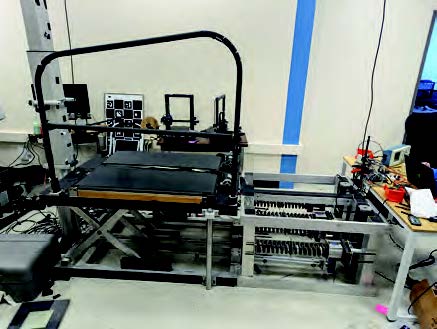
Closed Loop Motor Control System for Treadmill with Adjustable Stiffness
Team Members
Kirk Humes
Adam Malmquist
Quintin Bakker
Caleb Renfrew
External Sponsor/Mentor
Professor Amir Jafari
Internal Sponsor/Mentor
Professor King Man Siu
Abstract
This paper presents the design and implementation of a closed-loop control system for a novel treadmill with adjustable stiffness, aimed at improving reliability, precision, and user experience in rehabilitation and training settings. The system combines rotary encoders, stepper motors, and a proportional-integral (PI) controller to enable accurate position tracking of a pivot mechanism that regulates surface stiffness. Experimental results demonstrate that the closed-loop configuration ensures stable, repeatable stiffness adjustments. This innovation addresses critical gaps in existing open-loop treadmill designs, offering a more controlled environment for medical rehabilitation and specialized training.
Acknowledgments
Thanks to Dr. Jafari for allowing us to work within the ARM lab for the duration of the project.