 University of North Texas

Computer Engineering - Spring
Power Termination, Diversion and Notification using “COSMIC”
Team Name
COSMIC
Team Members
Robert Ehrlish
Jonathan Ibarra
Benjamin Bryan
Hamzah Nawfer
External Sponsor/Mentor
Dan Combe of COEVAC LLC
Internal Sponsors/Mentors
Robin Pottathuparambil, Faculty Mentor
Alejandro Olvera, Lab Manager
Abstract
Every year, 3,275 people die from smoke inhalation and another 500 die from carbon monoxide poisoning. These lives could have been saved with systems that monitor these poisonous gasses and provide ventilation, circuit breaking, and other life-saving measures. COSMIC does just that. COSMIC stands for Carbon Monoxide – Smoke – Interrupting –Circuit and will closely monitor levels of carbon monoxide and other toxic gases and provide necessary action for the environment that this gas detector is located in. This project aims to work with IoT systems to send essential data to cloud servers which will notify homeowners of dangerous gas levels on their mobile devices and also send this data to various actuators to help lower gas levels, such as garage doors and gas fireplaces. The homeowners will be able to check gas levels at any time on their mobile devices and can manually turn on ventilation systems at their request.
Water Monitoring System for Automated Inland Shrimp Production
Team Name
Caridea
Team Members
Garrett Morgan
Jorge Galeana
Anush Adhikari
Srijan Singh
External Sponsor/Mentor
Dan Combe
Internal Sponsors/Mentors
Robin Pottathuparambil, Faculty Mentor
Alejandro Olvera, Lab Manager
Abstract
Our project is seeking to solve a key problem for the US shrimp market. Reducing the price of imports by cultivating them in the United States in a controlled environment. To complete this task, we will be designing a system that will be able to take readings from the water and control the environment autonomously to create the ideal conditions for any type of shrimp. It will be able to work in saltwater as well as freshwater. The system will be taking readings of minerals, ph, temperature, oxygen, and other important parameters like feeding the shrimp. When these readings go outside the ideal conditions the system will add those parameters to the water. We will also be creating a cross platform app and store all important data on a cloud server.
Advanced Spacecraft Lighting Control
Team Name
LIT
Team Members
Farhan Ali
Shaafi Ahmed
Simar Kaur
Kshitiz Thapa
External Sponsors/Mentors
George Salazar - NASA Mentor
Texas Space Grant Consortium (TSGC)
Tim Urban, PhD - TSGC Coordinator
Talia Jurgens - TSGC Assistant Director
Internal Sponsors/Mentors
Robin Pottathuparambil, Faculty Mentor
Alejandro Olvera, Lab Manager
Abstract
Current lighting systems lacks the ability to maintain the circadian rhythm for the crew members and grow plants without sunlight on a spacecraft.
Our objective is to provide an innovative lighting system to improve usability, centralize connectivity, maintain the circadian rhythm for the crew members, be able to grow plants without sunlight using artificial lights, and implement a light monitoring system.
Acknowledgments
Department of Computer Engineering Lab Manager Alejandro Olvera
Private Cloud with Wireless Internet of Things (IoT)
Team Name
Denton Space Eagles
Team Members
Micah Warren
Ricardo Garza
Mark Younker
Shangda Li
Yicheng Feng
External Sponsors/Mentors
Chatwin Lansdowne, NASA JSC
Texas Space Grant Consortium (TSGC)
Tim Urban, Program Administrator
Talia Jurgens, TSGC Assistant Director
Internal Sponsors/Mentors
Robin Pottathuparambil, Faculty Mentor
Alejandro Olvera, Lab Manager
Abstract
NASA is currently dealing with is how they store and process data from spacecrafts and the space station. Currently, all data must be sent to Earth before it is processed and stored. Due to the inefficiency and highly expensive nature of this problem NASA is looking for a way to lower the inefficiency, cost of storing and processing. The solution would be to have all the data stored and processed on the spacecraft instead of being sent to Earth and processed, functioning like a private cloud for the spacecraft. This private cloud would receive and analyze data coming from experiments or sensors on the spacecraft, process it, and make it available to those on board immediately. This project is aimed at evaluating the emerging technology, for example cloud computing and Internet of Things. Evaluating these technologies helps NASA decide which to use in future missions.
AutoDIT
Team Name
Rigel
Team Members
Catherine Sarmiento
Matthew Trufan
Eunice Salinas
Girard Roston
External Sponsors/Mentors
Parker Wallace
Kyle Hughes
Internal Sponsors/Mentors
Robin Pottathuparambil, Faculty Mentor
Alejandro Olvera, Lab Manager
Abstract
Technological advancements have changed the digital world and have steered consumers towards an inclination for handheld sized products. The Rigel Team aims to address a custom need for hardware by an integral movie production technician crew called the Digital Imaging Technician. Auto DIT, short for Automatic Digital Imaging Technician, is a scalable high-speed media transfer intermediary that delivers affordable and efficient data management. It is a dynamic media management device that runs on modern processing power, rechargeable batteries, utilizes a color accurate 1080p resolution screen, and can transfer between multiple storage devices with peripherals that support super speeds of 5 Gbps and up. Auto DIT's key goals are to reduce the quantity of daily devices that technicians carry on set and to make fallible tasks such as checksum verification of hard disc recordings and backing up copies of media easier and as error free as possible.
Smart Power Connector

Team Name
Eagle Elite Engineers
Team Members
Sangeet Adhikari
Anup Adhikari
Rabin Acharya
Rajiv Chaulagain
Internal Sponsor/Mentor
Dr. Pradhumna Shrestha
Abstract
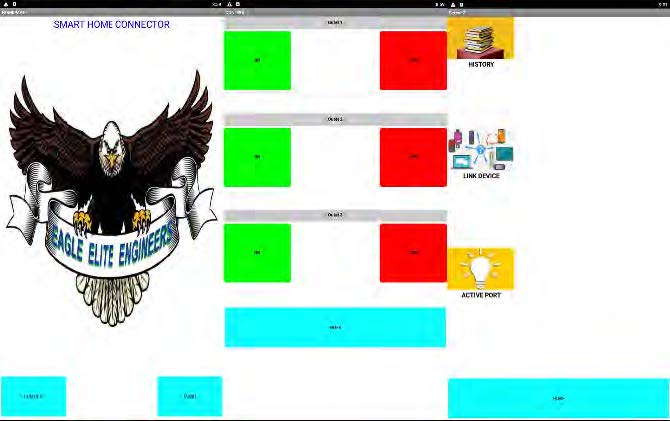
The project was created to change how we think about old power outlets and adopters as brittle, inefficient, and even dumb to a new smarter power connector so a user can have all the power in their hands and not in the wall of a house. On the hardware side of things, Smart Power Connector consists of three port with a fuse inbuilt that can detect power surges and failures Looking into the software side of things, an android app has been created so the user can fully control a power connector like a monitor active/inactive ports, generate history report, and power usage and turn on and off the port individually all within the app from anywhere as it is hooked into the global server.
The app. also has a user data integration and comes with a fully equipped user authentication mechanism so it can protect user data. On top of that, there is frequent soft testing is done by raspberry pi to detect any software and hardware failures. Firebase application program is what links together the things to the internet of things to maintain the interaction between IoT devices IoT data and IoT applications and the internet and its other elements within the network.
Accident Prevention System
Team Name
Fantastic 4
Team Members
Ayobami Alabi
Farhan Almufleh
Mohammed Al Saadi
Tanvi Mehta
Internal Sponsor/Mentor
Dr. Pradhumna Shrestha
Abstract
For the majority of Americans, cars are an integral aspect of daily living. They are required to commute to work, attend school, and conduct business. Unfortunately, accidents are an all-too-common byproduct of driving cars and are the leading cause of non-natural death in the United States. Our project, the Accident Prevention System (APS), attempts to curb the number of accidents caused by reckless or inattentive driving. APS warns drivers when they are driving on the wrong side of the road, when they or other nearby drivers are exceeding the speed limit, and when there are unmoving vehicles on or near the road.
The system is implemented through an app that is downloaded onto the driver’s phone. The app connects to a device in the car which monitors the car’s speed. The app also identifies nearby drivers who have the app and collects information about their speed and location based on their speed and location. Based on this information, the system can issue a warning sound and LED flash if someone nearby is speeding or if there is a stopped car on the side of the road. The app will consist of a registration page that allows new users to sign up by entering their information. The main page of the app will show the speed of the user’s car you’re located in and any warnings pertaining to the user’s area.
Acknowledgments
We would like to thank our professor, Pradhumna Shrestha, for his time and support in helping us stay on track for this project. Also, we would like to thank the UNT Computer Science & Engineering department for helping make this project successful by providing us with the necessary resources and equipment.
Covid-19 In-Room Management Stations
Team Name
Fighting Covid
Team Members
Richard Young
Danilo Claros
Cedric Urbino
Oscar Garcia
Internal Sponsors/Mentors
Dr. Pradhumna Shrestha
Alejandro Olvera
Computer Science and Engineering Department
Abstract
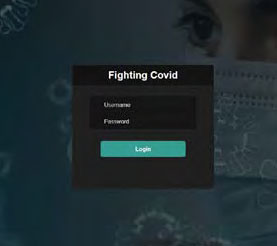
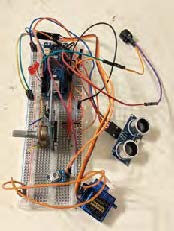
Team Fighting Covid’s project is “In-Room management stations for covid-19”. We are developing a system that will assist the management in monitoring assets to help prevent the spread of COVID-19. These stations will be able to disperse the perfect amount of solution to kill viruses and germs on the surface of a hand. Strategically placing these stations could help contain the spread of Covid-19. This will also allow us to keep cleaner environments throughout the pandemic. This project will allow multiple stations equipped with hand sanitization to be distributed among multiple areas. The project will consist of motion sensing with the wave of a hand to disperse a calculated amount of sanitation fluid. With this calculation the bag of solution will slowly be whittled down until there is around 3%-5% of fluid left within the station. A notification will then be sent to the user who has the app installed and will receive a notification to the custom built app.
Acknowledgments
Special thanks to Alejandro Olvera and Pradhumna Shrestha
IoT in Agriculture
Team Name
High Voltage Club
Team Members
Sahar Adnan
Antonio Kittrell
Sung In Cho
Brandon Gilligan
Internal Sponsors/Mentors
Dr. Pradhumna Shrestha
Alejandro Olvera
Abstract
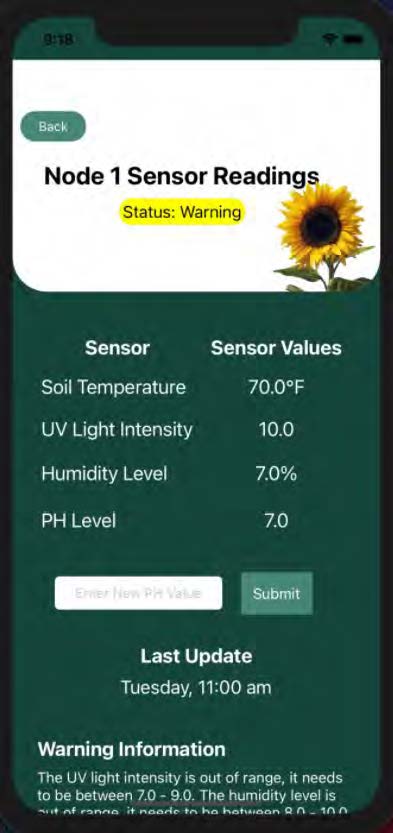
The project is a construction of multiple nodal sensor clusters that will detect multiple factors to determine and maintain the health of plants. The system will operate in an open field sectioned off into two quadrants. A rc car will separately visit each quadrant to take visual recordings. The nodal sensor clusters will have the capability of detecting the PH levels of the soil, the temperature, the current UV light intensity, and the current humidity levels. Through a networking system, each cluster will report its readings to a central hub for data collection. The central hub can share all findings to the users mobile device. Through the use of the owner’s mobile device, anything that the system is able to monitor will be accessible through an app created specifically for this project. The app will contain a database of information on the plant or plants being monitored and list various information from the type of plant to any information necessary for maintaining its health. With accurate readings and diligent monitoring the system will be able to warn the app user of detrimental environmental conditions and inform the users on corrective measures to maintain the longevity of their plants.
Lawn Heath
Team Name
Rush Hour
Team Members
David Caulcrick
Steven Kline
Nicholas Nguyen
Thomas Nguyen
Internal Sponsors/Mentors
Dr. Pradhumna Shrestha, Professor
Alejandro Olivera, Lab Assistant
Computer Science and Engineering Department
Abstract
Our project, Lawn Health, is an attempt to streamline the process of maintaining a healthy lawn. The solutions that are currently available are either not accurate enough in their metrics, focus on only one of the possible lawn reading requiring the homeowner to buy additional devices to check all possible lawn health readings and are too complex for average homeowners. We provide a lightweight system that is simple to set up, and has an easy to use interface through our mobile app. The app provides users with real-time data about the lawn’s soil moisture level, PH level, and the humidity and temperature in the air above. Lawn Health’s metrics give the everyday homeowner suggestions and accurate data to maintain a healthy lawn while also showing the weather in the area around the lawn.
Smart Door Lock
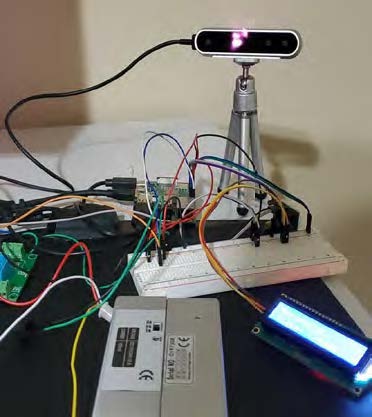
Team Name
UNT Engineers
Team Members
Aashish Nepal
Anup Bhattarai
Binu Gaire
Laxman Bal
Ram Bal
Internal Sponsors/Mentors
Dr. Pradhumna Shrestha
Alejandro Olvera
Abstract
This smart door lock system will be able to detect the person and open the door if the person is authorized. Also, this smart technology will differentiate between a picture of a person and an actual human face so that it is secure and cannot be opened by anyone else. This technology will make life easier and at the meantime keep the home secured from unauthorized access as there Is only two way to open the lock facial recognition system or override from the application. This innovation also solves the problem of monitoring the surrounding of the home when nobody is there. With the help of an application that is connected to the door lock system, it will help users monitor the live video. Also, the person can get a notification if someone who is not authorized tries to enter the home. With this technology, it will help people keep the home secure all the time. In addition to that, it will also help them monitor the activities around the home through the application. The application is user-friendly and easy to use. Admin will be able to create and delete profiles for new people at any time.
Acknowledgments
We would like to thank our mentor, Dr. Pradhumna Shrestha for continuously providing feedback and assistance on the project.