 University of North Texas

Mechanical Engineering Department - Fall
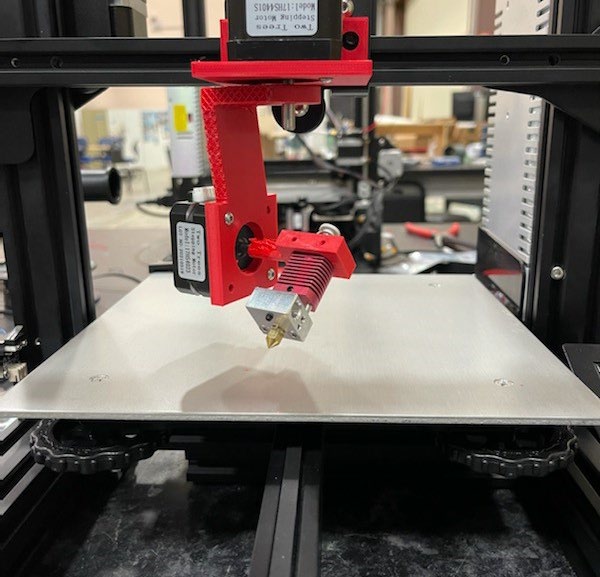
5-Axis 3D Printer
Team Members
Payton Ernest
Francisco Aguilar Quintanilla
Eric Wilck
Fawzi Elsharayheh
Internal Sponsor/Mentor
Dr. Stephen Jiang
Abstract
3D printing is an up-and-coming technology that has a wide variety of uses and a growing customer base. One of the main issues with 3D printing is the low detail and quality of a printed object for a regular 3 axis 3D printer. These printed pieces have supports that are added on to the main print and typically require secondary machining to be removed. In some cases, the printed object may need to be reprinted all together if the supports are not properly placed or if the quality of the print is insufficient. Our 5-axis 3D printer add-on kit directly solves this issue by adding extra angles of rotation for the extruder head which eliminates the need for supports on your object and increases the detail of the print. Our kit is designed to be compatible with one of the most basic and common 3D printers on the market, the Ender 3 3D printer. Using such a well known and popular 3D printer makes our kit useful and beneficial to a large part of the 3D printing community. Most 5 axis 3D printers are assembled using one motherboard to operate the printer; however, these printers are very expensive and complicated. Our kit is made to be added on to the system that is already installed making the kit affordable and easy to install while still being effective. With the combination of effectiveness, affordability, and simplicity, our kit can be useful for a sizable number of people in the 3D printing community looking to upgrade their printer.
Piezo Energy Harvesting Device
Team Name
The Piezo Crew
Team Members
Charles Adebiaye
Armando Castillo
Lauren Caves
Amilkar Crompton
Paul Espinoza
Michael Gonzales
External Sponsors/Mentors
Omar Huerta
Eddie Gutierrez
Brian Espinoza
Internal Sponsor/Mentor
Hassan Qandil
Abstract
The main objective of the Piezo crew is to create an easily detachable energy harvesting device that will either light-up LED lights or a battery. The device is called the Armandonator; the primary powering system consists of piezo-crystals that produce an electric charge when a kinetic force is applied. The Armandonator will be mounted near the back tire, in which a belt system drives a rotational rod and a spring system applies shear pressure to the piezo; this then creates energy.
Eterno Ovens Project
Team Members
Abdullah AlSawalhi
Craig Horricks
Isaac Salazar
Jimmy Maksoud
Josue Marcano
External Sponsor/Mentor
Wade Henderson - Eterno Ovens
Internal Sponsor/Mentor
Dr. Mark Wasikowski
Abstract
The main objective of this project is designing a single piece mold for a pizza oven. Commercial pizza oven molds usually come in 4 to 7 pieces that are put together using refractory cement. This process can add manufacturing and labor costs on the business owner. By designing a reusable cast that can produce a single piece mold would allow business owners to save money by cutting down the processes needed for manufacturing as well as labor costs of assembly.
UNT Flight Simulator Project
Team Members
Ian Coughlan
Michael Arnao
Dan Anderson
Justin Peska
David Ayodele
Sabin Adhikari
Internal Sponsors/Mentors
Mechanical Engineering Department
Dr. Mark Wasikowski
Abstract
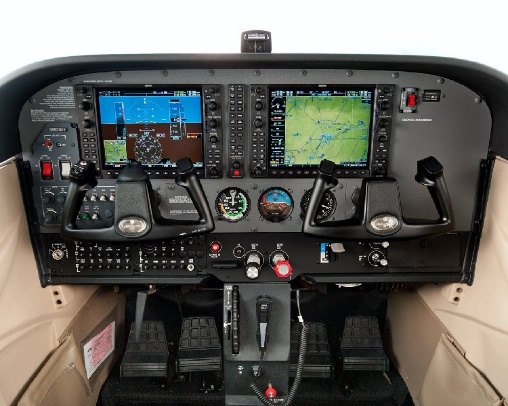
Our group is building a flight simulator to mimic the controls and feel of a Cessna 182. We are building upon the project that previous group had completed. The overall goal is to build a realistic environment to simulate flight for academic or recreational purposes. The multiple parts of the project needed to make the full cockpit are the: yoke, rudders, radio stack, instrument panel, and throttle quadrant. When coming together and completely wired and programmed through Arduino, the goal is to have a fully functioning simulation program that is compatible with the flight simulator program and aesthetically pleasing to give a genuine feel.
NASA SLI – Subscale Vehicle
Team Name
Sparrowhawk
Team Members
Jesse Sullivan
Mphatso Kachete
Karim Botros
Nischal Aryal
Zain Syed
Erik Bravo
External Sponsors/Mentors
Jack & Suzy Sprague - Dallas Area Rocket Society
Harry Spears - Tripoli North Texas
Internal Sponsors/Mentors
Mechanical Engineering Department
UNT Robotics Aerospace Division
Abstract
The NASA Student Launch is a research-based, competitive and experiential exploration project that provides relevant and cost-effective research and development to support the Space Launch System, or SLS. Student led research teams are given a NASA research topic which have been conceived by the SLS Program Office in collaboration with SLS industry partners. Teams will design and build a high-power vehicle while mirroring the NASA engineering design lifecycle. This project focuses on fulfilling the sub-scale vehicle requirement per competition guidelines.
After a competitive selection process, teams will participate in a series of submitted design reviews as design and assembly begin. Lessons learned from the sub-scale test will be applied to the full-size vehicle and payload. The competition culminates in a flight day hosted at the NASA facility in Huntsville, AL. Teams will then complete a Post Launch Assessment review, where the payload and flight data are analyzed. Scores are awarded based on flight readiness, accuracy of flight predictions, and payload demonstration.
Acknowledgments
We would like to thank Joe Moore, Lauren Caves, and Mishal Raza of UNT Robotics – Aerospace Division as well as Robert Watson at BuyRocketMotors.com for their incredible contributions in making this project happen. Fly safe!
MEEN Wagon
Team Members
Ford Feigle
Andrew Holcomb
Seth Spears
External Sponsor/Mentor
Richard Pierson
Internal Sponsor/Mentor
Andrew Holcomb
Abstract
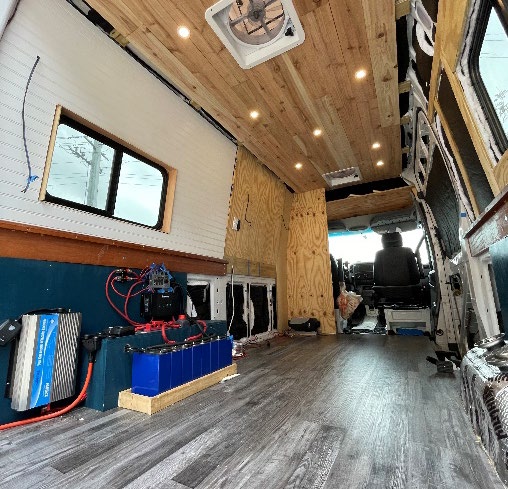
Our team is converting a 2007 Dodge Sprinter 2500 High Ceiling utility van into a self-sustainable class B recreational vehicle. The mobile living unit will be able to comfortably house our internal sponsor in any rural environment for a minimum of three days. In order to accomplish four-season sustainability, the following features will be designed, manufactured, assembled, and then incorporated in a series of interconnected subsystems - collectively creating a living solution. A 400-Watt solar panel, 7-Kilowatt hour battery bank, roof rack, heating element & ventilation, sound & thermal insulation, fully functional kitchen, TV, bedroom, navigation system, front and rear facing camera monitoring package, upgraded audio system, ample storage space, 20-gallon water tank with water heater, sink, and an external shower.
Acknowledgments
A special thanks to the external classmates and friends who volunteered their time and talents towards the construction of this massive undertaking.
Two-Phase Heat Exchanger
Team Name
Water Desalination
Team Members
Zarrin Bashir
Abigail Falcon
Jonathan Krause
Omar Manakhan
Internal Sponsors/Mentors
Dr. Weihuan Zhao
Dr. Hassan Qandil
Abstract
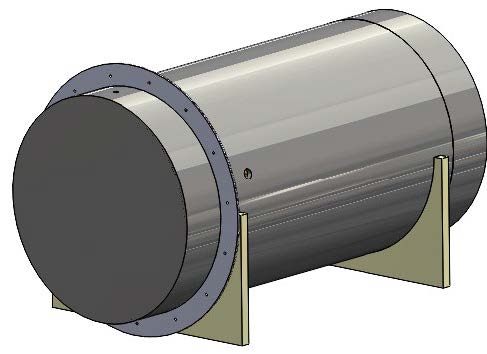
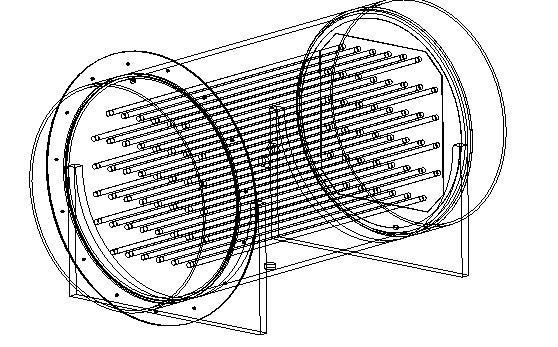
Water is the most essential matter on Earth, yet billions of people around the world lack access to fresh drinking water. To combat this global issue with a sustainable solution, our mentors, Dr. Qandil and Dr. Zhao, are proposing a solar-powered water desalination system for regions with arid climate and a lack of drinking water. The desalination system has many components; however, our team’s focus is designing the condenser. Our team’s objective is to design a manufacturable and efficient two-phase heat exchanger that will act as the condenser for the overall desalination system. A separate solar powered vaporization chamber with create steam from salt water. The salt will be left behind and the steam will enter our condenser. Once in the condenser the steam will interact with copper tubes that have cold sea water running through them, this contact will induce a heat transfer that will lower the temperature of the steam until it condenses into fresh drinking water. To test our condenser, we will use a hot plate to boil the water and direct steam into it. Our team’s primary goal is to design the heat exchanger to be easily assembled and disassembled, so it can be cleaned and maintained.
Acknowledgments
A special thanks to Dr. Zhao, Dr. Qandil. Dr. Wasikowski, Rick Pierson, Robbin Shull, and Bobby Grimes for their support and guidance.