 University of North Texas

Materials Science and Engineering - Spring
Design and Development of Duplex Coatings for Cylinder Liners in Hybrid Drones
Team Members
Advika Chesetti
Hong Huynh
Linsey Velez
Internal Sponsor/Mentor
Dr. Samir Aouadi
Abstract
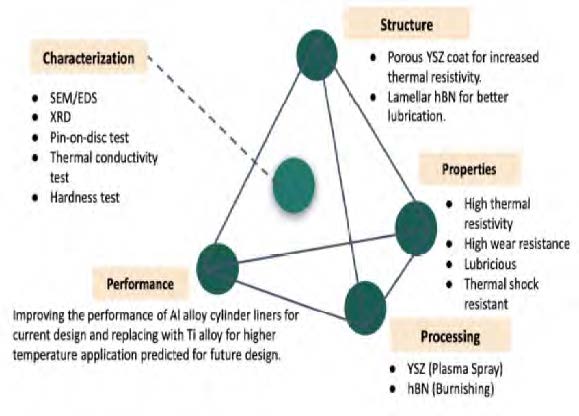
The goal of the project is to design and develop an optimal duplex coating for cylinder liners used in combustion engines for hybrid drones which reach temperatures up to 300℃. The project aims at designing solid lubricant that can sustain temperatures up to the specified temperature for Al alloys, and 500℃ for future design involving Ti alloys. The duplex coating will involve an oxide layer which acts as a thermal barrier to protect the base substate from early thermal degradation, and a solid lubricant coating consisting of equal parts hexagonal boron nitride and antimony oxide to provide lubricity for the sliding motion between the piston and the cylinder walls reducing wear. Tribological testing was carried out in the dry environment using pin-on-disk at ambient and elevated temperatures. The wear tracks of the samples were characterized, and the wear rate was calculated from the tests to assess the component's surface behavior and interactions.
Acknowledgments
We would like to acknowledge Euan Cairns, Mayur Pole, Dr. David Garrett, Bobby Grimes, and Asghar Shirani for their help and guidance throughout the project. We also acknowledge Dr. Nigel Shepherd and Dr. Diana Berman for access to their equipment.
Design of Nano Coating Materials for Stable Li Anode in Li Batteries
Team Members
Gerardo Gamboa
Sid Hashemi
Stacey Nguyen
Noah Smith
Internal Sponsors/Mentors
Dr. Wonbong Choi , team advisor, mentor, and sponsor
Dr. Xiao Li, mentor
University of North Texas, sponsor
Abstract
Current battery solutions are insufficient to meet today's energy demands. Conventional Li-ion batteries have reached their limits and therefore, a new solution must be developed to meet the need. Li-ion batteries are being disposed of in mass due to relatively small lifespans and becoming a dumping hazard in some parts of the world . Current anode technology is limiting the maximum capacity of batteries. Li metal anodes have a max theoretical capacity of 3860 mAh/g which is 10 times greater than Li-ion anodes capacity. These Li anode-based batteries are the future for high density storage electronics, vehicles, and many other applications. Nevertheless, lithium metal is very reactive under standard atmospheric conditions and prone to short-circuiting dendrites forming during charging and discharging cycles. Consequently, modifications must be made to the Li anode and battery electrolyte to overcome these issues. Our goal is to create a modified surface to the Li-metal anode which indicates coating the metal with a protective layer that will create a stable solid electrolyte interface (SEI). The coating must also allow for the SEI to have high passivation, complete adherence to the anode, and be ionically conductive to utilize the full potential of the Li anode. The design of this surface coating was engineered in a way to protect the anode and prevent dendrite formation while not diminishing the capacity of the Li anode and promote stable SEI layer conditions.
Acknowledgments
We would like to show our appreciation to Dr. Choi for his dedication and knowledge that guided us during this project and the material research facility and materials science department and faculties for access to their equipment.
Additive Manufacturing of 316 Steel Components Using Binder Jet Process
Team Members
Awasthi Prithvi Dev
Janjua Haider
Al Alawi Abdul Aziz
Honang Pedahel
Internal Sponsors/Mentors
Materials Science and Engineering Department
Dr. Nigel Shepherd, mentor
Abstract
Impellers are used in the oil industry to control the velocity of the fluids being pumped throughout the designated pipelines. Additive manufacturing techniques are expected to significantly improve the efficiency of the process manufacturing of impellers, and reduce costs by adding the capability to produce them on an as-needed, where-needed basis.
This project designed Binder Jet AM processes to print impellers from 99% pure 316 steel. The produced components were subjected post-print steps involving de-binding, binder burn-off, and sintering to obtain the final product. The impellers were produced using designed printing routines, and afterward characterized for density, mechanical properties, and microstructure. The data from the printed parts were analyzed and compared to traditionally produced 316 steel.
We demonstrated that our process design for additively produced impellers from 316 steel yielded more than 80 percent of the density of bulk 316 steel, thereby demonstrating the feasibility of using Binder Jetting AM for printing parts for the oil and gas sector.
Acknowledgments
We acknowledge the CAAAM facility for help in using the 3D printers to produce the parts.
Nanoparticle Production by Automated Delivery
Team Members
Matthew Harris
Francisco Martinez
Evan Ober
External Sponsors/Mentors
BLH Ecology Concepts
John Lott
Gerhardt Wissler
Internal Sponsor/Mentor
Dr. Richard Reidy
Abstract
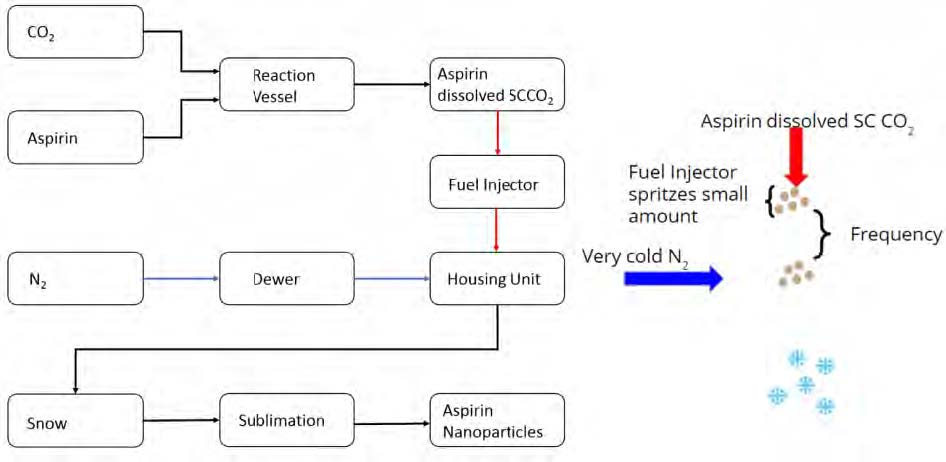
In order to satisfy an increasing demand in industries such as additive manufacturing, pharmaceutical, etc., a quick delivery method needs to exist to keep up with industry demand. Using a successful patent to produce nanoparticles, a fuel injector has been integrated as to increase efficacy by automating the process further. The integration of a fuel injector will aid in the production as it can be programmed to spray a species dissolved into a supercritical fluid which then sublimes and leaves behind nanoparticles behind on a substrate effectively increasing sample production size. This process specifically involves aspirin dissolved into supercritical CO2. This delivery system is also aided using a manifold which allows for the fuel injector to be adjusted into thus providing an efficient method of delivery and ultimately collection of the nanoparticles.
Heavy Metal
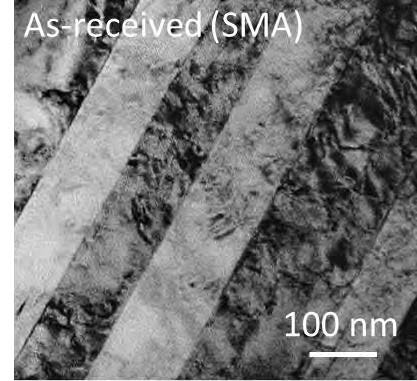
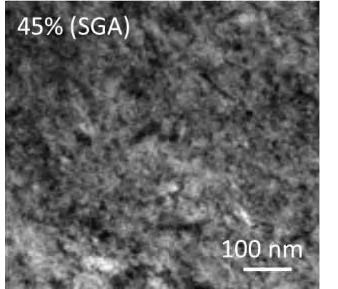
R. Wheeler, J. Smith, N. A. Ley, A. Giri, M. L. Young. Processinginduced strain glass
states in a Ni49.5Ti50.5 shape memory alloy Applied Physics Letters, 5 September 2018
Team Members
Neha S. John
Jessica Rider
J. Eli McCool
Jordyn M. Ward
External Sponsors/Mentors
Mr. Brian Van Doren
Dr. Robert W. Wheeler
Dr. Matthew A. Carl
Internal Sponsors/Mentors
Dr. Marcus L. Young
Christopher Reynolds
Michael T. Wall
Abstract
SGAs are metallic alloys with amorphous martensitic nano-domains within a crystalline material, which occur from process-or compositionally-induced strain and can be formed from a Shape Memory alloy (SMA) by disrupting the martensitic transformation. This glass-like state has superior energy absorption and enhanced structural and load-bearing abilities, in addition to the unique shape recoverability of SMAs. There is a need for actuators with enhanced properties that can withstand longer cycles and be less susceptible to mechanical failure. The overall goal of this design project was to utilize knowledge of shape memory alloys and strain glass alloys to design a more efficient and lightweight material for actuation devices. Characterization such as Differential Scanning Calorimetry (DSC), Thermo-Mechanical testing (TMT), Vickers’ Hardness (HV), Scanning Electron Microscopy (SEM), Energy Dispersive Spectroscopy (EDS), and transmission electron microscopy (TEM) were carried out to determine both the strain glass state in compositionally-induced buttons containing various Ni- content and a processing-induced Ni50.4Ti29.6Zr20 button that was cold rolled. Machine Learning was utilized to determine possible strain glass states in compositionally-induced NiTiZr. It was determined that both processing-induced and compositionally-induced strain glass was achieved and fit the constraints as defined by this design task.
Lubricious Coatings for Fuel Pump Applications
Team Members
M. Avina
M. Dockins
Y. Li
C. Morphew
External Sponsor/Mentor
Army Research Lab
Internal Sponsor/Mentor
Dr. Diana Berman
Abstract
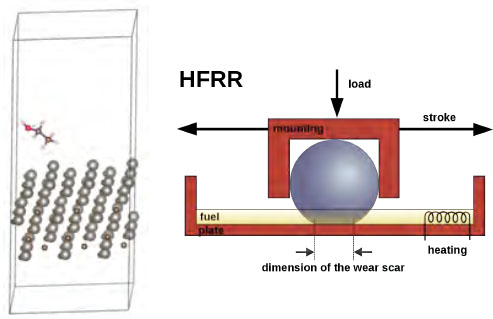
In recent years, the US Army has experienced high failure rates of fuel pumps inside of their drones. This project will design an anti-corrosive hard coating that will increase the life span of the current fuel pumps. From literature, we choose TiN, Fe2O3, WC and YSZ as our candidates because they have ideal properties to be used in tribology coating such as low friction coefficient, and high hardness. All of the four coatings will work in ethanol and dodecane environments, fuels commonly used in these drones. Then, a DFT method was applied to calculate the absorption energy for different coatings, from which we confirmed that all candidates have a degree of wetting in both environments. With WC having the best wetting of all the candidates, we choose two test two common. We then performed high frequency reciprocating rig (HFRR) testing on two common WC compositions (PTI 188/226) in order to verify our design for both fuel types. HFRR was performed as it best simulates the tribological conditions placed on fuel pump components in these drone environments.