 University of North Texas

Mechanical and Energy Engineering - Spring
Dynamic Balancer
Team Name
Pro-Bal Movement
Team Members
Noel Winslow
Jesse Cole
Danielle Da Costa
Hector Betanzo
Jairo Garcia
Hudson Hooker
External Sponsors/Mentors
Leith Whitley, VP - Pro-Bal Dynamic Balancing
Dustin Pavelek, P.E. - Kelm Engineering
Internal Sponsors/Mentors
Dr. Yijie Jiang
Dr. Yunwei Xu
Abstract
Our goal is to develop the high-speed turbocharger balancer, but at a price point more accessible to small turbocharge repair businesses. Utilizing a rigid, benchtop steel frame and a modular holding block system, our balancer is capable of being scaled and modified to accommodate multiple automotive turbocharger frames and sufficiently isolated the vibrations of the turbocharger from the environment surrounding. Preferring influence coefficients over modal analysis, the machine performs with versatility against different model turbochargers without the need to access manufacturing dimensions and materials.
Acknowledgments
Special Thanks: Rick Pierson (UNT), Tony Carter (Pro-Bal), Dustin Pavelek, P.E. (Kelm Engineering)
MGR Suspension
Team Members
Isabel Buenrostro
Bailey Rogal
Jordan Saxe
Zach Williams
External Sponsor/Mentor
UNT Mean Green Racing
Internal Sponsor/Mentor
Dr. Hassan Qandil
Abstract
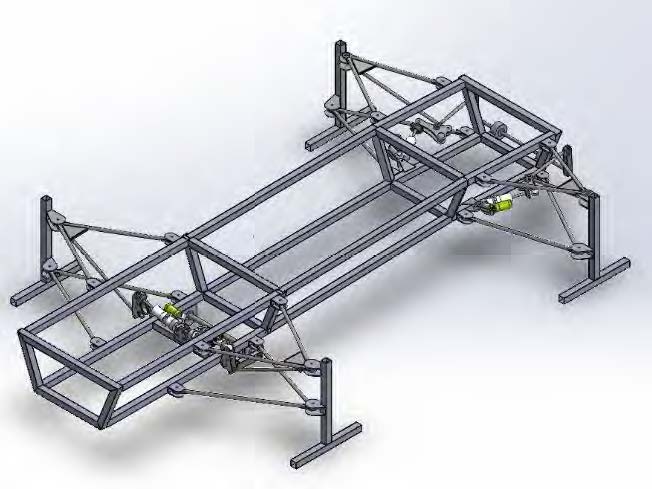
Our customer, Mean Green Racing, was looking for a suspension package that allowed us to use Hoosier’s new tire compound for a 10” wheel. This meant we had to create a suspension package that was small enough to perform as it has in the past but inside a smaller wheel. This meant making sure the range of motion of the control arms fit inside the envelope of the wheel and meant we had to redesign the suspension geometry. This lead to the core of the project.
MEEN Green UAV
Team Members
Tyler Vicente Cortez
Shishir Gaire
Matthew Gloff
Gregory De La Rosa
Huybinh Ma
Ashley Miller
External Sponsors/Mentors
Army Research Laboratory
Constandinos Mitsingas
Internal Sponsor/Mentor
Dr. Mark Wasikowski
Abstract
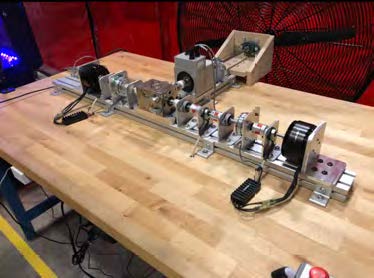
The MEEN Green UAV project is a research project to understand and develop a hybrid propulsion system for a Vertical Take Off and Landing (VTOL) UAV. The research will look at data points such as RPM, Torque, Velocity and PID Gains in order to determine at which set points the two independent motors work in conjunction best. The team has programmed controls to dictate when each motor runs and when the motors hand off power to each other depending on many scenarios for the UAV. This research and data could prove useful for future platforms for the Army Research Lab and help design more energy efficient UAV’s.
Automated Attic Ladder
Team Members
Jadin Lewis
Barrett Teakell
Charles Peacock
Quinn Nickerson
Dustin Taylor
Khoi Xa
External Sponsors/Mentors
Dr. Y. Anthony Nakamura
Tanner Hilton
Internal Sponsor/Mentor
Dr. Xiaohua Li
Abstract
The overall goal of our project is to develop and design a system that the general population could then purchase and install an automated attic ladder for their homes. The reasoning behind this project idea is that our sponsor wanted something on the market that could benefit the lives of homeowners and allow them to have easier access to the additional storage space in their attics. While it seems like a simple design concept, one of the biggest constraints is the budget that we were given to test and produce a finalized product ($1000), as well as the cost per unit goal that was set for us (max of $500). Due to these constraints, we as a group came up with several design ideas and then decided which would be best to pursue for the final design. After some deliberation we found that the best approach would be to purchase a base ladder and build the automated system around it. By doing so, this allows us to save money and time in the development process as well as keep the factor of safety high for the customer.
RC Car Supercapacitor
Team Name
Captain Carbon
Team Members
Kevin Beck
Jarod Haskin
Andrew Jarrett
Thomas Lastrapes
Mirella Sandoval
External Sponsors/Mentors
EcoEnvision:
Derek Cross
Matt Tehrani
Internal Sponsors/Mentors
Dr. Sheldon Shi
Jiyao Hu
Abstract
In order to reduce the harmful waste produced by traditional sources of portable power, i.e. batteries, a new faster and more environmentally friendly product was envisioned. A supercapacitor, comprised of predominately biodegradable materials, was desired because of its quick charging speeds and low weight. This supercapacitor will be small, easy to use, and designed to power several household electronics with hopes of scalability for larger applicatio ns in the future.
Our sponsor, Eco-envision, proposed creating a biodegradable super capacitor that can power an RC car with specifications that include powering a 2-12V motor, charging the RC car in 3 minutes and running it for 30 minutes.
Acknowledgments
Lee Smith (Materials), Wongbong Choi (Electrical), Carlos Fernandez (Manufacturing)
Fiber Mat Former
Team Members
Brandan Hartfield
Thomas Martin
Adam Nguyen
Danh Nguyen
Giovanni Soto
Miguel Villagrana
Internal Sponsors/Mentors
Dr. Sheldon Shi
Lee Smith
Abstract
Did you know that ten 40-gallon bags of clothes lint are collected by local laundromats and simply thrown away every 4 hours?
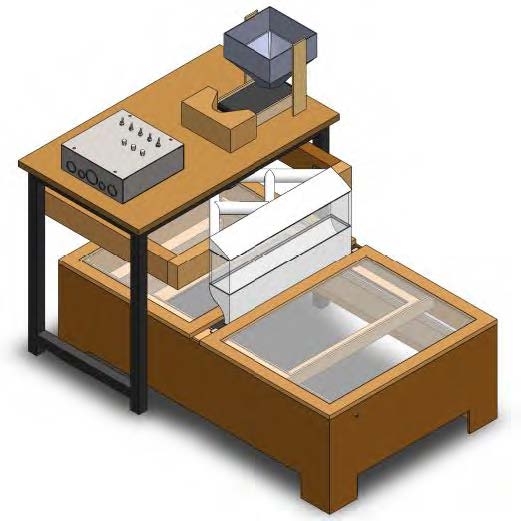
The intent of this project is to design a compact system to air lay recycled clothes lint, specifically organic fibers, into 2’ by 2’ square fiber mats. This process involves a material feed operation, a shredding operation to separate and shorten the fibers, and then an air laid fiber “web forming” operation which will form the mat itself. The system parameters are variable to allow for process optimization by the end user in order to achieve high uniformity of fiber distribution.
These fiber mats would then be pressed together with heat, pressure, and an adhesive binder to create a new type of biocompositefiberboard, analogous to the familiar medium density fiberboards. These fiberboards have the potential for wide use across the agricultural, textile, automotive, and construction industries.
Acknowledgments
Special thanks to the UNT College of Engineering, Dr. Sheldon Shi, Lee Smith, Dr. Hassan Qandil, Robbin Shull, Zoom, and to the entire faculty and staff of the Mechanical Engineering department for their invaluable contributions to our education and growth as engineers and problem solvers.
Aircraft Simulator
Team Name
Eagle Aeronautics
The Jetsons
Team Members
Eagle Aeronautics:
Cameron Ogrodnik (Team Lead)
Torrance Walker
Eyobed Astatke
Robert Zamarripa
Ian Hammond
Derrick Imade
The Jetsons:
Cydni Anderson (Team Lead)
Joshua Anderson
Megam Najera
Daniel Arteaga
Lucas Felczak
Haruna Iliya
Internal Sponsors/Mentors
Dr. Wasikowski
Abstract
UNT does not offer any type of hands-on experience for aircraft control and flight, so our team designed and fabricated a flight simulator that can be used as a learning platform for students to understand the basics of flying. The flight simulator is also being made with research in mind as well, allowing for custom code and modeled planes to be added into the simulator to see how the aircraft may react in real time. With all this in mind it was the objective of the team, while following all constraints, to create a close to realistic experience as possible.
A Vibrational Anomalies Detection System
Team Name
Forum Sense
Team Members
Bernie De Alva Garza - Team Leader
Avery Deatherage
Naomi Jacobsen
Matthew Muller
Matthew Turner
Kamry Waters
External Sponsors/Mentors
Forum Energy Technologies
Saul Dominguez
Peter Middleton
Internal Sponsors/Mentors
Dr. Mark Wasikowski
Dr. Qandil Hassan
Abstract
Forum Sense designed and fabricated a system for detecting vibrational anomalies through sound/vibration. Detecting these anomalies helped our sponsor, Forum Energy Technologies, decrease maintenance costs for their pumps. The pumps had periodical maintenance after a certain number of hours, where they would change specific parts due to predicted wear. This wear was not always present in these parts; therefore, they would spend money fixing something which was not broken or perhaps not close to failure. Our system helped clearly show when a particular part of the pump was damaged so that that maintenance would be done on time before critical failure. This saved money because the parts were only changed when needed, rather than by a predetermined schedule. Our project is innovative because the market has vibrational data acquisition systems around $3,000 - $16,000, and ours is less than $1500.
Acknowledgments
We would like to thank Dr. Mark Wasikowski for his guidance, Dr. Hassan Qandil for his support, Peter Middleton for starting us off on our project, and Saul Dominguez for taking over the role of sponsor and providing guidance through our project.
Heat Exchanger With PCM

Team Members
Ahmed Almatar
Mohammed Alzain
Mohammed Alnasser
Karl Sralla
Joseph Miller
Mohammed Alyaseen
Internal Sponsor/Mentor
Mechanical Engineering Department
Abstract
Energy recovery ventilators are widely used in building, in replacement of HVAC systems, which accounts for around 40 percent electricity consumption of commercial buildings. In this project, an ERV is designed with enhanced heat transfer using phase changing material (PCM), encapsulated in the spokes that are evenly distributed around the circumference of the thermal wheel. This system contains air duct to direct the flow toward the thermal wheel, which contains PCM that melts upon heat transfer and result in more exchange of heat. This project is designed in such a way that it can easily be used for mass production. Moreover, interchangeable energy wheel can be used depending on the climate conditions. The major purpose of this project is to decrease cost utilized in energy consumption of buildings and decrease energy loads on HVAC systems. Market analysis is done, in which comparable products, designs are discussed and compared with our one.
HPAC
Team Members
Faris Al-Etoum
Raymon Tawfik
Timothy Karbula
External Sponsors/Mentors
Eco Envision
Matt Tehrani
Derek Cross
Internal Sponsors/Mentors
Dr. Sheldon Shi
Jiyao Hu
Abstract
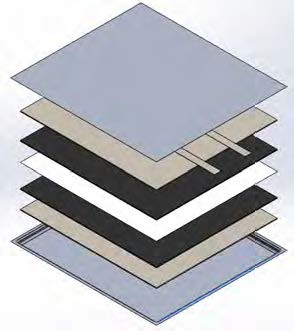
The problem handed to us by Eco Envision was to fabricate a supercapacitor that can be used to replace a lithium-ion battery to be used as a power source to heat a jacket. This project must be small, light weight, based on activated carbon made of biomass, charge in 3 minutes and discharge in 6-8 hours. Heated jackets are reliable for providing extra warmth to combat the cold. unfortunately, the specific power supplied to the jacket by lithium-ion technology is somewhat sluggish. Supercapacitors resolve this delay, due to the characteristic nature of supercapacitors. Unlike batteries they can provide a much higher specific power allowing for a faster delivery of energy compared to batteries. This distinctive property is what makes supercapacitors special and a unique energy storage device.
Acknowledgments
Highly showing our gratitude and appreciation to the support and guidance given by Dr. Sheldon Shi, Jiyao Hu, and Richard Pierson.
Ice Maker
Team Name
Ice Ice Baby
Team Members
Jonathan Okello (Leader)
Dymon Alfred
Zachary Starr
Austin Wartelle
External Sponsors/Mentors
Jeffery Abbott
John Houston (DUALAMS)
Cooper Wood
Internal Sponsor/Mentor
Dr. Xiaohua Li
Abstract
The goal of our project is to make a working ice maker. Originally we had wanted to make a portable ice maker, but due to many constraints and the difficulty of having very experimental project, our sponsors changed our goals. Because of that criteria, our ice maker does not look like a conventional ice maker. Nonetheless, we are making a ice maker that is efficient, durable, easy to use and capable of being improved upon the completion of this design where it will have the capability of making ice in remote areas for outdoor enthusiast’s and even medical transport.
Spotlight
Team Name
Light the Sky Green
Team Members
Aaron Poteet
Colin Paterson
Dean Gallion
Kyle Pressley
Mahdi Alkashi
Max Baley
External Sponsor/Mentor
John Alexander
Internal Sponsor/Mentor
Dr. Richard Zhang
Abstract
We are replacing the SkyTracker spotlight which weighs 2000 lbs and is powered by a loud diesel generator which cost more than $1,500 to rent on a daily basis. Our project will be to replace it as the spotlight for UNT’s bonfire or any event that is desired. Ours will be light weight to where one or two people can move it while producing next to no sound due to a cleaner form of energy generation.
Acknowledgments
Reginald Johnson – Logo permission
Carlos Hernandez – Fabrication help
Ultrasound Communication
Team Members
Arnaldo Frias
Conrad Willett
Harrison Taylor
Mateo Perez
Michael Newlin
Zachary Hughes
Internal Sponsor/Mentor
Dr. Haifeng Zhang
Abstract
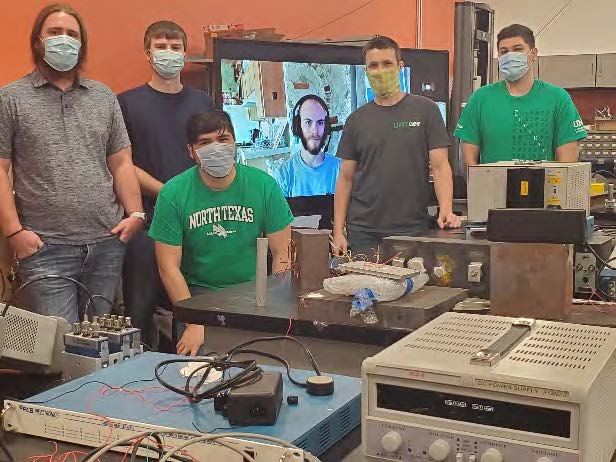
Our project is using ultrasound communication to send data through a steel wall. This project helps solve the problem of obtaining data within a container without having to open the container. This is useful for Non-Destructive Testing and obtaining data from inside potentially hazardous vessels.
Solar Tracker
Team Members
Shaun Pham
Beomhee Park
Colton Gunter
Ryan Boyce
Tamiah Waters
Mohammed Hamza
Internal Sponsors/Mentors
Dr. Hassan Qandil
Mechanical Engineering Department
Abstract
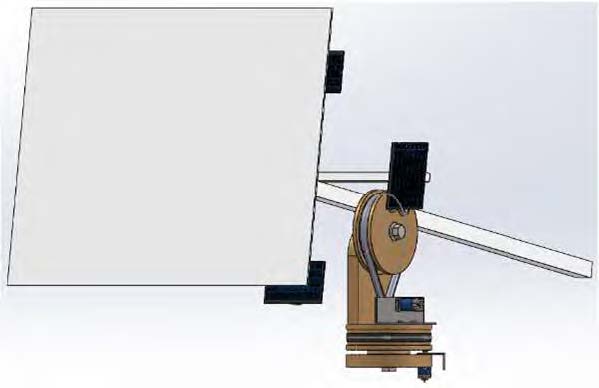
The purpose of this project is to build an autonomous solar tracking device that follows the movement of the sun. The solar tracker will be built in a way that will function without the need for batteries, a power supply or any outside solar database. Our solar tracker will be able to continuously track the position of the sun in the sky and will be able to automatically orient the panel to directly face the sun to harvest energy most efficiently.