 University of North Texas

Electrical Engineering - Spring
Parking Lot Detection System
Team Members
Hamza Siddiqui
Anthony Vaquera
Matthew Tumax
Ali Alsalim
Internal Sponsor/Mentor
Dr. Kamesh Namuduri
Abstract
Compelled from our own personal experiences, we felt enticed to produce a new, simple, yet unique instance of a parking lot detection system. The system will act automatic and the detection system will function through the use of motion sensors that will detect the presence of a vehicle. A motion sensor system will employ the use of passive infrared sensors that will detect if the light in its field of view has been interrupted. Whenever a vehicle is detected, a signal will be sent throughout the system through the use of a Raspberry Pi, which will enable an LED to either become “on'' or “off”, i.e. turning on the LED whenever a vehicle is in the parking lot. This detection system will prioritize practicality, mobility, and cost effectiveness, essentially acting as a singular unit. Other detection systems, such as that of DFW airport’s, prioritize multiple units that come to form a single system, thus not being able to act independently. Other notable traits for the prototype include the overall small size of the system, akin to a lamp post, which can permit a 4-way system setup to free up space. In regards to safety standards, the formation of the system will use safe materials and a soft-colored light for the LED to not harm any individuals. Relating to economic ethics, the system incentivizes haste and productivity, enabling individuals to reach their job in a timely manner. A societal issue that the system tackles is the risk of wrecks that could occur. Pertaining to contemporary issues, our system takes into account the idea of overpopulation, providing a feasible system that can hasten the progress of a society’s daily life.
9-Axis IMU-Based Gesture Recognition for General Device Control
Team Members
Jacob Daniels
Dustin Akins
Sydney Le
Internal Sponsor/Mentor
Dr. Colleen Bailey
Abstract
As both occupational responsibilities and leisure activities continue to increasingly rely on interfacing with technology, the use of standard input methods like mouse, keyboard, remote, and touch screen has become essential to our daily lives; however, these methods of input can often be slow, cumbersome, and unnatural. Current alternatives include devices which interface through bluetooth and place sensors at the base of the hand to use designated gestures to control various devices. While these devices provide a solution to the problem of natural input, they suffer from design flaws that impede the completion of other tasks while wearing the device, complex gesture requirements, and poor performance. To improve upon past work, our team developed a novel hand-mounted device that will use conveniently-placed 9-axis IMUs at the base of the hand as well as on the finger tips in conjunction with a central bluetooth-enabled microcontroller to process IMU input using machine learning, allowing the classification of a range of hand gestures for general machine-human interfacing. This device should be capable of integrating with bluetooth-enabled devices including but not limited to computers, laptops, phones, and IoT devices.
Machine Learning Audio Denoiser with CNN and FIR Filter Microcontroller
Team Members
Steven Edwards
Jonathan Tryon
Internal Sponsor/Mentor
Dr. Kamesh Namuduri
Abstract
Audio denoising describes a system that filters undesired noise out of a noisy audio input signal without degrading the original input signal. Machine learning is incorporated into this system by utilizing convolutional neural networks (CNN), a learning algorithm that’ll take audio data samples and differentiate them from other signals. Our system also incorporates an FIR audio filter interface hardware design that’ll filter out a range of unwanted high, mid, or low frequencies based on the user’s control. This system is helpful in many cases. Imagine a conference call where sirens are going off in the street in the background. An efficient audio denoising system would be able to filter that out while your speech remains prominent. This system helps people whose speech is compromised by environmental noise, like someone on a conference call or astronauts relaying speech back to Earth where noise from the spacecraft is present. This denoising system will bring audio clarity to these situations.
Rain Sensing Automatic Car Wiper
Team Members
Hussain Alradhwan
Aldo Cepeda
Terrence Brown
Khalid Alqahtani
Internal Sponsor/Mentor
Dr. Parthasarathy Guturu
Abstract
After noticing the modern car and all its upgrades with the advancements in technology. the Our team noticed one part of an automobile that could be enhanced: the car wipers. A car wiper is a device mainly composed of a piece of rubber on a metal frame that moves back and forth and pushes water, ice, snow, washer fluids, among other things, on the surface of the window at the front of a car. The aim of the project is to test, analyze and come up with a more reliable and efficient rain-sensing automatic car wiper that will help in reducing the distractions that may cause accidents, like the distraction of activating or deactivating a car feature, hence offering an additional layer of safety. To implement this feature. The results obtained after a series of programming code used in coming up with a rain sensor brought about a prototype that illustrated how exactly the automatic car wiper will work.
VDS: Vehicle Detection System
Team Members
Jose Madrigal
Gabriel Vega
Logan Strother
Internal Sponsor/Mentor
Dr. Colleen Bailey
Abstract
Motor vehicles are the primary form of modern transportation so there is a need for rider assistance systems to aid users and reduce the amount of potentially fatal accidents. Many new vehicles have integrated rider assistance systems for additional safety; however, the number of low-cost products on the market for consumers is limited. To address this problem, we designed a low-cost Vehicle Detection System(VDS) which can detect the location of a vehicle approaching from behind and provide an accurate description of the location to the user. The VDS is rechargeable and, on average, lasts a week per charge. This product will aid users every day when using their motor vehicles. The VDS is ideal for consumers who desire additional safety on their vehicles at a low-cost.
Radio Transceiver Modules: Fast Huff and Puff Frequency Stabilizer and Frequency Band
Selector
Team Members
Jeremy Lopez
Pradeep Jacob
External Sponsor/Mentor
George Bugh (Vasant Corporation)
Internal Sponsor/Mentor
Dr. Ifana Mahbub
Abstract
Our team was sponsored by Vasant Corporation to fabricate radio transceiver modules. We were tasked with implementing and testing a fast huff and puff frequency stabilizer that would be used in a radio transceiver with the goal of reducing the phase noise and birdies coming from the output and increasing the locking time of the signal. Birdies are any unwanted internally-generated noises coming from the transceiver modules. Implementing these two circuits in the radio transceiver will also lower the amount of components needed and keep the cost of materials lower, while maintaining efficiency. Using both the frequency stabilizer and the frequency band selector in the radio transceiver can be applied to devices like traditional radios, cell phones, and walkie-talkies. Radio transceivers are capable of transmitting and receiving information over airwaves using radio frequency (RF) communication.
Acknowledgments
A special thanks to George Bugh, from Vasant Corporation, and Dr. Mahbub for their guidance throughout the course of this project. Additional thanks to George Bugh for sponsoring this project.
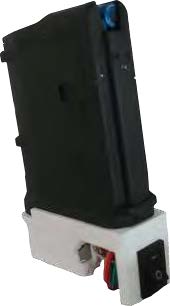
Ammunition Quantity Indication System
Team Members
Eric Hampton
Trevor Owens
Nicholas Britain
Hunter Oliver
Internal Sponsor/Mentor
Dr. Colleen Bailey
Abstract
In an era where smart devices are creating new opportunities within various markets, the firearms industry has fallen behind. The introduction of an accurate electronic system to measure and display the amount of ammunition in a firearm’s magazine will help fill this void within the multi-billion-dollar industry. The Automatic Quantity Identification System (AQIS) accurately and intuitively informs the user on the current quantity of ammunition in their firearm’s magazine. Current devices on the market with similar precision require extensive firearm modification and cost in excess of $1,000. Alternative, more affordable options within the market sacrifice precision and act as shot counters, rather than measuring the magazine’s quantity of ammunition in real-time. Utilizing a baseplate, microcontrollers, an optical sensor, and a display, AQIS accurately informs the user on the current amount of ammunition in the firearm’s magazine. This implementation is cheaper than popular alternatives, while successfully eliminating the necessity for firearm modifications.
Drone to Drone Communication using LoRa
Team Members
Joseph Ostovich
Jason Gonzales
Jose Marcelino
Louis Amador
Mayra Reyes
Internal Sponsors/Mentors
Dr. Kamesh Namuduri
Dr. Hector Siller Carrillo
Abstract
Drones have reached numerous real-world applications requiring more robust communication techniques than are currently available on the market. There are few systems and standards in place to allow for the exchange of data between drones. Furthermore, there are many problems that arise while attempting to establish communication with drones located out of range of a ground control station. In our project, we incorporate long range wireless drone-to-drone and ground-to-drone communications for flight operations and in-flight data relay. In doing this we are utilizing LoRa (low-power wide-area network protocol) technology that functions with a PIC18 microcontroller to process sensor and identification data and enable the communication. This systems relays information between drones, before finally establishing direct communication to a ground station gateway. The most common form of wireless communication is through Wi-Fi, but this range is limited and not suitable for areas with poor reception, so LoRa communication provides us with a reliable method to exchange sensor data and drone identification information during flight operations. We believe our design can be utilized by many different industries from the consumer level to the regulatory bodies that oversee drone operations.
Noise Cancelling System
Team Members
Omar Palomares
Parker Self
Ziad Alrashidi
Internal Sponsor/Mentor
Dr. Kamesh Namuduri
Abstract
It is often noticed when travelling in crowds, buses, or planes that the ambient sound from our surroundings drown out the sound from headphones. This problem causes a person to turn up the volume on their headphones so that they can listen to their music, and in doing this can cause problems to their hearing if used too long at high volumes. The project that our project team decided to make was a noise cancelling system that would cancel out the unwanted, ambient noise, so that a higher volume would not be needed to hear your music. This system would allow a user to plug in any over-the-ear headphones and make them into noise canceling headphones. The system would be a relatively small and portable system that can be carried in a pocket so it can be used when needed. This product would be ideal for people that travel in busy and loud environments such as an airport, bus, subway, and loud work environments.
Piloted UAV Weather Quad Copter
Team Members
Thuy Ly
Vien Nguyen
Hasan Al majhad
Natasha Quinn
Samuel Simmons
Internal Sponsor/Mentor
Dr. Xinrong Li
Abstract
Often, weather reports given by various news stations and applications have inaccuracies due to real-time data gaps in their forecast modeling. This shortcoming could be solved using a piloted unmanned aerial (UAV) vehicle quadcopter with an attached weather circuit that utilizes various sensors for collecting data. The piloted unmanned aerial vehicle quadcopter would travel to designated areas, collect and analyze weather data, and after enough weather data is collected, it would then return safely to the operational base. This operational base would vary depending on the pilot’s location but would be easy to transport to make the overall system portable. The prototype weather circuit uses sensors for measuring temperature. However, future iterations would be able to have multiple sensors to collect data including wind speed, humidity, or atmospheric pressure.
The weather circuit includes an Arduino, temperature sensor, and a serial port wireless module acting as a Bluetooth antenna. By taking another Arduino and Bluetooth antenna and connecting them to our ground station, there will be constant communication between the drone and ground station. When the drone is on its mission, the sensor will start collecting data within a certain amount of traveling time, and then the weather circuit will be constantly sending the collected data to the ground station, via Bluetooth module. The data collected will be imported to the Arduino IDE software to allow observations to be made.
The ideal target for this device would be as a tool for weather spotters who are constantly on the move searching for areas where severe weather conditions could occur. This device could also find use in the Office of Emergency Management of various cities. A network of weather spotters working together could create a grid of the city where each area has a designated piloted UAV quadcopter with an attached weather circuit assigned to it for use to relay first-person weather updates. This would give city managers more time to warn residents within the city when weather conditions become severe.