 University of North Texas

Mechanical Engineering - Fall
Cattle Cube Automatic Feeder
Team Members
Kamren Sargent
Thomas Speicher
Julian Cantu
External Sponsor/Mentor
Gordon England
Internal Sponsor/Mentor
Richard Pierson
Abstract
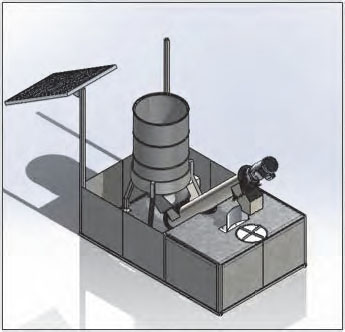
Raising cattle requires one to feed and care for them to allow for proper growth. There are various types of feed and methods to properly feed cattle. Factors such as extreme weather, rodents, feed supply, and ergonomics were all considered when designing the Cattle Cube Automatic Feeder.
Using cattle cubes or alike types of feed allow for the cattle to be fed from a supplemental source. The use of a Cattle Cube Automatic Feeder allows for the cattle to be fed when there are limiting factors that prevent the owner from being able to be present. This feeder was designed to disperse the feed outwards in a radial manner to provide a sufficient amount of feed to prevent competition. The automatic manner allows for the feeder to supply the cattle with feed without the need of human intervention. Our design utilizes an inclined screw conveyor to drive the feed upwards and then deposit it onto a spinner plate. The spinner plate will then disperse the feed out radially.
Acknowledgments
We want to thank our sponsor Gordon England and our advisor Richard Pierson!
Lightweight Aircraft Safety Seat

Team Members
Steven Menchaca
Jacob Hughes
Hoang Vu
External Sponsor/Mentor
Steven Menchaca
Internal Sponsor/Mentor
Dr. Xiaohua Li
Abstract
Owning you own aircraft brings a number of challenges and rewards. However it also brings certain risks, with operating an aircraft. In collaboration with a local flight school the team set out to design a safety feature that reduce the risks with operating a small aircraft.
The objective of this team is to design and manufacture an aircrew seat equipped with an energy-absorbing feature to replace the existing frame to protect the crew during a controlled flight into terrain situation. The concept is specifically tailored to fit into a 1976 Cessna 172 Skyhawk M aircraft airframe for reference for future design concepts. The design would need to mitigate injuries to the spinal cord and pelvic region by allowing the seat to compress and reduce the load during impact from both the vertical and forward axes. The team has designed and manufactured a seating system that embodies a damping system to reduce the forces acting on the human body.
Acknowledgments
The Lightweight Aircraft Safety Seat team would like to acknowledge the following individuals for the support and assistance to help in making our endeavor possible. Dr. Xiaohua Li, Dr. Hassan Qandil, Hannah Menchaca, Miranda Hardwicke, Tyler Sepe, and the teams of the Air Salvage of Dallas and Huffman Aviation.
PiezoClean V5
Team Members
Pumulo Bonna
Cesar Acevedo
Kieran Robarge
Nathan Scammel
External Sponsor/Mentor
Solar PiezoClean
Internal Sponsor/Mentor
Dr. Maurizio Manzo
Abstract
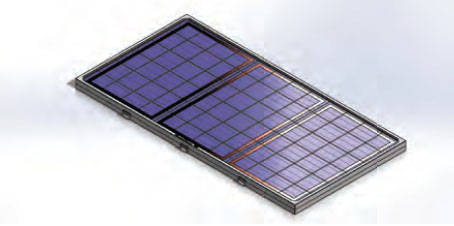
Piezofilm V5 is designed to address the environmental concern of excessive water consumption in the cleaning of solar farms by introducing an innovative self-cleaning system. Clean energy systems, such as solar energy, aim to minimize environmental impact, but ten billion gallons of water are annually required for solar panel cleaning yearly. Using a transparent Piezofilm on top of a solar panel it will clean the dust or dirt off the surface using zero water. Achieved by the Inverse Piezoelectric Effect the system induces vibrations from an electrical current passed through the film that can be run in short intervals effectively removing or dislodging 50-75 percent of the material. PiezoClean V5 stands as a sustainable solution, requiring no additional water or manual labor except for maintenance, thereby contributing to the advancement of eco-friendly practices in solar energy production and has the potential to revolutionize the industry.
Super-Cooling of Lumineers
Team Members
Kim Tran (Team Lead)
Collin Golay
Miranda Hardwicke
Ethan Nall
External Sponsor/Mentor
Ken Wilson (Signify / VARI-LITE)
Internal Sponsor/Mentor
Dr. Xiaohua Li
Abstract
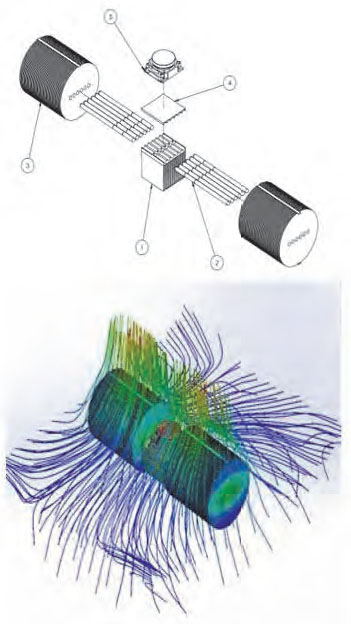
Our team's objective was to design a cooling solution for a 300W powered LED (located internally in luminaire structures) that produces minimal decibels. This was accomplished through an innovative design centered around 12 heat pipes and three heat sinks that dissipate heat through conduction and convection to the ambient air. Our heat pipes have additional cooling capabilities due to the inclusion of cylindrical fins, allowing even more surface area for heat to be distributed to the ambient air. This also creates an axis of symmetry in any direction. The heat pipes are fitted through the heat sinks allowing the structure to sit in place. The LED is fitted on top of the flattened section of the heat pipes to maximize surface contact with the LED. Our solution requires zero work input from noisy fans or pumps, eliminating the noise pollution generated by current market designs. This makes it perfect for any type of venue Signify might need. A byproduct of our design is the reduced cost and work required for operation since a fan or pump isn't required for forced convection cooling. Overall, our team was under the requested budget and successfully mitigated enough heat for sustainable operation of the LED for long term use. Thus, resulting in a financially savvy cooling system.
Acknowledgments
Special thanks to Ken Wilson, Reina Woolridge, and Li Xiaohua for their engineering expertise to help us design this product! Also a huge thank you to Astro Sheet Metal Co. for providing professional laser cutting for us!
Universal Trailer
Team Members
Micah German
Austin Anderson
Mario Robledo
Tyler Sepe
Victor Thai
External Sponsor/Mentor
Helena Ranch LLC
Internal Sponsor/Mentor
Dr. Rattaya Yalamanchili
Abstract
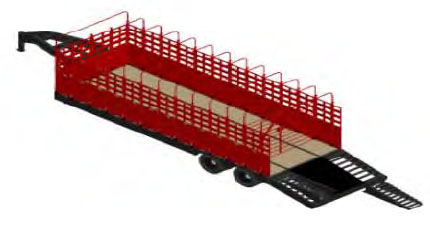
There are many different types of purpose-built trailers out there and it can be very expensive, and consume a lot of space, to own a different trailer for each different desired purpose. The scoper of the project will combine all of the different types of trailer into one single, modular, trailer. This will allow people on a budget and limited space to get all of the needed uses out of the trailer. The trailer will be universal and modular, this includes each piece being less than 50 pounds and the ability to assemble each variation of the trailer in 30 minutes or less. It will also be able to be assembled into different types of trailers such as: a livestock trailer, dump trailer, hay trailer, and an equipment hauler.