 University of North Texas

Mechanical and Energy Engineering - Spring
Analysis of a High-Performance Building

Team Members
Sruthi Iyer
Joshua Medrano
Jacob Roussel
Richard Thomson
External Sponsor/Mentor
Tony Robinson
Internal Sponsor/Mentor
Dr. Hassan Qandil
Abstract
Our sponsor, Mr. Tony Robinson is the builder of what we call a high-performance building. This structure was constructed from the ground up with a series of recycled materials and energy efficiency features including cork flooring, photovoltaic cells, a ground source heat pump system, rainwater collection capability, a ventilated wall layer and many other extraordinary features when compared to a conventional home.
Our project’s scope had 3 main tasks.
- To perform a detailed energy model to predict this building’s performance.
- Sensitize the envelope and measure real-life performance of the home.
- After analysis, provide the findings for a Case Study on the importance of sustainable building design, published with the Association of Energy Engineers.
Acknowledgments
Special thanks to the homeowner, Bill Byrom.
Car Crane
Team Members
Juan Rivera
Mitchell Burnaugh
Tyler Nester
Kristopher Whitaker
Internal Sponsor/Mentor
John Alexander
Abstract
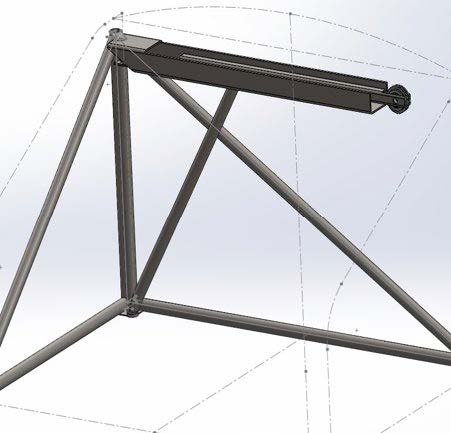
Our project is to design and build a simple and affordable car crane that can be mounted into the back of most SUVs to lift the client’s mobility device (electric scooter). For our basis of design our goal is to lift a collapsible electric scooter into the back of an Audi E-Tron SUV. Our crane is designed to lift a minimum of 50 pounds and place the scooter into the back of the SUV with in 45 seconds of attaching the scooter to the crane. The four major components of our design are the frame, boom arm, actuator and electric winch. A small 12-volt battery will be used to power the design. our design will be able to help those who can not afford the more complicated and expensive device currently in the market.
Acknowledgments
Thanks to our sponsor John Alexander for giving our team the opportunity to design this system!
Noise Reduction Drone
Team Name
Drone Dudes
Team Members
Shazad Ali
Bishwash Sapkota
Eloy Lopez
Melvin Nyagakah
External Sponsors/Mentors
ShazadAli
Eloy Lopez
Internal Sponsor/Mentor
Dr. Maurizio Manzo
Abstract
The purpose of noise reduced drone is to reduce the drone’s noise using active and passive sound system. Noise reduction drone reduces the environmental and human effect of drone operations. Drones can make loud noises that can bother or disturb people and animals. Drone noise reduction can help with numerous issues likeimprove safety, public acceptance, and environmental impact. Companies and organizations can improve drone operations' sustainability, efficacy, and societal acceptance by designing and employing noise-reduced features.
Acknowledgments
Our senior design team would like to take a second to acknowledge those who helped with our project. We wish to express our gratitude to Dr. Manzo for supporting our initiative and serving as our mentor and advisor, and to Robbin Shull for helping us with the purchase of parts. Marta Gonzalez's knowledge of 3D printing has been extremely beneficial to the process. We also want to thank Dr. Hassan for being our instructor and helping us out by giving us insightful criticism and guidance for our engineering experience.
Forum Sense
Team Members
Gregory Jackson,
Nick Poulter
Maxwell Allsup
Gabriel Rodriguez
External Sponsors/Mentors
Forum Energy Technologies
Garett Alison
Internal Sponsor/Mentor
Dr. Mark Wasikowski
Abstract
The use of hydraulic fracking in the oil and gas industry has increased in recent years. It is a process that is used to extract natural gas and oil from underground shale rock formations. This process can be complex but one portion of this process involves pumping water, sand and other chemicals into the ground at extremely high pressures. Currently, these large pumps do not have any means of tracking mechanical issues and have unexpected downtimes. These pump failures are due to a large variety of reasons that includes but is not limited to: wear and tear, corrosion, or damage to critical components such as valves, pistons, and seals, which can result in decreased performance or complete failure of the system. Forum Energy Technologies has partnered with the University of North Texas to develop a prototype to be used as an aid in the development of a custom vibration monitoring module. Our group has been able to construct an assembly using two accelerometers and one PLC to create our prototype. Along with our physical assembly we have created a software that stores and compares pump data in real time allowing for immediate checks of functionality. Our project explores what vibration metrics are relevant to large mechanical systems, how to track accelerometer information, and data comparison.
Friction Stir Additive Manufacturing

Team Members
Adrian Paredes
David Rasmussen
David Landrum
Noah Simonton
External Sponsor/Mentor
Dr. Rajiv Mishra
Internal Sponsor/Mentor
Ravi Sankar Haridas
Abstract
Friction Stir Additive Manufacturing is a type of solid-state welding where individual pieces of material are joined together to form a new structure or blank for a final product. Friction stir welders can join material in various directions, such asbutt welds, T welds, lap welds, or any combination of these. A unique aspect of this process is its ability to join metals of different compositions of materials.The welding process can resultin anincrease in mechanical properties, a reduction in the amount of material used, and a reduction in amount of wasted material. Depending on the application, theprocess can be applied to manyindustries that currently use more traditional processes such as subtractive manufacturing. Our project focuses on FSAMs goal to manufacture complex shapes and utilize the increase in mechanical properties and show off the capabilities of the process such as multi-materialfusion. Base materials of Aluminum and Magnesium are welded both separately and together and tested for mechanical properties, and an aluminum prototype is produced to validate the processes abilities.
Acknowledgments
Special thanks to: Travis Markwardt, Sam Dieterle and Austin Kilam for helping with the process of the project.
Hempcrete Development for Building Construction
Team Name
MEEN Hempcrete
Team Members
Angie Ferrer
Daniel Choi
Thomas Coykendall
Cameryn Griffin
Brian Patino
External Sponsors/Mentors
Dan Fette, Dan Fette Builders, Inc.
Jacob Waddell, President of the Hemp Building Institute
Internal Sponsors/Mentors
Dr. Sheldon Q. Shi, Professor and P.E., Renewable Bioproducts Manufacturing
Dr. Lee Miller Smith, Ph.D., Adjunct Instructor, Researcher
Abstract
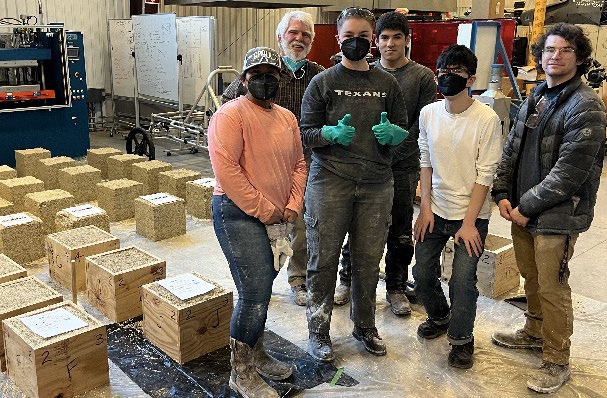
Hempcrete is a construction material made from hemp hurds, lime, and water, that could provide a sustainable alternative to current insulative non-structural elements in use. In the US, the limited information and experience with this biomaterial prevents utilization within the construction industry. To meet the needs of our project sponsor, we experimentally studied the effects of mix composition on key mechanical, thermal, and fluid barrier properties to arrive at a mix design suitable for use as in-fill within the exterior walls of his newly constructed home.
The composition of our hempcrete material includes the basic components with the addition of either pozzolanic volcanic ash or metakaolin, along with Portland cement as an additive. The binder ratio of hydrated lime to volcanic ash or metakaolin varies from 90:10 to 40:60, each with and without a 6% addition of Portland cement. A selection of 12 different mix ratios were determined to be viable for properties testing to ensure that the samples met the requirements defined by the International Residential Code®.
Mini Solar Steam Turbine

Team Members
Ibi Eni
John Zukoski
Brady Kriesman
Mayra Bustillos
Hoang Phan
External Sponsor/Mentor
Mitchel Curran, Better Place Electronics
Internal Sponsor/Mentor
Dr. Tae-YoulChoi
Abstract
Solar concentrators have seen extensive application in the production of clean energy in recent years due to their ease of use and the practically limitless availability of sunlight. Instruments such as a Fresnel lens are quite popular for their ability to generate enough heat to boil water, especially when conductive media such as high absorptivity nanoparticles are added to create a more efficient suspension, improving the steam production and heating capabilities of the lens by a significant margin.
This project sought to expand on that principle via the design and manufacture of a closed-loop, solar powered energy system that would collect the steam produced by the Carbon N115 nanoparticles to rotate a turbine and generate electricity. This system was engineered to withstand the high pressure and temperature amassed by the concentrated sunlight of a Fresnel lens, efficiently distribute heat, and funnel the accumulated steam to a turbine.
Acknowledgments
Dr. Hassan Qandil
Photopia-Optical simulation Software
NASA Clean Aviation Energy
Team Members
Anup Dhungana
Jorge Pineda
David Rosenbaum
Joseph Saeger
External Sponsor/Mentor
National Aeronautics and Space Administration (NASA)
Internal Sponsor/Mentor
Dr. Richard Zhang
Abstract
The current aviation industry landscape is heavily dependent on fossil fuels as an energy source, which has led to major increases in CO2 emissions levels. To combat these rapidly increasing levels, it is imperative that the aviation industry moves towards accessible and clean energy sources. The aim of this proposal is to implement a hybrid system comprised of hydrogen fuel cells supplemented by a solid-state electric generation and storage system. The proposed system comprises of thermoelectric generator shell, perovskite solar cells, and room temperature sodium sulfur solid-state batteries as energy storage. The goal is to take advantage of these combined sources to power electric motors while also increasing fuel efficiencies using a wing-strut plane framework. Furthermore, the use of a Very High Temperature Reactor (VTHR) will be implemented to produce hydrogen on site to eliminate the need to purchase and transport from outside sources. A solar farm will be constructed at airport sites to recharge and top off any returning or idle planes to ensure maximum fuel economy.
Project Phoenix, NASA University Student Launch Initiative
Team Members
Keon Brown
Brian Garcia
Gary Kropp
Joseph Moore
David Nachega
Tommie Snow
External Sponsors/Mentors
NASA USLI
Dallas Area Rocket Society
Jack & Suzy Sprague
RESPEC
MOUSER Electronics
O’Reilly Auto Parts
MassiveSoft
Internal Sponsors/Mentors
Dr. Mark Wasikowski
Dr. Hassan Qandil
Vignesh Pagadalu
UNT Robotics, Members and Alumni
Abstract
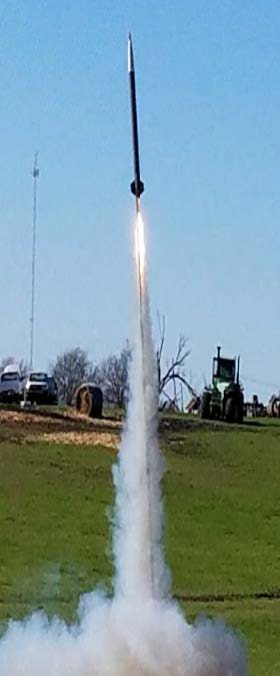
NASA Student Launch is a research-based, competitive and experiential exploration project with an eight-month commitment to design, build, and fly payloads. The project is built around a NASA mission, not textbook knowledge. Payloads developed by teams address missions set by NASA. This year is to build an autonomous payload that will be able to use RAFCO (Radio Frequency Command) to carry out inputs given by NASA.
Teams participate in a series of design reviews that are submitted to NASA via a team-developed website. These reviews mirror the NASA engineering design lifecycle, providing an experience that prepares students for the Human Exploration and Operations workforce. Teams must complete a Preliminary Design Review, Critical Design Review, Flight Readiness Review, and Launch Readiness Review that includes a safety briefing. Teams must analyze payload and flight data during a Post Launch Assessment Review.
Off Grid Hydroponic Tower
Team Name
TriFarming
Team Members
Dylan Gorski
Balvina Pineda
Karimat Sowemimo
Amanda Swart
Flora Trinh
Internal Sponsor/Mentor
Dr. Yunwei Xu
Abstract
The start of the pandemic has spurred an increase in gardening but not everyone has the space for a garden plot. The off grid hydroponic tower project is a vertical system saves space and does not utilize soil, only water and fertilizer. Our project is divided into three sections which allows for a wider range of plant growth due to plants having different nutrient requirements, whereas current market hydroponics only have one single reservoir. It is also important that the tower rotates to provide even sunlight, so no matter where the sun path is, all parts of the tower will receive even growth. In order to ease gardeners into the gardening world, TDS meters that track nutrient levels has been paced in each of the three reservoir, as well as water level sensors to alert low water levels. The tower also has off grid capabilities using solar to charge the battery, which runs the pumps, Arduino, motor, float switch and TDS meters.
UAV Drone Delivery
Team Members
Matt Gruetzmacher
Bill Hoang
Garrett Seaver
Dan Tran
Muhammad Masood
Internal Sponsor/Mentor
Mechanical Engineering Department
Abstract
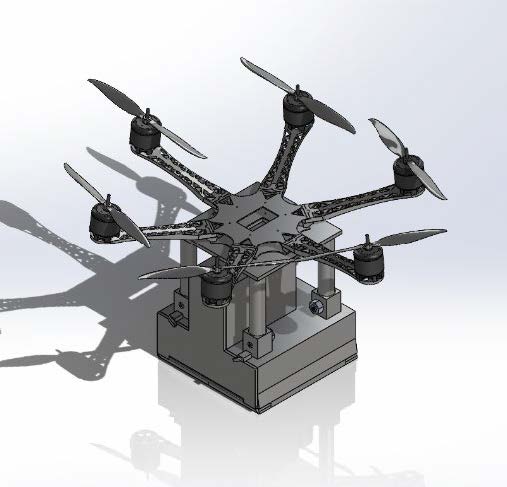
Pizza delivery consists of many cons such as delivery times ranging from 10-45 minutes (depending on traffic) and vehicle emissions which contain greenhouse gases (smog) causing respiratory problems. Traffic relations vary throughout the day, where we can’t determine when traffic happens due to accidents, weather, hazards, and people getting on the road all at once. We believe our project can solve these issues because we are delivering from a UAV drone which reduces emissions and delays of delivery. We’re reducing emissions by using an electric motor compared to a gas motor on a car that’s exponentially bigger. We’re also reducing delivery times since drones can operate quickly and are unaffected by ground traffic and hazards on the road. We believe this is an innovative way since this method of delivery of transportation is barely being introduced and reduces emissions and delivery times.
Wind Wall
Team Members
Catarino Hernandez
Aldo Salazar
Mark Goodson
Alexis Manzanares
Joshua Fongang
Internal Sponsor/Mentor
Dr. Hassan Qandil
Abstract
Renewable energy is becoming a necessity for regions that may not have access to affordable means for powering their basic housing necessities. Without cheap energy, the ability to teach and educate newer generations becomes increasingly difficult as technology becomes increasingly more complex.Conventional means of wind energy, typically brought about through large windmills, require complex and expensive maintenance while solar energy costs too much for some areas to purchase or produce. So how can we develop a renewable energy source to not only produce enough energy for a small home, but to also be affordable to purchase and maintain? With planning and research, we decided to expand on the product known as the Wind Wall. The Wind Wall model has been created in a couple different designs by a few engineers but has not been used on a large scale. The design of a Wind Wall consists of a rectangular frame with multiple rods connected to a motor that holds lightweight blades that will catch the wind and rotate, generating power and energy to a battery or system. The materials used include plywood, PVC pipe, and aluminum so it can be produced in regions that may have limited access to funding. The wall itself can be placed on top of buildings and stacked on top of each other or on the side of a building that receives the most wind shear. The blades of the wall can be shaped in many ways and are implemented to be easily replaceable.