 University of North Texas

Electrical Engineering - Spring
Unmanned Aircraft System Traffic Management
Team Members
MykleChavez (BSEE/Mathematics)
Chris Pacheco Hernandez (BSEE/Mathematics)
Abdullah Al Awad (BSEE/Mathematics)
Trey Nixon (BSEE/Mathematics)
Internal Sponsor/Mentor
Dr. Kamesh Namuduri
Abstract
The increased prevalence of drones has led to an increased need for a system that can show us the location of these drones in airspace. This brings about the need to implement a system that allows us to manage the traffic in this unmanned airspace. The goal of this project is to implement this traffic management system by visualizing simulated drones in a 3D representation of the world. This system needs to be able to take live-simulated telemetry data and plot locations of each drone in a certain area. Considerations for the design include latency in data processing, CPU power, GPU power, development time, and cost.
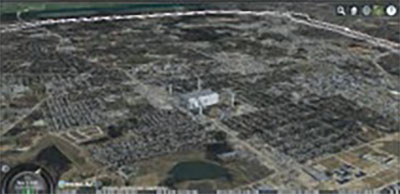
The as-implemented design of our 3D platform included a Cesium HTML file that allowed us to render a 3D Geospatial representation of the world. Our platform utilized JavaScript to create and utilize 3D images onto this 3D space. The telemetry data is collected from Gazebo through PX4 and posted onto the Hermes Server/Database. Telemetry data is then pulled from the Hermes Server/Database into our JavaScript file where it will be used to visualize each drone.
AFTOS: Adaptive Fiducial Tracking Optical System
Team Name
DeepVision
Team Members
Joseph Toney
Ben Schnuck
Paris Fralin
Ross Pulliam
External Sponsor/Mentor
Hari Chandran – Anora Labs
Internal Sponsors/Mentors
Alejandro Olvera – UNT Lab Manager
Robin Pottathuparambil – UNT Faculty Advisor
Rick Pierson – UNT Machine Shop
Abstract
Device testing is a major part of the Semiconductor engineering industry. Quality assurance testing of assembled circuit boards is a time consuming and hands-on process that would benefit from automation to improve throughput and minimize physical board handling. Automation has been difficult in small volume scenarios caused by drift within the system eventually leading to misalignment between the part and the tapered alignment dowels used to accurately place the PCB to the test assembly.
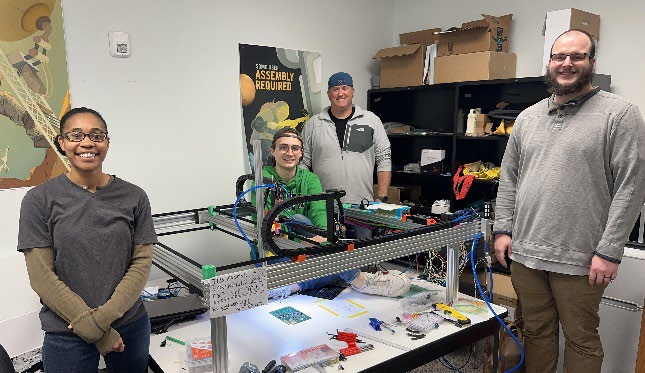
Team DeepVision intends to solve this problem by using an optical tracking system that finds fiducial markings to accomplish precise PCB placement and removal in an automated test bench. The fiducial tracking system will be able to identify the PCB in a staging area ready for pickup, pickup and place the PCB accurately on tapered dowel alignments pins, then remove the PCB from the testing tray and move the part to a post-test location adjacent to the test tray.
Acknowledgments
We would like to specifically thank Dr. Pottathuparambil and Mr. Olvera for their support and encouragement during the design and implementation phases of this project.
Smart Greenhouse
Team Members
Carter Beavers
Paul Elliot
Jose Lugo
Raul Vides
Internal Sponsor/Mentor
Dr. Parthasarathy, Guturu
Abstract
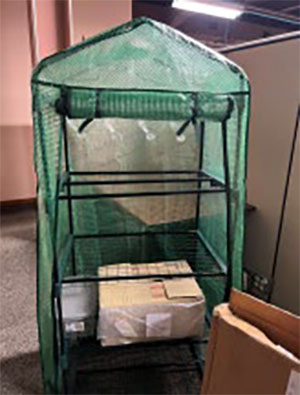
This project’s purpose is to simulate the ability to manage fertilization, moisture, and climate conditions to support the agricultural industry in Texas. Research in farming conditions was implemented to determine how the conditions of Texas’s agricultural industry are and how autonomy is slowly integrating into this field. Our findings show that as electronics evolves, so does its involvement in agriculture. We concluded that to raise awareness for this field, we built a smart greenhouse to show areas that can be utilized with electronics in this industry.
Keywords: Soil, Moisture, Arduino, Raspberry Pi
Small Homogeneous Landing Field Handlers (SHLFH)
Team Members
Kai Campbell
Brian Duarte
Warnakula Jansze
Keaton McGill
External Sponsor/Mentor
National Aeronautics and Space Administration (NASA)
Internal Sponsor/Mentor
Colleen Bailey, Ph.D.
Abstract
The expansion of space travel has heightened the need for safe landing fields. Current landing procedures utilize satellite imaging techniques requiring high resolution cameras and advanced algorithms to collect data. These techniques still lead to issues, as weather conditions can rapidly change slopes and craters on both the moon and Mars, which increase the risk of failed landing.
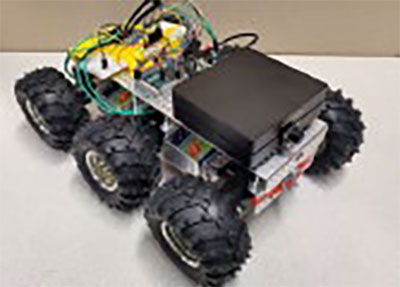
To improve the probability of successful landing, we implemented Small Homogeneous Landing Field Handlers (SHLFH), which are a set of swarm robots utilizing machine learning models to perform autonomous object avoidance and obstacle categorization. These devices were constructed with motor controller, motor driver, power, and ML components on a provided 6WD cart. The SHLFH robots have two operating modes: travel, where the object avoidance ML algorithm is active, and mapping, where object avoidance continues, and images are saved at regular intervals for analysis. These images will have regions classified as sand, soil, bedrock, big rocks, or other via semantic segmentation using a Res-UNET architecture. By analyzing the percentage of each obstacle, the SHLFH devices can indicate the safest landing field.
Object Detection using RoboMaster S1
Team Members
Hae Reh
Andrew Martinez
David Leiva
Internal Sponsor/Mentor
Dr. Kamesh Namuduri
Abstract
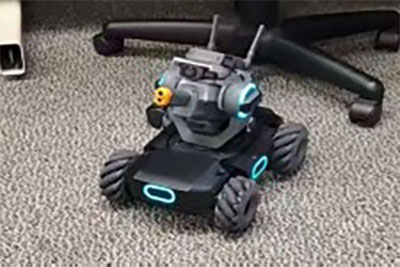
Object detection is an essential task in robotics and computer vision that enables different types of machines, such as robots, to identify and locate objects/persons in an environment. The use of object detection has become more prevalent with the increase usage of AI and machine learning programs. We propose a system to detect objects, people, and symbols using the RoboMasterS1. The design will revolve around using the RoboMasterS1’s mobility and built-in camera to inspect and observe different forms of data within its environment, which will then be processed by the detection program we design. The program will be controlled via a PCB that will be integrated onto the RoboMaster S1.
The proposed system that we would like to employ uses a deep-learning approach based upon convolutional neural networks (CNN) to identify and recognize objects. We do so by using OpenCV and TensorFlow libraries in unison with the RoboMaster’scamera, where the visual data obtained from the camera will be inputted and processed by the libraries in Python. If implemented correctly, the program will be able to make the RoboMastermove autonomously as it inspects and obtains data, searching for the requested subject that is assigned to it.
Home Energy Monitoring System (HEMS)
Team Members
Cody Winchester
Josh Dechert
Gene Scroggins
Internal Sponsor/Mentor
Dr. Elias Kougianos
Abstract
Power is being consumed at an ever-growing rate in the average American household. As the demand for energy grows, so does the demand for ways to actively track and monitor household usage. Our team is designing a system that will aid homeowners and small businesses track electricity consumption and will provide essential data. The price of electricity is rising every year, and when this is paired with inflation, consumers want to save money in any way that they can. Our solution to this demand is a home energy monitoring system (HEMS). Our system also has the potential to help business owners with identifying new avenues for saving. If our product is utilized properly by millions of people, it can save the power grid from being overly taxed during times of crisis. Electricity companies today have a way for the user to see how much electricity they are using, but they only allow them to see limited data. In most cases the information provided by the electric company comes too late to act on or is too difficult to even find for the average consumer. What the user can see varies greatly between energy companies. These companies generally provide the kilowatt value with no way to see how that translates to the real world.
We are developing a unit that will have a display and it will show the users real time data of how much electricity they are using per hour, 12 hours, or 24 hours. They will also be able to see how much money they are being charged for the electricity in dollar amounts. Our product aims to be more proactive than reactive. This is done by giving customers an easy way to see how much their bill will increase or decrease per hour, rather than a delayed response after the bill. This device will also have a cloud feature that will make it accessible from a phone or computer, providing remote information to the customer. This device has scalability with more additions to it and can in the future be used to see exactly how much electricity each machine or device is using in the house. When scaled up to businesses, it can possibly save thousands of dollars a month and prevent an enormous amount of wasted electricity.
Microgrid Load-Shedding Controller (MLSC)
Team Members
Jason Foster
Austin Meyers
Patrick Thompson
Internal Sponsor/Mentor
Dr. King Man Siu
Abstract
In a 2019 report, the U.S. Energy Information Administration (EIA) projects that worldwide energy consumption is expected to grow by nearly 50% between 2020 and 2050. Weather plays a large role in energy consumption in the United States, especially during the winter and summer.
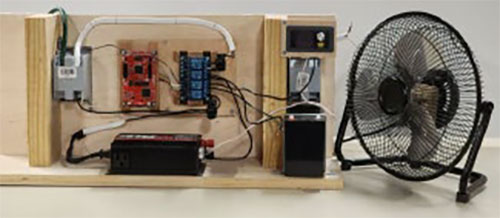
Texas sees its fair share of extreme weather, from hot summer days to cold snaps during the winter. This leads to wide fluctuations in energy demand throughout the day. The Microgrid Load-Shedding Controller (MLSC) is the device we created to address these issues. The goal of the MLSC is to reduce the energy demand on the grid. Our device manages a battery system to supplement power during high-demand hours. Our scaled-down model is designed to supply power for a single household appliance, such as an air conditioner, electric range, or central heating unit.
The MLSC is centered around the MSP432 microcontroller which controls a relay board. This allows the MLSC to select the power source received by the load and when the battery is charged. Using data gathered from the Electric Reliability Council of Texas (ERCOT) and other government sources, we created a daily schedule for the MLSC based on various seasonal days. We chose to construct a scale model that is capable of providing 200W of power.
Our project has provided the opportunity to experience and apply the entire engineering design process to a real-world problem and create a viable solution. The results measured from our prototype can be scaled-up to model the behavior of a full-sized residential installation. Our results show up to a 25% decrease in energy demand during peak hours when using the MLSC.