 University of North Texas

Mechanical Engineering Technology - Spring
Solar-Powered E-Paper Display
Team Name
The Ultimate Sign
Team Members
Reid Davison
Waleed Khan
Fabian Lopez
Matthew Larsen
Kevin John
External Sponsor/Mentor
Mr. John Alexander, DFW Datacom
Dr. King Man Siu, Electrical Engineering Department
Internal Sponsor/Mentor
Dr. Hassan Qandil
Abstract
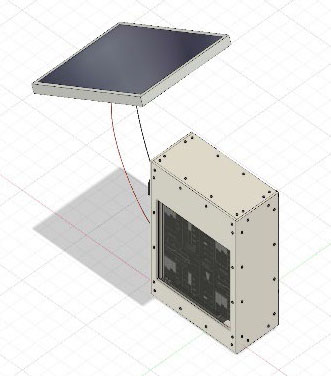
As a team, we were tasked with developing a solar-powered, E-paper display with the goal of it being used as a welcome sign to the neighborhood. The current sign at the entrance was an old wooden letter design and needed a new and innovative idea to bring it into the modern age.
Mr. Alexander’s goal for the project was to create a sign that was new, unique, and self-sustaining. Due to the location of the sign residing in a street median, there would not be any external power being fed to the sign and left us with no other option except solar energy. Mr. Alexander also requested the sign to be visible in direct sunlight for incoming drivers to be able to see. One display type that excels at this is E-paper.
In order to accomplish this task, we chose the Raspberry Pi as our controller for this E-paper display. The Raspberry Pi communicates with the E-paper driver board using a combination of python and C coding languages. The solar power used for this project is managed by a solar controller and necked down to 5V for the battery. From the battery, power is fed to the Raspberry Pi and the E-ink display.
Acknowledgments
Special acknowledgement to Alejandro Restituyofor his assistance writing code for our project.
The Fantastic Light
Team Members
Gregory Bowyer
Cody Hudgens
Mario Romero
Suraj Wagle
Jacob De Sisto
External Sponsor/Mentor
Mr. John Alexander, DFW Datacom
Internal Sponsor/Mentor
Dr. Seifollah Nasrazadani
Abstract
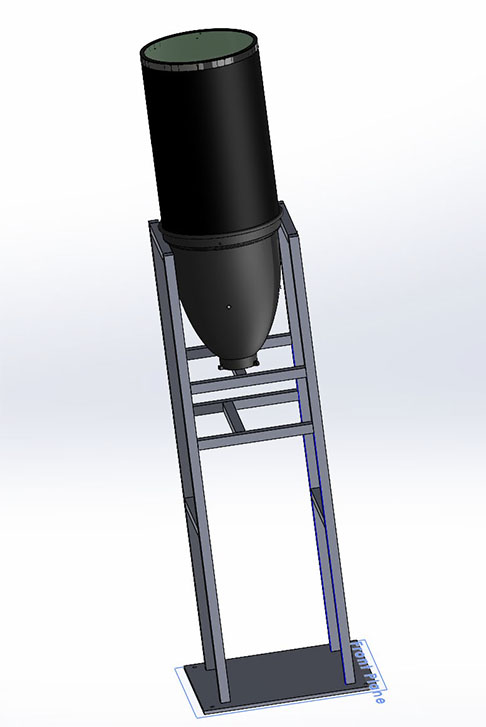
The Fantastic Light project has been in production for two years with the this being the third year. The overall goal of the project has always been to create a university themed spotlight to use at university function and create a unique experience for students. The goals of this iteration of theproject was to help redesign and improve upon previous teams' version of the light rather than build a new one altogether. In our attempt we decided to add an alternative power source in the form of a rechargeable battery, allow for the parts to become detachable for transportation, and overall improve the quality of the light to ensure an increase life span and weatherproofing. These changes will enable the university more options for the light to be used as it will allow the light to be portable, more user friendly, and tolerate unpredictable weather.
The Extrusion Solution
Team Members
Erick Alvarado
James Tiu
David Schwendemann
Armando Berumen
Amrit Singh
External Sponsor/Mentor
Dr. Ravi Sankar Haridas
Internal Sponsors/Mentors
Dr. Hector Siller Carillo
Center for Friction Stir Processing
Abstract
The Extrusion Solution is an innovative project that utilizes Solid-stir extrusion to aid in the development of lunar infrastructure. This cutting-edge manufacturing process leverages frictional heat to plasticize materials, extrude them through a die, and produce complex and high-strength materials with lower external heat and energy consumption.
Using a die alongside a friction-stir machine, aluminum alloy rods can be extruded with ease and efficiency. Given the abundance of aluminum on the lunar surface, this technology has a significant advantage, as it eliminates the need to bring raw materials from Earth to build infrastructure on the moon.
The Extrusion Solution recognizes the potential for continued advancements in the manufacturing process and the friction-stir machine. The project is committed to driving progress and finding solutions to critical problems by pioneering this exciting new approach to material processing.
Acknowledgments
The Extrusion Solution project is part of UNT's "SIMPLE" concept, awarded $180,000 by NASA for developing technology to produce lunar infrastructure.
Universal Tie Down Tool
Team Members
Luis Chabes
Mia Flores
Juan Garcia
Samantha Konen
Eli West
External Sponsor/Mentor
Helena Ranch LLC
Internal Sponsor/Mentor
R.C. ‘Chow’ Yalamanchili
Abstract
The problem with typical ratchet straps is that they must be manually operated and require a decent amount of strength to tighten and release the slack when holding down a load or cargo. In many cases, ratchet straps often get jammed and tangled if not operated correctly and when the tool is used properly, excessive force may be required to release the tension on a strap. With sizes ranging from two to four inches in width of polyester webbing material, these straps must be capable of holding loads of five hundred to thousands of pounds in place. Since the manual components are typically exposed to outside elements, the hand crank along with other mechanisms for the product wear down, rust, and break off easily. The overall goal of designing this tool is to be able to tighten and release ratchet straps to increase the ease of use, safety and reliability while protecting the mechanical parts of the tool. By designing a tool that strays away from the tedious work of ratcheting, the plan is to provide an easier method for a market of consumers that would prefer to save time and effort when having to load and secure cargo.
Regenerable Liquid Desiccants for High-Efficiency Humidity Control In Microgravity
Team Members
Gerardo Castro
Laura Barbé
Martin Vu
Josh Joblin
Jeffery Asencio
External Sponsors/Mentors
Dr. Cable Kurwitz - Texas A&M
Grace Belancik - NASA
Internal Sponsors/Mentors
Dr. Huseyin Bostanci
Alexander Sarvadi
Chirag Byanjanker
Abstract
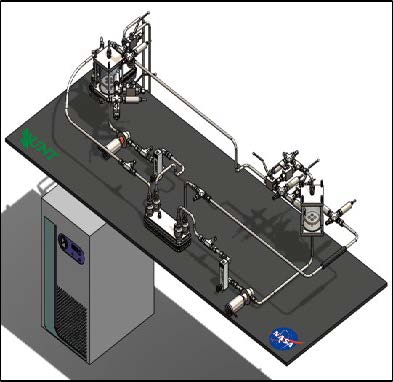
When looking into deep space ravel, new equipment is needed to make sure that breathable oxygen can be regenerated long-term. To assist with this new technology, dehumidification is necessary before the removal of CO2. Our system incorporates two vortex phase separators (VPS) that run synchronously, with a regenerable liquid desiccant to remove the moisture from the cabin air. The desiccant will of course need to be safe for the astronauts. Since there is no gravity in space, there must be a way for the desiccant to remove the moisture and that is where the VPS system comes in. The VPS systems will mix the liquid desiccant with cabin air to draw the moisture out. Once the humidity in the air is lowered from the first VPS it connects to a CO2 removal system. After that, the system will send the liquid desiccant through other systems in the spacecraft to assist with energy efficiency. When the desiccant returns to our system, a second VPS removes the moisture from the desiccant and put it back in the cabin air. The system is meant to run continuously and with low maintenance. This process theoretically will facilitate the solution for long-term air revitalization.
DFW Hotshot Ranger (Suspension)

Team Members
Daniel Arce III
Javier Buendia
Enan Garcia
Emiliano Madrid
Charter Mitchell
James Rateliff
External Sponsor/Mentor
DFW Hotshot Inc.
Internal Sponsors/Mentors
Dr. Hector Siller
Daniel Arce III
Abstract
The goal of our project was to design and manufacture front control arms 5 inches wider than the OEM arms from Ford. There are currently no companies offering a +5” suspension kit for the current gen Ford Ranger. The kit allows for more total travel and the ability to be taken off-road with speed on rough terrain while also being tolerable under daily use on the road. The team oversaw the manufacturing process from beginning to end, in house at the University of North Texas.
DFW Hotshot Ranger (Chassis)

Team Members
James Hale
Parker Smith
Zachary Kephart
Jesus Ivan Ramirez
Stone Coston
External Sponsor/Mentor
DFW Hotshot Inc.
Internal Sponsors/Mentors
Dr. Hector Siller
Daniel Arce III
Abstract
The goal of our project is to design and manufacture an off-road capable street truck using a 2019 Ford Ranger. This project will specifically focus on constructing a full bed cage, while following a set of criteria, for the sake of increasing the safety of the user in the occurrence of an accident. While creating a functional bed cage that will secure the components of the truck when used off-road.
As a design specification, the cage needs to be able to fit in the bed with the tailgate upto keepthe usability as close to the original. Two additional requirements for the project include creating areas to hard mount two spare tires to the cage and to create a space to mount and protect a fuel cell in the bed. As an aesthetic detail, the two spare wheels mounted to the cage would be preferred to be placed vertically on the tailgate to improve the overall look of the build.
Acknowledgments
For the guidance and abilities offered, we would like to thank:
Dr. Siller, Daniel Arce III, DFW Hotshot Inc, Rick Pearson.
Locking Anti-Tamper Handwheel
Team Members
Brandon Bosch
William Dalrymple
Dylan Coleman
EdricAn
DarryanClark
External Sponsor/Mentor
Mr. Jason Wipf, MasterFlo
Internal Sponsor/Mentor
Dr. Huseyin Bostanci
Abstract
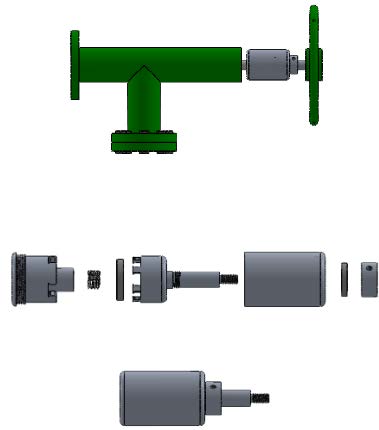
The goal of this project was to create an anti-tamper hand wheel for H2 choke valves for our sponsor Masterfloto help solve the problem of unauthorized use of the valve from humans, animals or other external factors. The design criteria included a design that would be easy to operate without the need for specialty tools or keys while still being able to prevent external forces and other people from tampering with the valve. Secondary requirements included making the design cost effective to produce and be able to withstand the elements like rust and corrosion. Multiple designs were created and the clutch based system that was an add on to existing valves was chosen for ease of use while making it more difficult to unintentionally turn the valve or allow unauthorized users to use the valve. This design also helped with creating a broader customer base with the ability to work with new and existing valves while making it a replaceable part to minimize downtime for businesses. The clutch based device was later improved with a dovetail locking mechanism for easier operation and manufacturing and the use of stainless steel for better corrosion resistance.
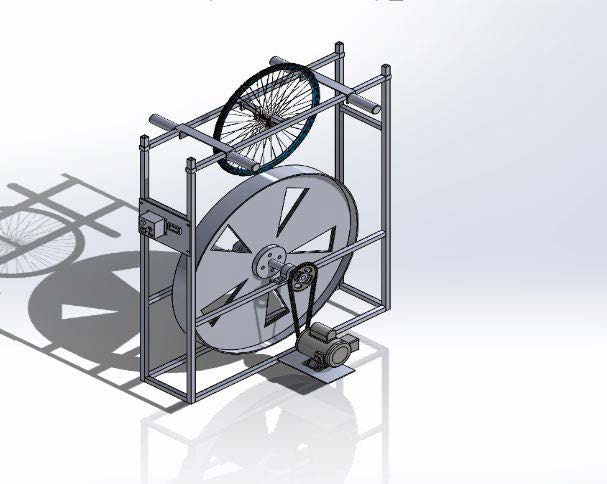
Cycle Tire Testing Machine
Team Members
Nathan Palmer
Seth Dunnam
Samuel Hernandez
Erick Garcia
External Sponsor/Mentor
Mr. Jason Wipf, MasterFlo
Internal Sponsor/Mentor
Dr. Hassan Qandil
Abstract
The project sponsor, MasterFlo, tasked the team with building a cycle tire testing machine. Bicycle riders always seek to maximize speed for competitions or physical performance goals. To reach this goal it is necessary to find tires that provide the most efficiency which happen to be tires with the least rolling resistance. The tire rolling resistance is the energy a bicycle rider needs to maintain movement at a consistent speed over a surface or the effort required to keep a tire rolling. The higher the energy to keep the tire rolling, the more energy a bicycle rider will burn. The cycle tire testing machine is designed to calculate the tire rolling resistance so that it helps bicycle riders get the information needed make an informed decision when choosing the tire that provides the most efficiency. The cycle tire testing machine considers additional variables that potentially affect rolling resistance on tires such as tire pressure, rider weight, and variation of speed when calculating the rolling resistance of the tire.
FSAE Drivetrain
Team Members
Cody Gauthier
Christopher Diaz
Ethan Sanders
Joseph Nowak
KeilanKorfanty
Pratap Poudel
Internal Sponsors/Mentors
Dr. Hector R. Siller
Mechanical Engineering Department
Abstract
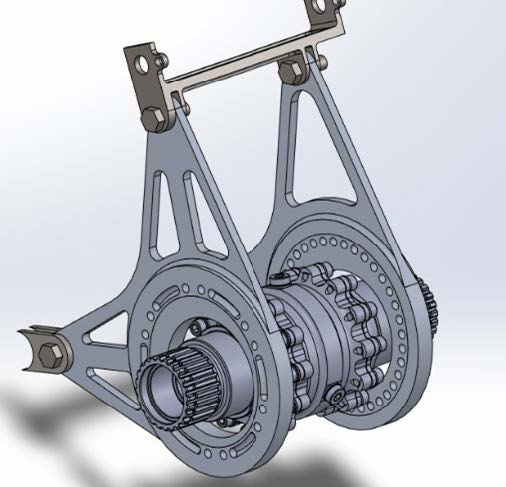
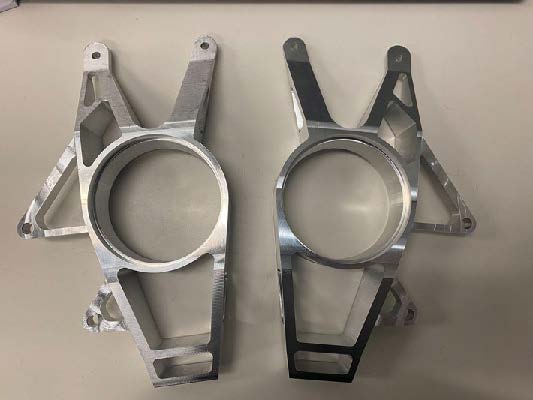
For the 2023 season, the Formula SAE team decided to redesign the drivetrain due to shortcomings during the 2022 competition. The redesign includes creating an eccentric differential package and a completely new design of the uprights to support onboard brakes in the rear. The new differential package will save weight, while allowing for better alignment and faster tensioning of the drive chain. Because of this new differential mount, the inboard mounted rear brake had to be moved from the differential itself, to be mounted on the rear uprights. In the design of the uprights, topology studies were used to identify the most optimal shape, then modeled a new part based on that study so that the design is machinable using 3 axis mills. The new uprights have been designed to make the entirety of the assembly lighter, installation easier, and fit the constraints of outboard brakes. All parts designed are manufactured using a HAAS VF-2 and machined out of aircraft grade 7075-T6 Aluminum by students in the Mechanical Engineering department’s machine shop.
Solar Car Structural Chassis
Team Members
Kian Adedeji
Megan Paige
Dawson Riethmayer
Hammad Almutib
Gana Hedato
External Sponsor/Mentor
Schneider Electric
Internal Sponsors/Mentors
Dr. Xiaohua Li
Mechanical Engineering Department
Abstract
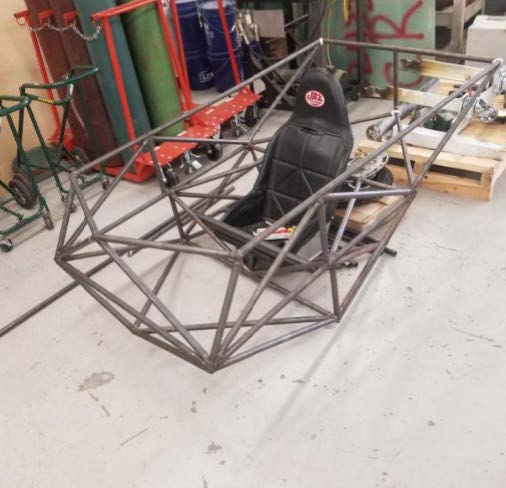
The objective of this project is to build a solar car structural chassis to attach to the solar car. The team is asked to create a structural chassis for a road-legal, solar-powered car for the Formula Sun Grand Prix Race.
There are multiple regulations needed to adhere to for the structural chassis which includes safety and the certain loads this chassis must withstand. This project’s mission is to show that solar powered cars could be the next car of the future by trying to prove they can drive long term, can adhere to any safety regulations/loads given, and are environmentally safe.
This is an innovative project that could potentially serve car companies/manufactures to start looking into a future of solar-powered cars.
Solar Car Suspension

Team Members
Samuel Pitts
Alexander Salinas
Quentin Icenogle
Kevin Dao
Edwin Onofre
Internal Sponsors/Mentors
Dr. Xiaohua Li
Mechanical Engineering Department
Abstract
The objective of this project is to design a suspension system for a Solar Car to meet the 2023 Formula Sun Grand Prix regulations. The system will need to handle the expected weight of the vehicle including the driver, as well as give a certain level of stability during dynamic tests. The vehicle must be able to perform a 6-meter turning radius without exceeding the 11-meter total radius. The layout for a slalom test is a 126-meter-long course with eight cones that are 18 meters apart and the main objective is to have the vehicle finish the course by weaving, without touching, in and out of the cones. It also must be ensured the design is compact and would not cause the wheel to rub against the body at any point in time.
Ergonomic Redesign of FSAE Components Using Carbon Fiber Fabrication
Team Members
Sunny Downs
Marta Gonzalez
Thomas Aaron
Natalie Torres
Kolby Cupps
Internal Sponsors/Mentors
Dr. Lee Smith
Mechanical Engineering Department
Abstract
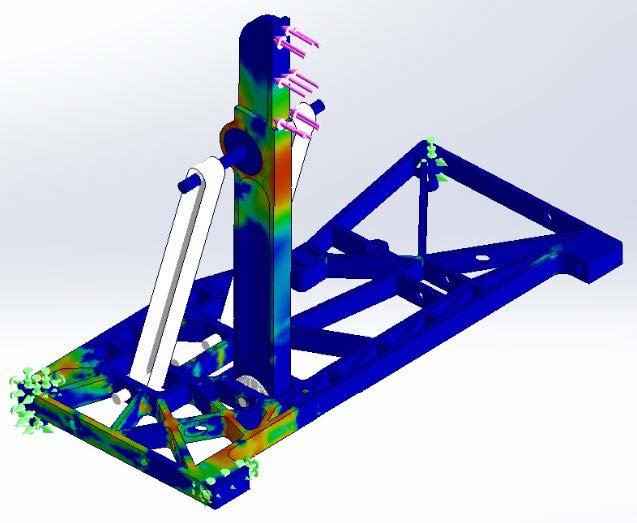
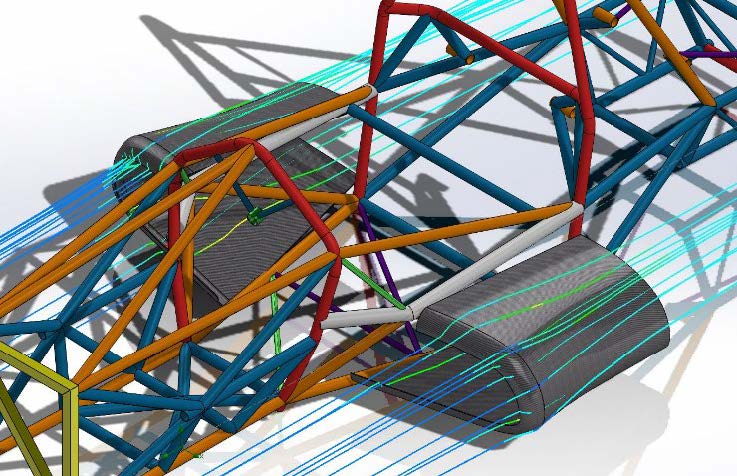
UNT’s Formula Society of Automotive Engineers (FSAE) team proposed a project for a complete ergonomic redesign to optimize components and reduce the overall weight of their 2023 race car. All FSAE rules and regulations were met while using the engineering knowledge and skills imparted by UNT to improve the designs of components including the pedal box, steering column, steering wheel, shifting linkages, closeout panels, nose cone, and side pods to obtain the maximum performance of the vehicle. Previously, these parts were manufactured from aluminum, steel, or fiberglass, and were uncomfortable and difficult for the driver to interact with. To correct these issues and assist all other subsystems in their shared goal of weight savings, this project aimed to redesign ergonomic components to be as lightweight, structurally sound, easily adjustable, safe, and driver friendly as possible. This was accomplished by creating multiple iterations of each component, analyzing, and updating the designs in SolidWorks until fully optimized. All machining and fabrication of parts was performed by students in UNT’s Mechanical Engineering Department.
4-Bar Rocker Suspension Drivetrain

Team Members
Yedhartha Sai Chinnasani
Dean Akins
Manfred Rebello
Steve Tipton
Keaton Spilker
Internal Sponsors/Mentors
Dr. Hamid Sadat
Mechanical Engineering Department
Abstract
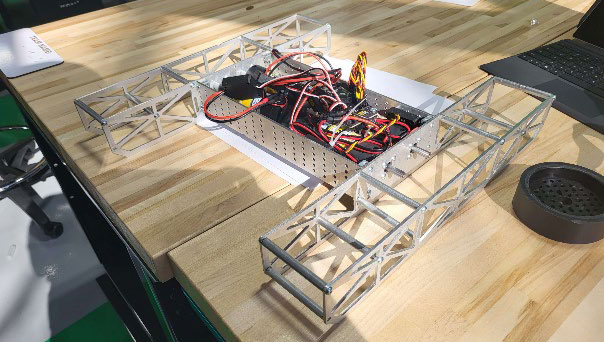
The 4-Bar Suspension Drivetrain is a manually operated, remote-controlled robot with a modular drivetrain, allowing for better user control across various terrains and climates. The highlight of our design is the dynamic four-bar suspension that allows for suspension in the Z-axis, and the ability to change out wheels, hence the modularity of our design. Our end goal is to produce our design for public service agencies to be used in hazardous situations.