 University of North Texas

Computer Engineering - Spring
Off Grid Eyes
Team Name
The Maker
Team Members
Rosas Alberto
Arreola Lopez Javier
John Wilson Raj Judith
External Sponsor/Mentor
Dan Combe
Internal Sponsors/Mentors
Dr. Robin Pottathuparambil
Alejandro Olvera
Abstract
The average farm in America is 445 acres ( about 0.6953 square miles). Farms continue to grow and with the growth in size the issue of security grows as well. Farmers and ranchers cannot monitor their entire property and the goal of the project is to help alleviate that pressure with hope of it being useable in both rural and urban settings. This will be done by the device having motion detection system paired with a camera in order to immediately inform the owner of an intrusion/extrusion on their property fence lines. Additional information will be gathered to help inform the owner of things such as direction of intrusion, weather status, and ability to power on/off their electrical fence lines.
Light-Fidelity System (Li-FiS)
Team Name
Mellowship
Team Members
Abtin Ortgoli
Conor Vanek
Daniel Carrillo
Vinh Trinh
External Sponsors/Mentors
George Salazar
Dr. Tim Urban
Internal Sponsors/Mentors
Dr. Robin Pottathuparambil
Alejandro Olvera
Abstract
There is only so far that we can push the limits of any technology. Unlike Wi-Fi and traditional radio frequency communication, Li-Fi uses visible light to transmit and communicate, which theoretically can reach much higher speeds using wireless communication. Li-Fi also can have a higher security and lower interference compared to radio frequencies since light can not pass through opaque surfaces.
This technology can be a viable choice to use on the future space missions as it has no electromagnetic interference issues, and the data speeds can reach much higher since light has a higher frequency than radio waves. We accomplished this by using an LED and a photodiode to detect visible light and send bits of information between two system. By taking into the count of the rise and fall of the photodiode we can adjust the speed of communication accordingly. In this case two Raspberry Pi (Transmitter and Receiver) controllers that are communicating to control different sensors and devices. All the devices that connected to both controllers are working independently from each other so inputs or critical sensor values will not be missed. Both controllers has GUI and touch screens to be a user-friendly platform.
What makes this technology is so innovative is the fact that we can use any visible light source and LED all around us as ways of communication. This technology has the potential to revolutionize the future of communication.
Acknowledgments
Special thanks to Dr. Robin and NASA TSGC for their hospitality!
AFTOS: Adaptive Fiducial Tracking Optical System
Team Name
DeepVision
Team Members
Joseph Toney
Ben Schnuck
Paris Fralin
Ross Pulliam
External Sponsor/Mentor
Hari Chandran – Anora Labs
Internal Sponsors/Mentors
Alejandro Olvera – UNT Lab Manager
Robin Pottathuparambil – UNT Faculty Advisor
Rick Pierson – UNT Machine Shop
Abstract
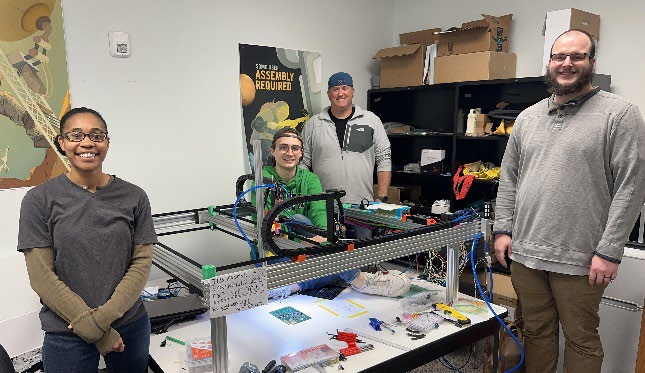
Device testing is a major part of the Semiconductor engineering industry. Quality assurance testing of assembled circuit boards is a time consuming and hands-on process that would benefit from automation to improve throughput and minimize physical board handling. Automation has been difficult in small volume scenarios caused by drift within the system eventually leading to misalignment between the part and the tapered alignment dowels used to accurately place the PCB to the test assembly.
Team DeepVision intends to solve this problem by using an optical tracking system that finds fiducial markings to accomplish precise PCB placement and removal in an automated test bench. The fiducial tracking system will be able to identify the PCB in a staging area ready for pickup, pickup and place the PCB accurately on tapered dowel alignments pins, then remove the PCB from the testing tray and move the part to a post-test location adjacent to the test tray.
Acknowledgments
We would like to specifically thank Dr. Pottathuparambil and Mr. Olvera for their support and encouragement during the design and implementation phases of this project.
Forest Fire Detection System
Team Name
Quad Core Crew
Team Members
Matthew Wilson
Edwin Hernandez
Luis Guevara
Lluviana Vasquez
External Sponsor/Mentor
FIl J. Cosentino
Internal Sponsors/Mentors
Dr. Robin Pottathuparambil
Alejandro Olvera
Abstract
The problem we aim to solve is the early detection and prevention of wildfires, which have become increasingly destructive worldwide. These fires pose a significant threat to natural habitats, wildlife, property, and human lives, while also causing substantial financial burdens. By enabling early detection, the Wildfire Detection System assists firefighting teams and communities in quickly responding to and containing fires before they escalate into large-scale disasters.
The Wildfire Detection System is unique and innovative because it leverages a combination of off-the-shelf technologies, including ionization and photoelectric smoke detectors, temperature sensors, and wireless telemetry. This approach provides a cost-effective solution to proactively monitor fire-prone areas, ultimately protecting the environment, property, and lives by enabling a rapid response to emerging fires.
Home Smart Hub
Team Name
Fantastic 4
Team Members
Rakinder Sanghera
Gianna Schneider
Macs Stewart
John Goodrich
Internal Sponsor/Mentor
Dr. Pradhumna Shrestha
Abstract
Many of us want to monitor and remotely control devices in our home like lights, TVs, garage door, etc. However, upgrading all of them to make them smart is too expensive So, we are creating a Smart hub to connect “dumb” devices. This hub is also a source of power and plugs into the wall. To make this possible, our system as an app to offer the user an easy interface to interact with, a hardware component that connects into the wall,and data hosted on a server for communication between the apo and the hardware. The tools used in our design include AWS (DynamoDB, IOT Core, and AWS lambda), Android Studios to create the mobile application, Arduino Microcontroller and PCB Devices.
Assisted Living Smart Home
Team Name
The Senior Citizens
Team Members
Philip “Cort” Rhodes
Bradley Lewellyn
Tristan Makarwich
Christopher Wong
Internal Sponsors/Mentors
Professor Pradhumna Shrestha, PhD
Alejandro Olvera
Abstract
As the elderly population continues to grow, there is a pressing need for innovative solutions that can help seniors stay healthy and maintain their independence. To address this need, we developed an assisted living smart home and portal that leverages wearable technology, a mobile application, and smart pill device to monitor the health and well-being of senior citizens. Our system consists of a smart watch worn by the patient that tracks heart rate, GPS location, and accelerometer data for fall detection.
In addition, we developed a smart pill bottle that tracks medication usage and alerts the caregiver if a dose is missed. Through extensive testing and evaluation, we demonstrated that our system can provide a reliable and effective means of monitoring senior citizens and ensuring their safety and well-being. Our work has the potential to significantly improve the quality of life for elderly individuals and their caregivers, and represents an important step forward in the development of innovative technologies in caregiving.
Acknowledgments
Special thanks to Dr. Pradhumna Shrestha for helping us to continually develop our ideas throughout the entire project. Working with him helped us to see things from an outside perspective and we could not have accomplished our project goals without him. We greatly appreciate his assistance and knowledge.
Smart Farmer
Team Name
Singularity
Team Members
Matthew Bradley
Eric Teo
Sarah Alsalim
Nwachukwu Odumegwu-Ojukwu
Internal Sponsors/Mentors
Dr. Pradhumna Shrestha
Alejandro Olvera
Abstract
In the current agricultural landscape, it is difficult to measure and keep track of a crop’s health and well-being in a maintainable and efficient manner. Additionally, when multiple factors of the crop’s health are measured, it is difficult to make sense of all the data unless you are a trained professional.
With our Smart Farmer, we aim to solve both of those issues to make farming a more efficient and maintainable endeavor. Our product will allow for farmers to install nodes into their existing crops so that they don’t have to manually monitor the health of their plants. A user-controlled data-collection robot powered by a microcontroller expedites the process of retrieving data from the crops. The robot simply has to go near the nodes to establish a connection, which allows access to the crop data. The robot then uploads this data to a database where it can be retrieved by a user-friendly app. This app will display the crop data and photographs to the user, in addition to providing analytics regarding the health of the plants.
Acknowledgments
Special thanks to Dr. Pradhumna Shrestha and Alejandro Olvera for their support and guidance throughout the creation of this project.
Smart Door
Team Name
Spider
Team Members
Bikash Shah
Asim Timsina
Rohan Lamichhane
Leslie Delval
Internal Sponsor/Mentor
Dr. Pradhumna Shrestha
Abstract
Our senior design project aimed to develop a Smart Door system that enhances security and convenience. The system uses facial recognition, one-time generated QR codes, and a mobile app for access. The facial recognition, developed by AWS, uses deep learning algorithms trained on a dataset of faces to accurately identify authorized users. The QR code generation uses secure cryptographic algorithms to generate unique, time-limited codes.
The mobile app interface provides a user-friendly way to manage access rights, monitor the door's status, and receive notifications. The app also integrates with the facial recognition system to enroll new faces and manage profiles. Testing showed high accuracy and reliability, providing an additional layer of security and user convenience. The Smart Door system has potential for residential, commercial, and industrial settings.
Smart Farmer
Team Name
The Eagles
Team Members
Hessah Almufleh
David Gasca
Ruvail Shahzad
Internal Sponsors/Mentors
Dr. Pradhumna Shrestha
Alejandro Olvera
Abstract
Plants provide over 80% of the food consumed by humans and are the primary source of nutrition for livestock. However , 14.1% of crop loss is due to plant disease which is estimated to cost 220 billion USD annually. Also, nutrient deficiencies cause chronic disease in plants. So, plant growth is slowed and susceptibility to disease is increased.
Our project intends to improve crop health as well as increase efficiency and accuracy since we’ll be able to measure plant nutrients and notify the farmer if the plant needs immediate attention. This project is aimed at automating tasks that the farmer would usually have to do manually. It will monitor the crops health remotely, saving the farmer time and money. Automation in turn will increase the production of the farm by limiting the field’s losses in bad harvests. While our project is done at a smaller scale, we believe that if done at a bigger scale, it would reduce operational cost since the time, labor, and resources that requires farmers to monitor their plants’ health will all be done using this system.
Heatmap Monitoring and Alert
Team Name
Titan
Team Members
Kedrick Levy
Christopher Flint
Nick Sundara
Shan Phu Lang Thang
Internal Sponsors/Mentors
Dr. Pradhumna Shrestha
Alejandro Olvera
Abstract
Checking the temperatures of individuals in public buildings or spaces with heavy traffic can be a challenge, as it is largely inefficient and time-consuming to check each person one by one.
The goal of this project is to create an automated system to overcome this challenge, where each monitoring system is setup in areas with heavy traffic. By utilizing a thermal camera and sensors, the system can quickly and accurately check the temperature of multiple individuals at once and alert the proper personnel via SMS if intervention is required.
This type of system could be particularly useful in settings such as airports, shopping malls, or office spaces.
Overall, the development of an automated heatmap monitoring and alert system could improve public health and safety by making it easier to detect any thermal symptoms.