 University of North Texas

Materials Science and Engineering
Laser
Team Members
Martin Smith
Daniel Genthe
Sponsors
Josh Ballard
Dr. Nigel Shepherd
Abstract
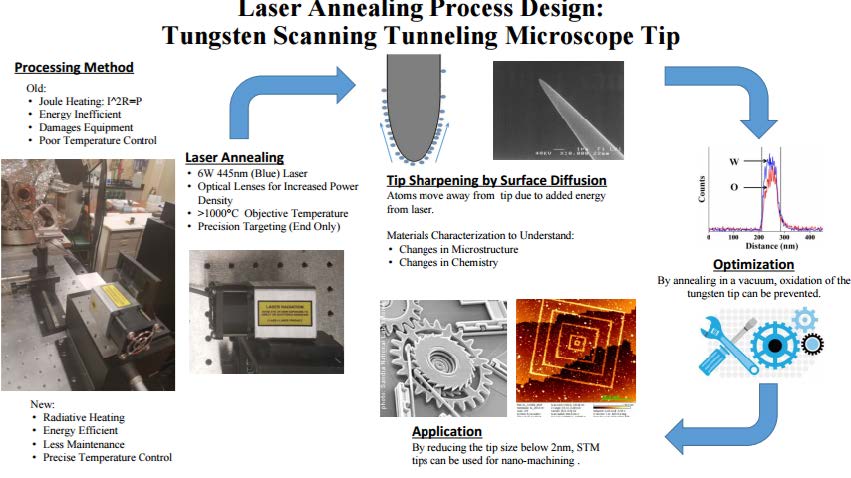
As manufacturers continue to pursue higher levels of quality and develop ever smaller products needs manufacturing methods are needed. The STM is at the head of nano-machining and the cost and quality of STM tips a limiting factor in its use. We've developed a process of laser annealing tungsten wire for the purpose of sharpening STM tips. This method will provide greater control and be more efficient over the current annealing method allowing the technology to advanced and mature.
Acknowledgements
CART, Zyvex Labs
Young's Modulus
Team Members
Avery Young
Tyler Torgerson
Keirsten Tafoya
Sponsors
Dr. Othmane Benafan
Dr. Marcus L. Young
Abstract
A new NiTiSn low temperature shape memory alloy (SMA) has been designed to be implemented as an actuator for a deep space expandable habitat. This material shows potential to: 1) reduce the mass and cost, 2) increase the reliability and functionality of actuation devices in deep space conditions. Throughout this design process the site preference and solubility of Sn in NiTi was evaluated. The effects of Sn content, NiTi ratio, and precipitation strengthening on transformation temperature, phase composition, and mechanical properties in the NiTiSn SMA system were also assessed.
Self-Healing Ceramics
Team Members
Haley Barnes
Jordan Reed
Caitlin Huntley
Larissa Ulbrich
Sponsors
Dr. Samir Aouadi
Dr. Diana Berman
Abstract
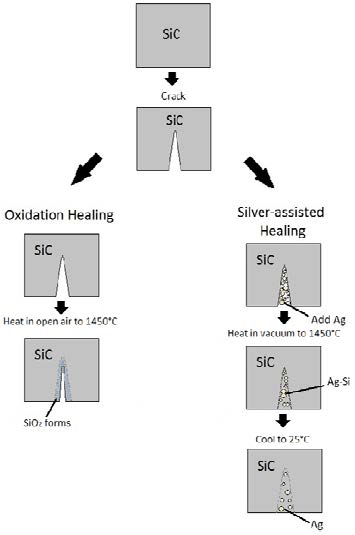
Ceramics are easily susceptible to fracture due to their ability to create and propagate a crack under stress with little ability to blunt the crack. This creates immense environmental, health, and economic burden when ceramic applications, such as nuclear fuel cell cladding, fail, causing complete replacement of structure. In our design, we compared the self-healing methods of oxidation healing and silver-assisted healing of silicon carbide.
SiC was chosen for its ability to readily oxidize in open air furnaces and its ability to react with silver in the proposed self-healing method. At high temperatures, silver binds with silicon creating a liquid matrix that causes a quicker diffusion rate of the whole system. Consequently, this heals the crack by filling itself in through reduced interfacial tension between the silver-silicon matrix and the silicon-carbide matrix. As the system cools, silver will evaporate leaving silicon carbide to reform crack-free.
Acknowledgements
Special thanks to the Saul Sepulveda for our CART training, David Garrett for helping us with furnace set-up, Jianchao Li, Ph.D. for helping us sputter our samples.
Degradation Resistant High Entropy Alloys for Biomedical Applications
Team Members
Richard Clore
Rudy Arce
Colin Pinell
Sponsor
Sundeep Mukherjee
Abstract
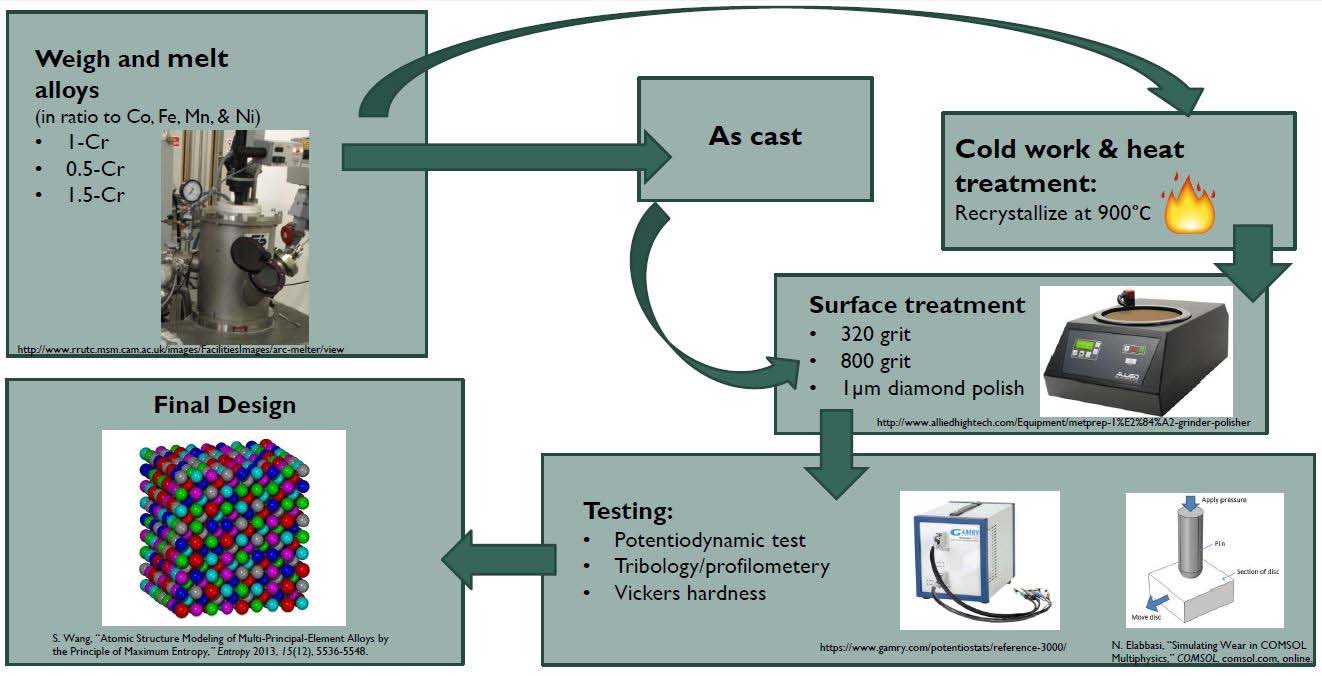
High entropy alloys (HEA s) have been shown to have good corrosion and wear resistances, making them candidates for applications in medical implants. The corrosion and wear properties of three different compositions of a CoCrFeMnNi alloy, with varying amounts of chromium were tested. Different surface roughnesses and as-cast or cold worked and recrystallized variations of each alloy were also tested in order to design a CoCrFeMnNi alloy that maximizes corrosive and wear properties.
Acknowledgements
The authors would like to express thanks to Dr. Sundeep Mukherjee, Dr. Nigel Shepherd, and all of the UNT Materials Science and Engineering faculty and staff for their advice and guidance on this project. The authors also gratefully acknowledge the University of North Texas for financial support of this project.
Recycling PVC for Metal Wires and Cables Coat
Team Members
Brittany Sanchez Luyue Wang
Grant Johnson
Sponsor
Witold Brostow
Abstract
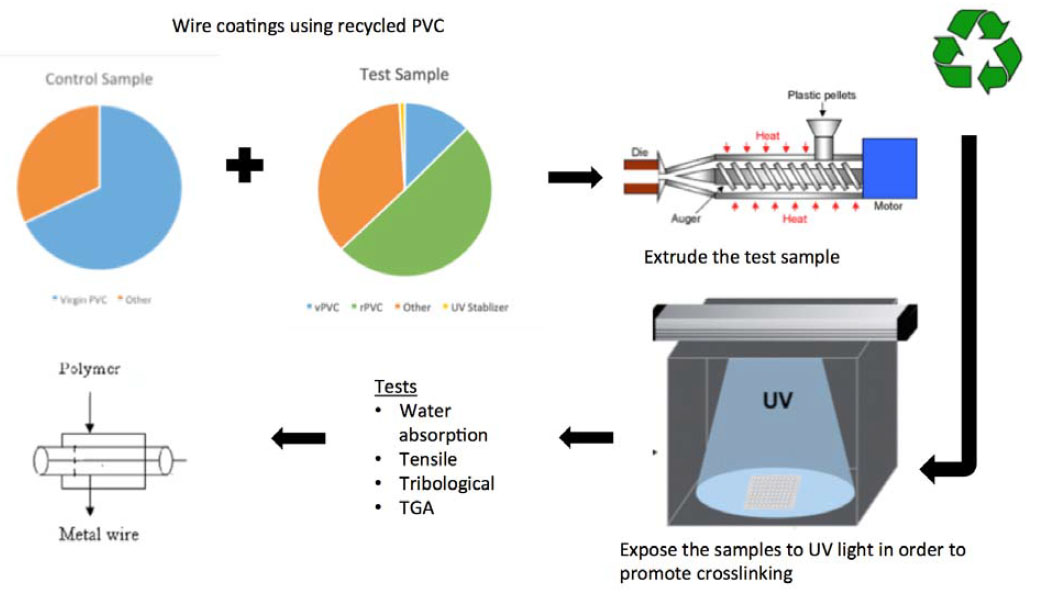
Polyvinyl chloride (PVC) is one of the most used polymers in industry. There is an environmental contamination problem because as PVC degrades in landfills it releases toxic chemicals into the soil. We have incorporated recycled PVC into the electrical wire coating formula in order to reuse the material. We have found that by adding crosslinking agents and UV stabilizers to the recycled PVC mixture we have mitigated the deterioration of properties including tensile strength and the elongation at break. The best set of properties is seen in the 80% recycled PVC as it offers the best elongation properties which are important to the application since wire coatings must be able to bend without snapping and exposing the wire underneath. With the addition of recycled material the overall cost of the wire coating will be lower than using virgin PVC only while the rate of putting PVC waste into landfills would be mitigated.
Acknowledgements
The authors would like to recognize the contributions of Dr. Witold Brostow, Nathalie Hnatchuk, Gregory Granowski, Mark Yang, and Ethan Zhang and the Encore Wire Corporation
Team Aqua
Team Members
Dominic Ortega
Hunter Oltman
Yaotian Yang
Kara Scanlon
Sponsor
Rick Reidy
Abstract
A design has been proposed to detect degradation within a fiberglass pipe using an acoustic transducer. The transducer will find defects as an early warning to catastrophic failure. The acoustic transducer is contact based and is fed a voltage from a pulse generator to emit a wave and sends a signal to an oscilloscope from an interface reflected wave. Measurments will be periodically taken to document defect progression.
Acknowledgements
Dr. Rick Reidy, Dr. Nigel Shepherd, Gail Kreuger, Ashley Parsons, David Garrett, Tracy Lynch and Kurt Weih