 University of North Texas

Electrical Engineering
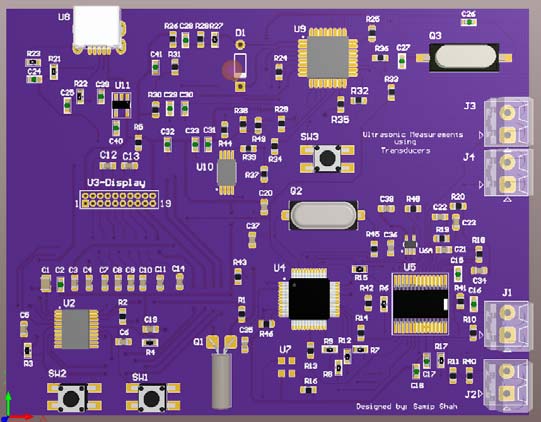
Ultrasonic Measurements Using Transducers
Team Name
Ultrasonic Measurements using Transducers
Team Members
Samip Shah
Branson Haberkorn
Sponsor
Li Xinrong
Abstract
Ultrasound has been around since 1794, when Lazzaro Spallanzani, a physiologist studying ultrasound physics, reveled that bats used ultrasound to navigate by echolocation. Ultrasound is defined as any sound greater than human hearing in the range of 30 KHz to 10 MHz. Our design operates using a piezoelectric transducer which creates an electromagnetic pulse into a medium that is created from an electrical pulse exciting the transducer. That pulse then moves through the medium until it reaches an acoustic boundary. An acoustic boundary is determined by a difference in two mediums with two different speeds of sound. At that boundary, some energy will pass through and some energy will not. The energy that does not pass through is reflected back towards the transducer. The transducer then detects that echo and turns it back into an electrical signal.
This product is designed for gas, oil and chemical industries. The below figure shows how portable our design is and how it can be used to sense level, flow, and concentration of the fluids. The design uses two microcontrollers, one analog front end chip to detect fluid level, one USB port for sending/receiving data and to power the board, and one display that shows how much liquid is inside the tank. This portable Launchpad will help multiple industries detect fluid inside their tanks. This solution is safe, portable and environmentally friendly.
Acknowledgements
Dr. Li Xinrong
Dr. Murali Varanasi
Digital Door Scope for Home Security
Team Members
Dasan Washburn
Amber Henderson
Sponsors
Dr. Kamesh Namuduri
Abstract
Modern home security has the advantage of being built upon older established technologies and methodologies, as well as, having access to a plethora of new digital and wireless advancements. However, full featured commercial security implementations remain costly for those in low income areas who need it most; and low-to-medium budget implementations are lacking in relatively basic and common sense features. This project explores taking one such medium budget implementation, the Digital Door Scope (or digital peephole viewer), constructing a smart enhanced version as a do-it-yourself project, and evaluating the commercial feasibility of refining the prototype for mass market production.
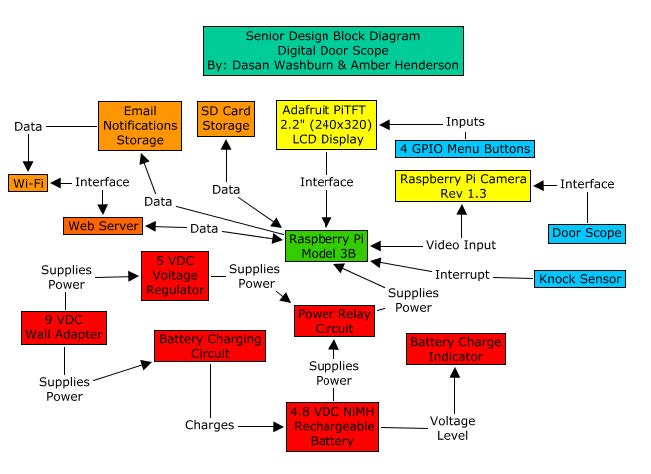
In order to avoid reinventing the wheel, the Raspberry Pi 3 Model B with a Pi Camera and an Adafruit PiTFT 2.2 (240x320) LCD display is used. The controller programming is done in Python 3 and utilizes the Tkinter and OpenCV libraries. Internal and external storage options are available to store image files. Two interfaces are available to configure and operate the device, a GUI physically operated from the Raspberry Pi and a website accessible through Wi-Fi. A custom circuit will automatically switch between wall power and a rechargeable battery, provide knock sensor input, and indicate battery charge levels.
Acknowledgements
Dr. Kamesh Namuduri, Dr. Murali Varanasi, Mohit Vaswani, Raspberry Pi Foundation, Python Software Foundation, OpenCV Team, XYZprinting, Mouser Electronics, Adafruit Industries, Tanner Electronics
Effectiveness of Low Wind Tturbines and Photovoltaic Panels for Servicein Denton
Team Members
Ian Hunt
Ore Afolayan
Eric Hanf
Natalie Powers
Evin Alarilla
Sponsor
Miguel Acevedo
Abstract
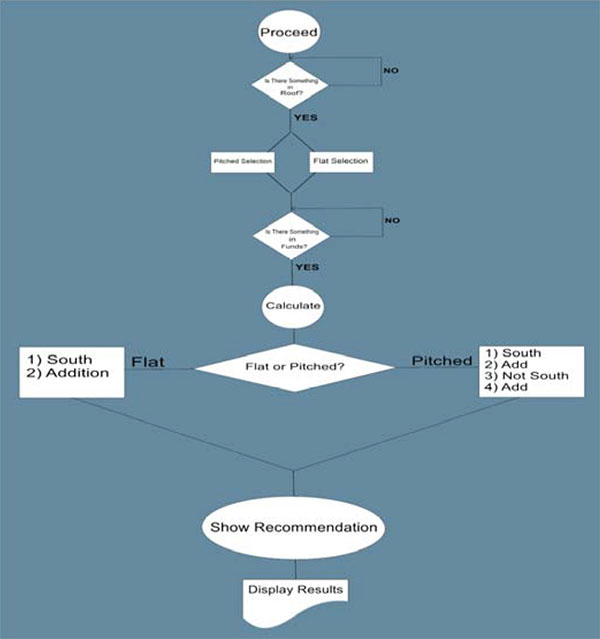
Renewable power in Denton, TX consists primarily of roof-mounted photovoltaic (PV) panel systems. Our research project aims to provide information to residents and businesses within Denton regarding PV panels to aide in their adoption of renewable power. We packaged data from actual PV panel installs within Denton, including system cost and generation, into a MATLAB program. Given information about an installation site, the program can determine its viability; the program is able to suggest an amount of panels that a potential site can support and subsequently approximate power generation, installation costs, and the payback period. Our project also aims to overcome prominent issues with the roof-mounted approach: limited roof space, non-ideal orientations, and poor conditions.
We designed individual structures capable of more efficiently utilizing PV panels while doubling as useful shade structures for parks or parking lots. We designed four covered parking structures to account for different parking lot sizes and orientations and modeled a park shade structure. This challenged us to find a balance of cost, structural integrity, aesthetic value, and practicality with regards to building materials, sizing, and the overall structural configuration. We integrated this information into the program to provide alternatives to a user that could improve their specific install.
Audio CODEC Booster Pack
Team Members
Daniel Brock
Gabriel Martinez
Johnny Nguyen
Sponsor
Xinrong Li
Abstract
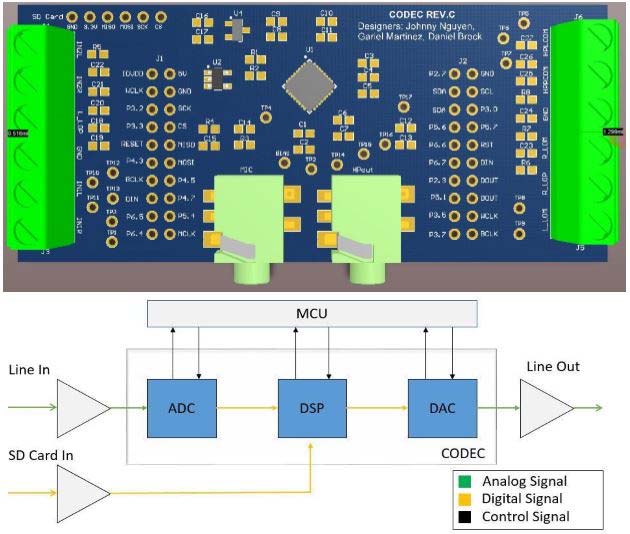
The Audio CODEC Booster pack provides an easy-to-use platform for performing end-to-end
DSP (Digital Signal Processing) on TI Launchpad microcontrollers. Inspired by a DSP
course taught by Dr. Xinrong Li, our team worked closely with Dr. Li in order to create
a Booster pack that would enable students to more easily experiment with signal processing.
The Booster pack is equipped with two native input methods, 3.5 mm Line-In and SD
Card, that allow for signals to easily be sampled. There are additional inputs that
can be used, like a microphone, that require external connections. Once the input
audio is in digital form, if not already, it can go through many different forms of
DSP on the CODEC, like boosting the bass or low pass filtering. After processing is
performed, the signal then goes through
the DAC (Digital to Analog Converter) in order to output an audio signal to a speaker
or headphones.
Helmet Heads-Up-Display Speedometer

Team Members
Mohammad Qawash
Abdullah Ragab
Victor Rodriguez
Sponsor
Parthasarathy Guturu
Abstract
The idea of our project is to prevent potential safety hazards for motorists when operating their vehicle, by diminishing the rider s distraction of having his or her eyes off the road. We were inspired by BMW Motorrad as it is developing its own HUD display helmet that shows the speed of the motor vehicle. In our project, we are designing a system that will calculate the speed of a car or motorcycle using GPS technology coupled with a micro-controller for processing. The system will start by searching for satellites, and once the GPS receives a signal from a satellite it will lock on it. After that, it will obtain the longitude and latitude coordinates and there will be a 1000 ms delay and then it will obtain the new coordinates. Using both coordinates, it will be able to calculate the distance and speed, then it will display the calculated speed on a LCD display that will be reflected on the windshield or the helmet visor. This project is powered by a lithium ion rechargeable battery. We designed a circuit for charging anagement that will allow safe charging and discharging of the battery.
Room Temperature Sensor with Lid Controller
Team Members
Oscar Llamas
Mohammad Alkhamis
Abdul Hawari
Sponsors
Dr. Agbor
Abstract
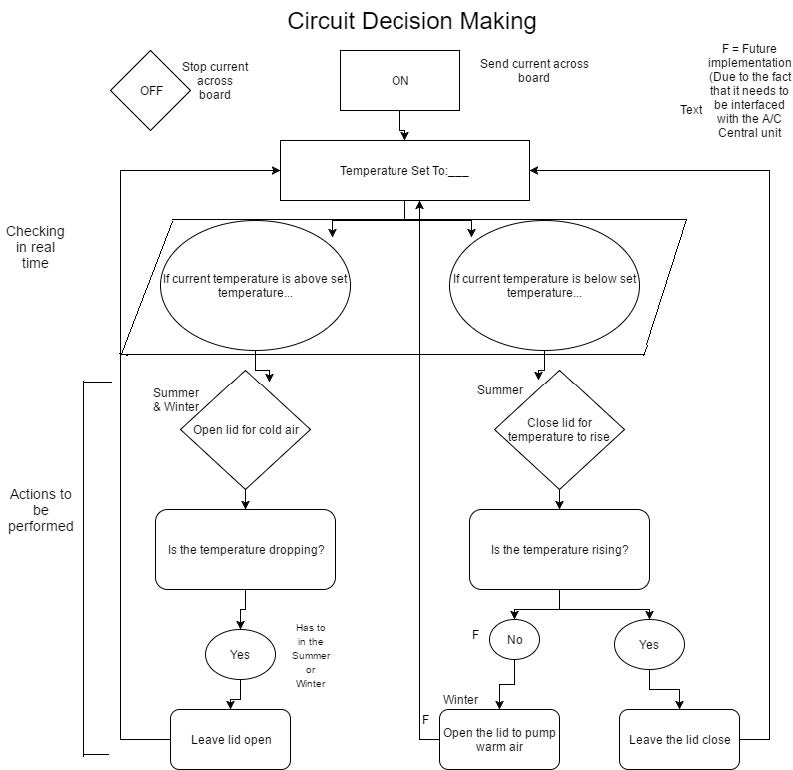
This team decided to tackle the issue of having the option to set rooms at different temperatures all within one household. One of the team members faced this problem, and the group thought it would be a great idea to approach this problem. So the project is set to control the air vent s circulation of air flow. To do this, we will either close or open the lid on a rooms air vent. The group would first need to get the users preferred room temperature, compare it to the actual room temperature, and make a decision either to close or open the lid for air flow.
To achieve this, the group used a microcontroller with pushbuttons and an LCD screen.
The pushbuttons are used by the user to set the desired room temperature and the LCD
screen prints that value. To get an actual value for the room temperature, the group
used a DS18B20 temperature sensor. This sensor gets the room temperature value in
real time and compares it with the set room temperature. The microcontroller was coded
to make a decision after the comparison, either to open or close the lid for air flow.
It constantly compares the temperature in real time. Also, the current room temperature
prints on the LCD screen so that the device can be more helpful to the user. To move
the lid, the group needed a device to control it. For this, a servo is used. After
some adjustments, the servo is programmed to exactly open or close the lid. The motor
that it uses is also strong enough to lift more than the lids weight so it can have
a smooth transaction. If the user wishes to change the room temperature again, then
the
user simply uses the pushbuttons which will update the logical comparison that happens
in the microcontroller.
Personal Intelligent Trainer Tracker
Team Members
Travis Black
Floyd McGriff
Craig Bonner
Sponsor
Xinrong Li
Abstract
This project is designed to target the medical and athletic community; which gives them the ability to have a Personal Intelligent Trainer Tracker device. This is implemented by a sophisticated algorithm and hardware components. The hardware for this device is an accelerometer, display, low power processor, battery, and buttons. The tracking of exercises is done by an algorithm that we created to both figure out, which of the four exercise (Sit-Ups, Arm Curls, Lateral Raises, and Rotations) that the user is doing and increment that exercise accordingly. In this exercise algorithm, the screen displays the exercise the device deems the user is doing and the current count number the user has for that exercise. Whenever the user desires to know their progress; a button is implemented to display the current count of the four exercise for 10 seconds, and then go back to the exercise algorithm. When the user desires to clear all the current count values of the exercises a clear all button is implemented. This gives both recovering patients and fitness people an easy means to track the physical exercises they do, and allows the algorithm to be implemented on other compatible devices.
Smart Power Strip
Team Members
Stephan Morris
Elijah Wilkinson
Sponsor
Kamesh Namuduri
Abstract
We are designing a smart power strip. The Power Strip measures the power being used at each outlet and controls whether the outlet is on or off. We are doing this by using a Current sensor on each AC receptacle and measuring the output voltage of these sensors with an analog to digital converter. A Tiva Launchpad is used to calculate the power being used. Bluetooth is used to control the device and monitor the power usage. Definitions and parameters are described to establish the project s background. Competition is identified and discussed, as well as, the requirements and specifications needed to make the project more advantageous than competitors. Furthermore, design considerations are laid out referencing the current status and future plans for the project. Lastly, the project s schedule and conclusions are given.
Configurable Power Distribution Unit
Team Members
Michael Thomason
Taylor Muskopf
Sponsors
Jesse Terrell - Elbit Systems of America
Dr. Shengli Fu
Abstract
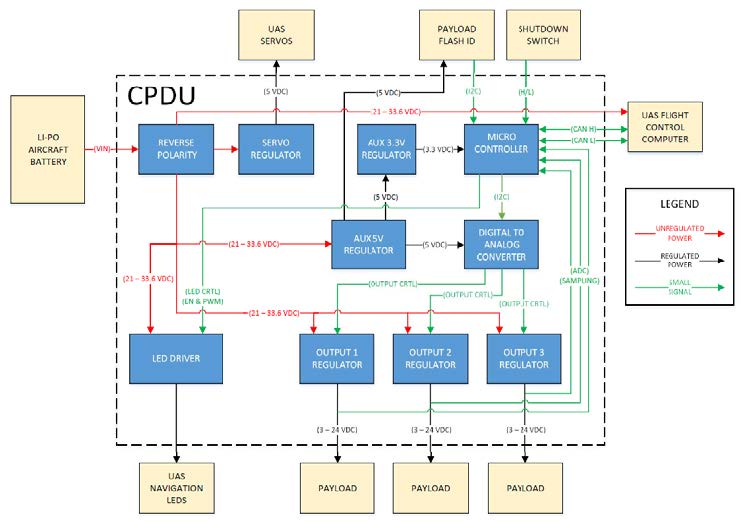
Unmanned Arial Vehicle systems rely on a wide range of advanced payloads to gather and process data about the surrounding environment and terrain below. The electrical characteristics and power needs of each payload can vary greatly from one to the next. Thus, for a UAV to be versatile, it must have a Power Distribution Unit (PDU) capable of supplying a range of voltages and currents to accommodate many payload types.
Sponsored by Elbit Systems of America (ESA), we have developed a highly configurable PDU capable of delivering 3 24V DC to three attached payloads simultaneously. Our robust PDU design includes features such as input reverse polarity protection, over current and over voltage protection, automatic payload identification, output current sharing, and real-time output monitoring. The development of this PDU in the professional and structured environment of Elbit Systems of America has not only allowed our team to produce a commercial grade product but also gain invaluable experience in the process.
Acknowledgements
A special thanks to those who have guided us during this project:
Dr. Shengli Fu
Jesse Terrell
Eli Ashkenazi
Solar Panel Cooling System
Team Members
Eduardo Limon
Eric White
Jose Diaz
Sponsor
Parthasarathy Guturu
Acknowledgements
Dr. Parthasarathy Guturu
Abstract
Global Warming has become a growing concern to the modern-day citizen. In correlation to its growing concern, people have been considering eco-friendlier solutions rather than generating energy from burning fossil fuels. Due to this dilemma, more and more people have looked to solar panels to help sustain their energy needs. Unfortunately, through plenty of usage to solar panels, many concerns have risen. Among the concerns, one has been reoccurring the most. That problem is overheating of the solar panel; which leads to poor efficiency or short circuiting of the panel. Due to the over exhaustion of the solar panel, our group had come up with an idea to help and potentially solve this issue. We have conceived the idea of building a cooling system for solar panels to help ease the stress of the heat and improve efficiency.
The basis of our design is trying to optimize the flow of cool water through our design
so that it comes in cold on one side and warm on the other. With the light coming
in ideally at the center of the panel, we plan to use the end points of the panel
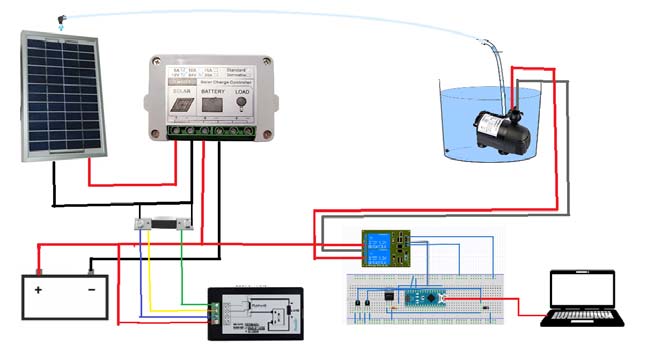
to act as entry/exit ways. To implement our design, we used a 50W solar panel that
would power our circuit. The panel is connected to a digital multimeter that will
measure wattage, amperage, voltage and energy produced by the panel. Also connected
is solar charge controller that will monitor the charging rate our 12v deep cycle
battery. Through a 2-channel relay we have a microcontroller connected to the panel,
the setup and a 12V
DC water pump; which will then push water on to the panel to help cool it. Please
look at the design shown below for better visualization.
Automatic Blinds
Team Members
Aaron Boss
Matthew Swan
Osvaldo Avila-Martinez
Andrew Deluna
Sponsor
Ikechukwu Agbor
Abstract
We are designing blinds that can be automated to work with minimal physical interaction from the user. The implementation of our automatic blinds incorporates using a light sensor, a servo, a PWM/Servo HAT and a raspberry pi as the controller. The light sensor will be used to detect light which will then be measured by the raspberry pi. The raspberry pi will then interface with the HAT to control the servo in order to turn the blinds. We first developed a code using Python to control the servo and allow it rotate for up to 7 revolutions within the blind. This rotational movement of the servo has to be precise in order to properly work with the light sensor depending on different lighting conditions. We are also developing the ability to control the blinds using time instead of luminance through the raspberry pi. Through our progress in designing the automatic blinds we hope to give greater flexibility and adaptability to users.