 University of North Texas

Mechanical Engineering Technology
G6 Composites
Team Members
Amirah Suleiman
Carlos Corral
Sean Cassidy
Chiamaka Ejiogu
Hussain Alquraish
Sponsor
Leticia Anaya
Abstract
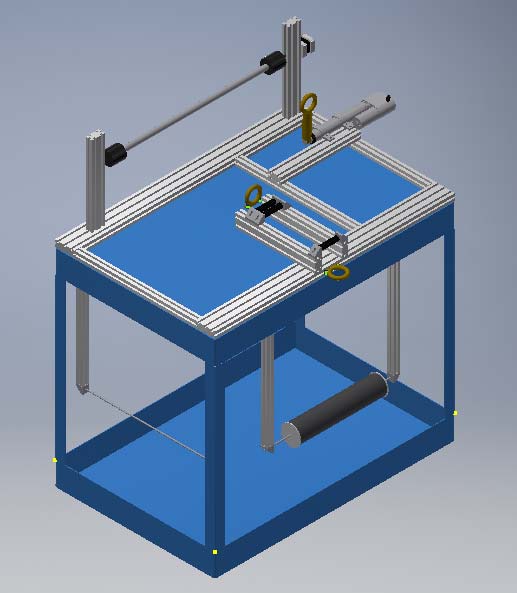
G6 Composites created a filament winder which is a machine used to create hollow composite shafts. The filament winder consists of winding a continuous roving of fiber onto a rotating mandrel in predetermined patterns using servo motors and linear actuators to provide control of the fiber placement and uniformity of structure.
The main purpose for manufacturing this machine is to enable the department of engineering technology to create low cost testing material while enabling the current labs to produce its own composite shafts. With this machine in the lab, the Engineering Materials course, ENGR 3450 and ENGR 3451, would expand beyond metals and enable comparative tensile testing between metal and composite shafts. Furthermore, the filament winder would allow multiple types of composite shafts to be made with varying filaments, resins, and application angles to test for different tensile strengths.
Solidarity
Team Members
Saleh Alatwah
Santiago Aguirre
Christopher Haney
Rockey Lafayette
Bryan Villarreal-Silva
Sponsor
Mr. Ali Nouri
Abstract
During the 1950’s, the need for solar power to provide energy became essential for space exploration. Now with an increase in climate change and the burning of fossil fuels the need to provide alternative power to everyday technologies is becoming a necessity. Solidarity can help to not only store energy, but to also use that energy to charge essential electronics while maintaining a degree of comfort.
The concept of using solar panels to power electronics is not a new one. Solar technology has been in use since 1953, but several advances in creating compact designs that deliver the same power have risen. Solidarity’s lightweight and foldable design with an efficient solar system enables users to utilize more sunlight to charge electronic devices while taking time to relax on a comfortable chair. By mounting the solar panels to the top of the chair this created a canopy that not only maximizes the ability to capture sunlight, but also helps to shade the user while sitting down. The solar panel charges a battery conveniently mounted to the bottom of the chair via wires that run through the frame of the chair. USB and regular outlets are mounted into the chair and are provided power via the battery.
Green technology is the future, and the design team have embraced that future by creating
a chair that utilizes green power and maximizes relaxation. The implementation plan
will be carried out in two phases: preparing for manufacturing, and then marketing
and selling the product. In preparation, it is planned to optimize the design by using
the best and cheapest material, and purchase wholesale materials in bulk to cut down
on costs. In marketing and selling, the plan is to hire knowledgeable salespeople
who not only understand the product but also can help with customer repairs or changes
if needed. To promote the product, places are to sponsor several outdoor activities,
team up with companies selling complimentary products, and involve the company in
greener solution community events such as cleaning rivers and lakes. The total estimated
cost for fabrication and assembly is $600- $700 not including markup. Solidarity is
the newest technology and modification in a growing market eager for new green products.
Solar Solutions believe that Solidarity will create a new wave of outdoorsmen and
women who
enjoy being outside in the fresh air, while not being limited to the battery of electronic
devices. This proposal offers the opportunity to join an industry with an exponential
trend of growth.
Thermalsleep
Team Members
Alejandro Torres Delgado
Ai Sexton
Andres Lopez
Tyler Faught
David Siebe
Sponsor
Dr. Seifollah Nasrazadani
Abstract
The objective of this project was to provide a more comfortable sleeping experience while reducing usage of air conditioning systems. The Actively Controlled Temperature Mattress System (ACTMS) features a water cooled/heated mattress topper with adjustable temperatures. The system utilizes a thermoelectric cooler (Peltier) to control temperature and conserve energy.
Using distilled water as the flowing fluid, it adds or removes heat into a pad which maintains the desired temperature. The system will use a portable case which houses the pump, reservoir, heat exchanger, and electronic components. During the design process, areas of consideration included affordability, reliability, and ease of manufacturing.
T1 Aerodynamic Solutions
Team Members
Brad Kaisner
William Patton
Shawn Myron
Robert Estrada
Sponsor
Dr. Robert Hayes
Abstract
Aerodynamic devices are integral to the dynamic performance of vehicles. With the
help of sponsors,
other FSAE teams, and various faculty, T1 Aerodynamic Solutions is set to produce
a high end
aerodynamic device that will greatly increase the dynamic capabilities of MGR 17,
the formula car being
designed and manufactured this year. The team discovered, through research, that with
the increase in
airflow there is a decrease in pressure. The undertray will increase the air velocity
from the front nose and
diffuse under the rear axle creating a low pressure zone which subsequently produces
more downforce
allowing the car to maneuver quicker. Another added benefit of an undertray is the
ability to maintain
higher speeds while cornering while keeping the car stable. The method used is vacuum
bag infusion due
to its ability to infuse resin at a high rate allowing for an even distribution of
epoxy while maintaining a
vacuum on the part ensuring that the various layers are molded into one uniform piece.
The mold that
holds the carbon is milled out of high density foam, and the surface is treated with
an automotive body
filler to fill the pores and create a smooth surface for layup.
Acknowledgements
We would would like to thank the following people for their assistance with our project: Dr. Robert Hayes, Kyle McDougal & the SAE team, Dr. Phillip R. Foster, Bobby Grimes, the Discovery Park maintenance crew, and our friends & families for supporting us.
We would like to thank the following companies for supporting our project: UNT College of Engineering Department of Engineering Technology, Airtec, and Bartlette Painting Inc.
Titanium Anodizing Line
Team Members
Patrick Doran
Noel Martinez
Wyatt Braden
Jeffrey Hutto
Sponsors
CTL Medical Sean Suh
Leticia Anaya
Abstract
Team 3 plans to create a larger, automated titanium anodizing line system to increase production and quality. CTL Medical, medical device design, development, and manufacturing company in Addison, Texas, has trouble reaching quantity and quality standards with current anodizing equipment. They plan to use our system to improve their titanium anodizing process, especially by taking advantage of automation in the cost-effective design. The estimated budget will be around $3,000-5,000, much less than competitive products.
Acknowledgements
Otis Blackwell
Mike Townsend
Jon Suh
T7 Statics
Team Members
Hunter Cerny
Brian Moreno
Kunbao Lin
Hadi Alzawad
Fadel Alzawad
Sponsors
Superscapes
Leticia Anaya
Abstract
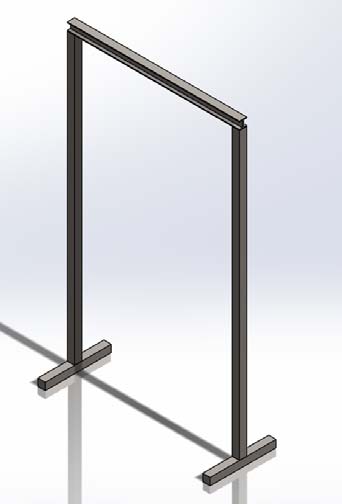
The Dual Gantry Crane assembly is a structure that saves Superscapes Landscaping time and money, resulting in increased efficiency. The dual gantry crane was able to lift the metal crate assembly covering the cab two feet in the air, which allowed the mechanic enough clearance to drive the irrigation truck forward. Once the cab was far enough forward, the mechanic was able to utilize the tilt cab design, which allowed him access to the engine bay.
Superscapes asked our team to design this specific lift due to a previous incident where one of the irrigation trucks needed its radiator replaced. Unfortunately, neither the mechanic nor the dealership had a way to hoist the crates off of the truck to access the engine bay.
The team's design accomplished and surpassed all of the goals set by Superscapes. The initial design criterion was strictly based off of height dimensions, and a decent budget. The crane passed all safety standards, and came in under budget. These accomplishments made the mechanic feel safe while operating under the crane, and made the owner happy by spending only half of the initial budget.