 University of North Texas

Mechanical and Energy / Engineering Technology - Spring
ASME Gripper
Team Members
Justin Breedlove
Samuel Burkhalter
Kameron Hightower
Heriberto Miranda
Jibrael Montenegro
Jakob Schnitker
External Sponsors/Mentors
UNT American Society of Mechanical Engineers Club
Abstract
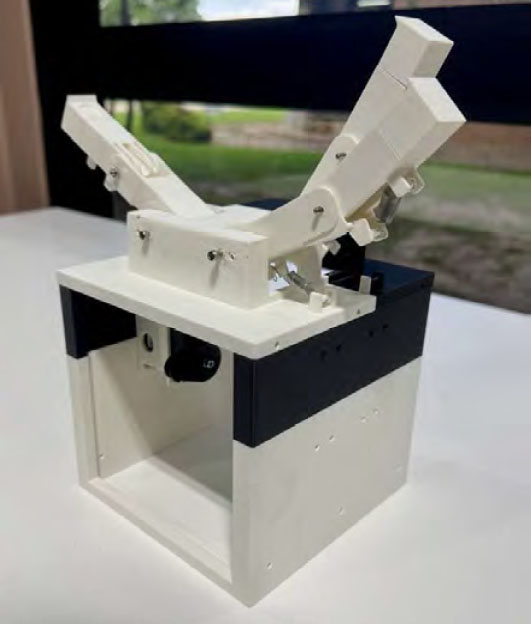
Our project is a 3D printed robotic gripper for the University of North Texas American
Society of mechanical Engineers club. The gripper will be used on their mars rover
that will be competing in the University Rover Challenge in 2027. Our design uses
a three finger design powered by tendons pulled by motors in the base. Our
electronic system was design by us and is powered controlled by an ESP-32. Our gripper
prototype is printed out of PLA for its ease of use but our final gripper is 3D printed
out of ABS dueto its resistance to heat and overall durability. Additionally, our
fingertips have a 3D printed TPU cover to increase the coefficient of friction between
the finger tip and any object as well as allowing the finger tip to deform when picking
up objects which increases its overall gripping surface area.
BioFlow
Team Name
BioFlow Eight
Team Members
Morgan Benner
Ashwaq Cheema
Zain Choudhry
Eva Nettles
Taylor Nguyen
Nathaniel Parker
Gerardo Rubio
Kenny Wells
Internal Sponsors/Mentors
Dr. Mark Wasikowski
Dr. Rattaya Yalamanchili
Z&S Tech
Dr. Sheldon Shi
Xuan Wang
Jonas Ahonen
Abstract
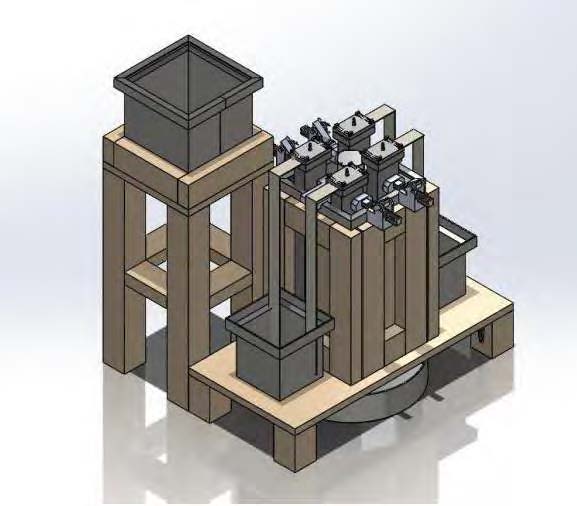
Traditional methods of lumber treatment, such as industrial autoclaves, require high pressure environments which are energy intensive, expensive, compromise the structural integrity of the lumber, and oftentimes are incapable of achieving complete chemical saturation. This project presents a lab-scale prototype designed to implement a self-flowing treatment process inspired by transpiration and capillary action. By using hydrostatic forces and an absorption sheet siphoning mechanism aided by a vacuum inducing cap, the system allows continuous flow of the treatment fluid through the woods internal capillaries.
Wheelchair Bracket System
Team Name
Bluesky Swifts
Team Members
Joseph Martinez
Jocelyn Ferrusca
Numair Baig
Carlos Rodriguez
An Lac
External Sponsors/Mentors
ALL Wheels Up
Ms. Michele Erwin
Mr. Walt Fluharty
Internal Sponsors/Mentors
Dr. Rattaya Yalamanchilli
Dr. Mark Wazikowski
Abstract
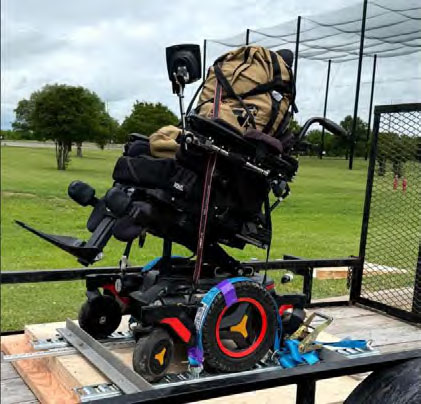
Designing a system that will allow passengers to use their personal wheelchairs on commercial aircraft. The lack of accessibility in the aerospace transportation industry leads to the loss of dignity for passengers and increases the possibility of injury. Our team, Bluesky Swifts has been working with All Wheels Up to design a prototype that will allow passengers to use their own wheelchairs that are FAA compliant during flights.
Our product is a wheelchair bracket system sponsored by All Wheels Up designed with the intent to allow automatic wheelchair users to safely and comfortably ride on airplanes, while preserving their dignity as much as any able-bodied passenger. In keeping with the needs of the market, the product must be attached to the interior of the airplane cabin in a way that doesn't interfere with the airline experience of other passengers and leaves minimal traces on the cabin itself.
Automated Modular Exchange System (AMES)
Team Name
Cowboy Drone
Team Members
Grant Emery
Armando Madrigal
Isaiah Nygard
Mac Van Benthuysen
Alejandro Villanueva
Internal Sponsors/Mentors
Dr. Rattaya "Chow" Yalamanchili (Customer/Project Sponsor/Faculty Advisor)
Dr. Mark Wasikowski (Faculty Advisor)
Abstract
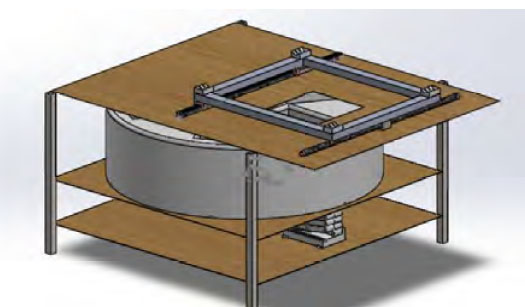
The Autonomous Modular Exchange System, later formalized as AMES under the broader Cowboy Drone project, was developed to address a practical and recurring limitation in unmanned aerial vehicle deployment: the inability to autonomously change payload modules between missions without direct human involvement. In many current UAV applications, especially in agriculture, remote inspection, and repetitive site monitoring, the aircraft itself may be capable of flight autonomy while still depending on an operator to physically land, retrieve, reconfigure, and relaunch the system whenever mission needs change. That operational break reduces the real usefulness of autonomy. The AMES project was undertaken to reduce that bottleneck by creating a ground-based mechanical exchange system that could receive a landed drone, align it, present a selected module, attach the module through a repeatable vertical transfer mechanism, and secure it using a positive retention device.
Electronic Throttle System
Team Members
Clayton Wong
Jaron Murnan
Benjamin Prange
Harrison Gutierrez
Connor Hirst
Joshua Banks
External Sponsors/Mentors
ECU Master
Evolution Dynamics
UNT Mean Green Racing
Formula Societry of Automotive Engineering
Internal Sponsors/Mentors
Mechanical Engineering Department
Abstract
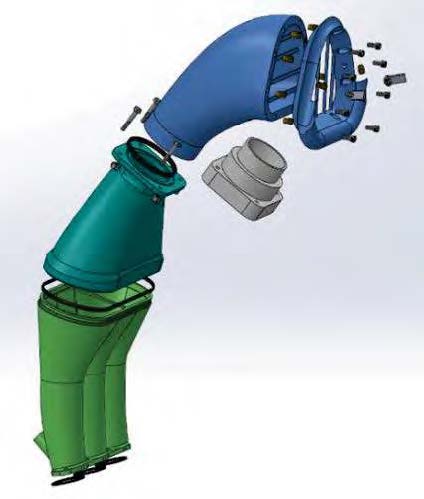
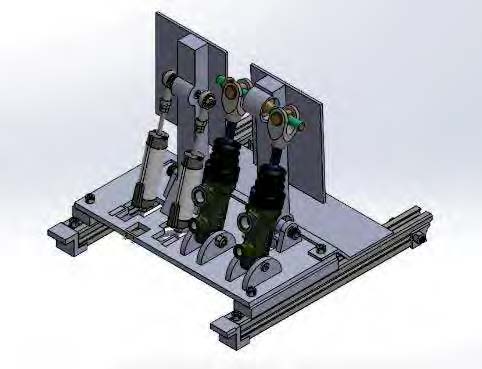
An Electrical Throttle System retrofit was developed to improve throttle response and overall drivability in a Formula SAE legacy vehicle by replacing the traditional cable system with an electronic setup. The design combines a lightweight pedal assembly with built-in sensor redundancy, an electronically controlled throttle body, and a compact intake manifold designed for efficient airflow. The goal was to create a system that responds more consistently to driver input while allowing better control through the ECU, as well as improved safety features. Materials and manufacturing methods were chosen to keep the design simple, strong, and easy to produce and modify. Overall, the system provides more reliable throttle behavior and a solid foundation for future improvements.
High Performance Aerodynamic Automotive Design

Team Name
HexAuto
Team Members
Melbin Chandy
Roberto Jimenez
Chih-Lin Chang
Almin Kotadia
Shahmir Hamid
Israel Sanchez
External Sponsors/Mentors
Pascal GIROLLET (Design)
James Pacheco
Internal Sponsors/Mentors
Mechanical Engineering Department
R.C "Chow" Yalamanchili, PhD, PE
Dr. Mark Wasikowski
Dr. Hamid Sadat
Abstract
The HEXAUTO project is an aerodynamic, high-performance automotive body designed to reduce drag, maintain balanced downforce, and achieve a modern aesthetic. The scope is limited to the exterior shell, excluding all internal systems, with the goal of a manufacturable design that meets customer requirements and Texas road regulations.
The Car is designed to reduce turbulence and maintain balanced aerodynamic loading. CFO simulations predict a drag coefficient of 0.21 and lift coefficient of -0.54. Moment calculations values increased from approximately 0 to 103.69 at 100 m/s, reflecting the predicted rise in aerodynamics loading and stability effects.
FSAE Active Aero
Team Members
Emily Gooden
Anthony Holcomb
Aidan Kearney
Aidan Larkin
Juan Carlos Molina
Mahmoud Rusan
External Sponsors/Mentors
UNT Mean Green Racing
Abstract
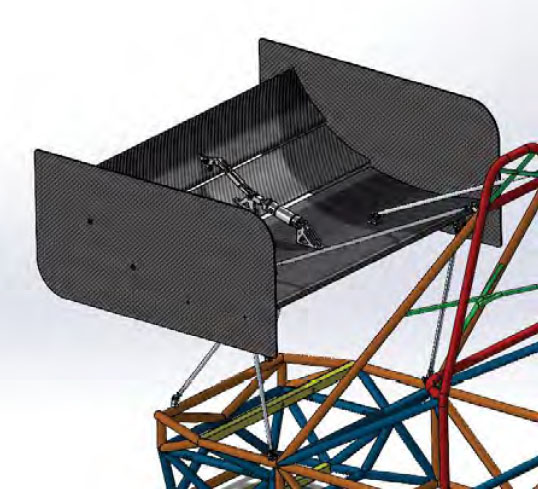
Mean Green Racing tasked our team with designing and manufacturing an "active" rear wing for their F26 FSAE race car. The wing will allow some of its upper elements to pivot to a neutral position when downforce is less necessary to reduce drag forces applied on the wing. This will allow for faster acceleration times during MGR's dynamic events at their annual FSAE competition, and they will be able to iterate upon our original designs to further improve the technology, and optimize it for better performance in future years.
Ouroboros 3D Printing System


Team Members
Elliott Bradley
Brent Lackey
Olakanmi "Peter" Oso
Paul Sarlea
Brian Shaka
Internal Sponsors/Mentors
Mechanical Engineering Department
Dr. R. C. "Chow" Yalamanchili
Dr. Mark Wasikowski
Abstract
In the realm of 3D printing, a lot of plastic waste is produced in the form of supports and failed prints. In larger plastic manufacturing sites, the waste of plastic is even more prevalent. Our solution to address this is a modified extruder that uses an auger system to push plastic down a barrel to then print a model. This is to recycle plastic and save money for models, benefiting hobbyists especially. A storage tank will hold the material being processed, while the auger system in the extruder not only compresses, but melts the plastic as it goes down. The auger will be driven by a high torque motor run through a 10:1 gearbox to maximize torque.
A brass barrel that will be able to contain the necessary melting temperature of 250°C while two 3010 size turbofans will remove any unnecessary heat from fins on the barrel.
Upon analysis of design choices using FEA analysis and real world tests, we can provide the plastic in a melted state that is desirable for printing.
Palm Ratchet


Team Members
Fabien Perez
Lawrence Lam
Ajia Staudt
Christabel Alese
Christian Doan
External Sponsor/Mentor
HPF Consulting
Internal Sponsors/Mentors
Mentors:
Dr. Chow
Dr. Wasikowski
Abstract
This project focuses on the design and development of a handheld electric palm ratchet.
The primary objective is to create an electric ratchet that is small and able to assemble/disassemble hardware efficiently. This palm ratchet is designed to be lightweight and durable. The ratchet will torque at 15-20 in-lbs, which is considered finger tight. This is so it can be used with softer material hardware.
Traditional ratchets are helpful but can cause strain in the wrist and upper arm after repeated use. Electrical drills, impacts, and existing ratchets are too strong and may damage any softer materials being used.
Parallel Pipeline Flow
Team Name
Pipeflow
Team Members
Nathan Chulick
Nathaniel Mercer
Ian Fair
Tyler Haverland
Thomas Diaz
Derrick Lawrence
External Sponsors/Mentors
Scott Bode - NIBCO
Quentin Mackie - Oslin Nation
David Leckman - Great Plains Industries
Paul Tulley - Charlotte Pipe
Brian Teitell – Shapes Plastics
Anthony Gonzalez
Internal Sponsors/Mentors
Dr. Maurizio Manzo
Dr. Rattaya Yalamanchili
Dr. Mark Wasikowski
Abstract
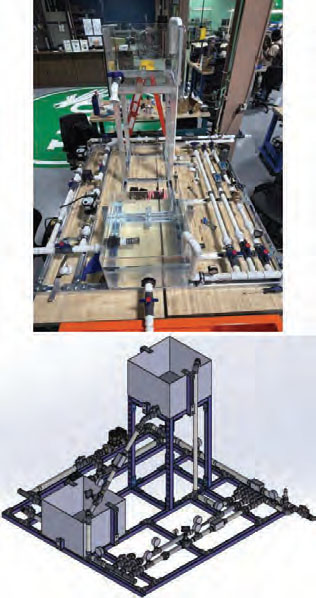
Current fluid flow lab apparatuses owned and operated by the school do not possess the capability to run pump curve, Bernoulli's Principle, or minor loss experiments. Utilizing variable speed recirculating pumps and pipe unions for modularity, a unique solution was designed to allow multiple experiments to be run using the same experimental apparatus. The system will be used to educate students on flow behavior through parallel branches, pump characteristics, parallel vs series pumps, Bernoulli's Principle, and major vs minor losses. Laboratory sessions consist of TA-driven experiments with students interacting via ball valves, globe valves, and pump speeds. The system utilizes water as the working fluid in an open-loop recirculating system between two 15-gallon acrylic reservoirs. Experimental values for lab reports will be readable via flow meters and pressure gauges strategically placed before and after areas of study. The goal of this project is to give students the ability to physically interact with and observe real-world equipment.
Pressure Differential Energy Recovery System (PDERS)
Team Members
Sergio Loma
Austen Murphy
Eduardo Romero
Carlos Vivanco
Lucas Wilhoyt
External Sponsors/Mentors
Emerson
Neal Ackerman
Anthony Amaro
Campbell Masteller
Internal Sponsors/Mentors
Rattaya Yalamanchili
Mark Wasikowski
Hamid Sadat
Abstract
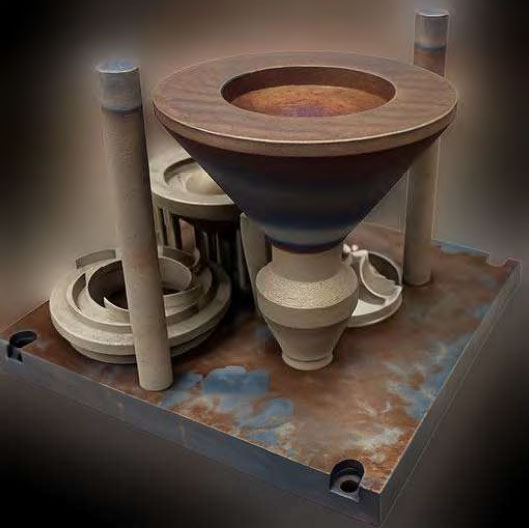
Industrial natural gas pipelines transmit gas at high pressures. When approaching city limits, a pressure regulator is used to reduce the pressure. This loss of energy from the pressure drop can be extracted using PDERS. This project presents a Pressure Differential Energy Recovery System (PDERS) designed to capture that wasted pressure energy and convert it into electrical power using a compact high-speed radial turbine operating near 10,000 rpm. The system features a 316 stainless steel pressure housing, a sealed shaft support structure compatible with natural gas environments, and a magnetic coupler that enables power transfer without dynamic seals. Analytical calculations and simulation-based validation confirmed acceptable stress levels, shaft deflection within clearance limits, and safe high-speed operation. Results demonstrate the feasibility of integrating compact pressure-energy recovery devices into pipeline systems to support sustainable energy utilization.
Plant Level Nutrition and Tactile Stimulation System (P.L.A.N.T.S)
Team Members
Avi Hughes
Connor Foster
Jorge Morales
Priyanshi Patel
Loralyn Sanders
Internal Sponsors/Mentors
Sponsor:
Mechanical Engineering Department
Mentors:
Dr. Yalamanchili
Dr. Wasikowski
Abstract
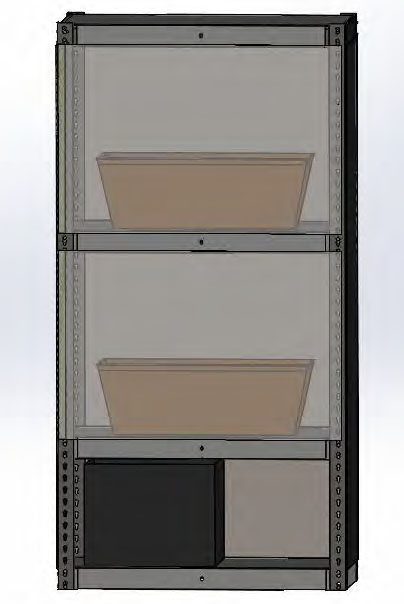
Indoor plant growth is often limited by the absence of natural environmental stimuli such as wind, consistent sunlight, and regular watering. This project focuses on designing the P.L.A.N.T.S. System (Plant Level Nutrition and Tactile Stimulation System), a compact, self-contained indoor plant growth that creates an automated environment to grow healthy and strong plants. The system uses vibrations to simulate wind, increasing pollination and strengthening the stems, along with automated and programmable light and watering cycles. Sensors monitor soil moisture and water levels, allowing a micro-controller to automatically adjust system operation with minimal user input.
The physical structure was deigned to safely support the weight of fully saturated soil and water reservoirs, while maintaining stability over time. Materials were selected for durability and resistance to corrosion in high humidity environments.
Our goal is to create an efficient, low maintenance system that improves indoor plant growth by mimicking key aspects of a natural environment.
Solar Assisted Lawn Care Autonomous Robot (S.A.L.C.A.R)
Team Members
Ramzi Aouadi
Lashael Bramlett
Max Gunn
Sophia Guerra
Daniel Sanchez
Jasmine Vina
External Sponsor/Mentor
ASI Robotics
Internal Sponsors/Mentors
Mechanical Engineering Department
Mark Wasikowski
Rattaya "Chow" Yalamanchili
Saad Mohammed Iqbal Ali
Abstract
The Solar-Assisted Lawn Care Autonomous Robot (S.A.L.C.A.R.) is a student-designed autonomous lawn maintenance system developed to reduce homeowner effort while minimizing environmental impact. The system targets residential users, including those with mobility limitations, and is designed to operate reliably on varied terrain without continuous supervision. The final design is organized around three integrated subsystems, powertrain, drivetrain, and controls; built on a 48 V electrical architecture selected through trade studies to meet torque, runtime, and efficiency requirements. The mechanical platform features a lowcarbon steel structural frame with custom PETG-HT 3Dprinted enclosures, and is driven by high-torque gear motors with a LiFePO4 battery providing extended runtime margin. The control system manages navigation, safety functions, and system operation, including a mandated 3-second blade stop. Engineering validation through structural FEA, drop testing, and thermal simulation confirms compliance with all high-priority requirements, including a 20° slope capability and safe passive cooling of sealed electronics.
Automated Tire Recycling System: Integrated Debeading and Shredding

Team Name
Industry Shredders
Team Members
Carlos Rivera
Leonardo Rojas
Caleb Mccord
Ryan Melon
External Sponsors/Mentors
Rami Transportation Inc.
Milan Patel
Ervin Rojo
Yadira Rojo
Daniel Rivera
Internal Sponsors/Mentors
Bobby Grimes Hector Siller
Dr.SrinivasanMark Wasikowski, PhD.
R. C. "Chow" Yalamanchili, PhD, PE
Zachary Warren
Suleiman Abu-Suleiman
Abstract
This project presents an integrated industrial tire recycling machine that combines debeading and shredding into a single automated system for commercial truck tires. The gravity-assisted workflow uses a hydraulic platform to position tires for bead wire extraction via a vertical hook, after which the tire feeds into a low-speed, high-torque single-shaft shredder below. Steel bead wire is recovered separately, and shredded rubber is collected in a standard 10-yard dumpster for use in applications like mulch, playground surfaces, and asphalt additives. The system integrates structural, hydraulic, electrical, and mechanical subsystems within a heavy-duty steel frame, with safety features throughout. Tensile testing of extracted bead wire on an lnstron machine validated the design's force calculations. However, the sponsor, Rami Transportation Inc., chose not to fabricate the machine due to high operational costs and poor ROI for a trucking company without continuous processing volume. The design remains viable for dedicated recycling operations with higher throughput and lower labor costs.
Additive Mechanical Performance (AMP)
Team Members
Diego Hernandez
Eduardo Mendoza
Brandon Boone
Alexis Lopez
Jackson England
Dominique Quizhpi
External Sponsors/Mentors
Northeast Grinding (Mentor)
3D Print Labs (Mentor)
Internal Sponsors/Mentors
Mentors:
R. C. “Chow” Yalamanchili, PhD, PE
Mark Wasikowski, PhD, ME
Dan Nguyen
Sponsor:
Mechanical Engineering Department
Abstract
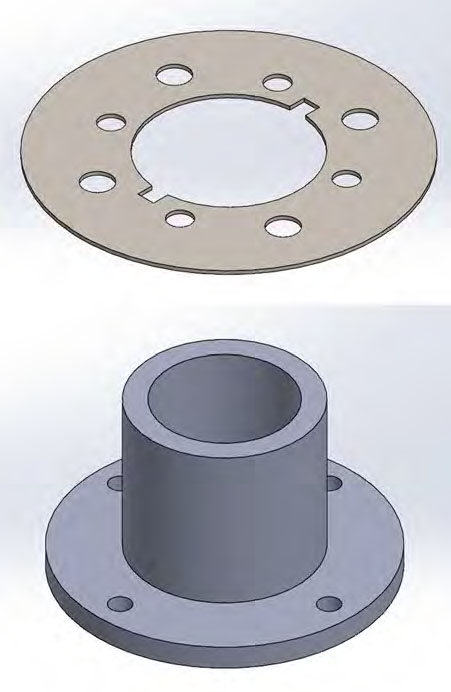
Traditional steel components in concrete grinding systems are durable but suffer from high costs and long lead times. This project evaluates the feasibility of replacing machined steel spacers and flanged fittings with additively manufactured polyphenylene sulfide (PPS) components. While initial concepts explored electroplating to enhance polymer performance, this approach was discontinued due to process complexity, high cost, and limited mechanical benefit. The redesigned approach leverages fused deposition modeling (FDM) with carbon fiber reinforced PPS (PPS-CF10) to produce direct, drop-in replacements. Mechanical validation includes dimensional inspection, finite element analysis (FEA), and real world operation. Results demonstrated that PPS-CF10 components meet core functional requirements while reducing total assembly cost. Although polymer parts may have a shorter service life than steel, on-demand printing enables same-day replacement, significantly reducing downtime.
SUN-V System
Team Members
Mahesh Bista
Marco Hernandez
Connor Kokora
Christopher Rendina
Jonathan Silva
Joel Smith
External Sponsors/Mentors
Ascent SOLAR Technologies:
Chris Metcalf - Electrical Engineer
Shannon O’Reilly - Electrical Engineer
Connor Pierce - Electrical Engineer
Internal Sponsors/Mentors
UNT Association of Energy Engineers (AEE)
Zach Warren - Electrical Engineering Student Mentor
Dr. Rattaya C. Yalamanchili
Dr. Mark Wasikowski
Abstract
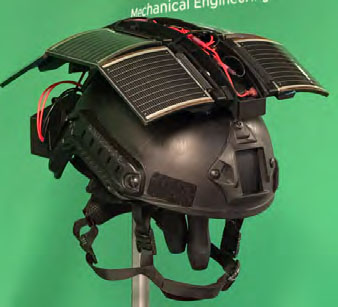
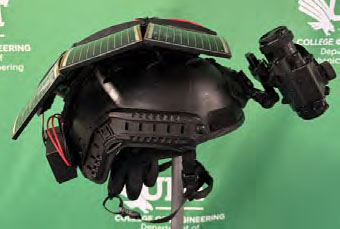
The SUN-V system addresses the logistical burden of battery dependence for military and industrial personnel by integrating a renewable charging platform directly onto standard headgear.
An array of 6 Fermion panels - provided in-kind by Ascent Solar Technologies - work in conjunction with a Maximum Power Point Tracking (MPPT) system to provide 28 Watt-hours of energy to a pair of rechargeable 18650 batteries and 5V of regulated USB-A and USB-C accessory charging.
With a weight limit of ~1.7 pounds, and limited dust and water spray protection, the SUN-V system enhances mission endurance and safety in rugged environments by providing passive, on-body power generation.
Flywheel Energy Storage System

Team Members
Finn Morton
Evan Adamson
Gabriel Ramlall
Dennon Farrell
Louis Anguiano
Internal Sponsors/Mentors
Mechanical Engineering Department
Dr. Mark Wasikowski
Dr. Rattaya Yalamanchilli
Abstract
Energy Recovery Systems such as regenerative braking have become common in many hybrid and electric vehicles. These products store this recovered energy directly into their Lithium-Ion Battery Storage System. Exposing these batteries to frequent, high-power, charge and discharge cycles has a substantial impact on their life.
One solution is to route the recovered energy to a separate, alternative energy storage system. Our team proposes a Flywheel-based Energy Storage System, FESS as that ideal alternative. This technology possesses similar specific power and specific energy as Li-batteries while being rated for the frequent, high-power, charge/discharge cycles regenerative braking demands.
Our design uses a high-speed, steel flywheel to store 100 + kJ of kinetic energy. Our power electronics system simulates the charging and discharging at 750 W and testing is conducted at 5000 RPM inside thick, steel casing. The result of our project: a stable, high-speed, low-cost FESS prototype intentionally designed for applications in vehicular energy recovery systems.
Thermoelectric Concrete

Team Name
Pavement Power
Team Members
Alex Cook
Djonny Mukuna
Godson Izuogu
Jarrett Farrier
Xavier Ayala
External Sponsor/Mentor
Mr. John Alexander
Internal Sponsors/Mentors
Dr. Rattaya Yalamanchili
Dr. Mark Wasikowski
Abstract
The Thermoelectric Concrete project presents and innovative approach to mitigating the urban heat island effect by harvesting waste heat from pavement surfaces. Conventional concrete infrastructure can reach temperatures up to 140 Degrees Fahrenheit, posing a danger to anyone who comes in contact with it. This system uses the Seebeck effect to convert thermal gradients into usable electrical energy while simultaneously reducing surface temperatures. The finalized design incorporates a modular three layer architecture that balances structural integrity with thermal efficiency. The top layer is concrete. The middle is 21 TEG shock absorber units between under-slab foam strips. The bottom layer integrates a machined heatsink and sub-base to maintain a temperature gradient with the cooler soil. Modeling confirms the products feasibility, producing approximately 50Wh per day per 9 square foot slab.
Uni-Pump
Team Members
Mark Andzie Quainoo
Shawn Dattalo
Ethan Kluthe
Vincent Gray
Roger Mena
Tacoreus Starks
Internal Sponsors/Mentors
Dr. Mark Wasikowski
Dr. Rattaya Yalamanchi
Abstract
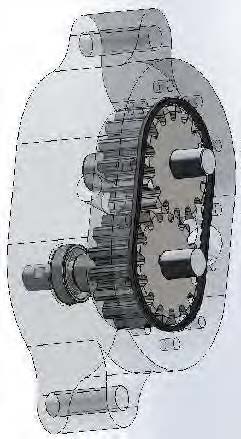
The Uni-Pump Project is a Senior Design Capstone project with the goal of designing and manufacturing a pump capable of handling fluid across a range of viscosities. Oil and water were selected as the upper and lower bounds on viscosity for our project. Research showed several types of pumps as promising for our design before simulations led us to our final selection of an external gear pump. Through stress analysis, our initial design was changed to a more durable part to ensure function under load. In the manufacturing phase, further modifications were made to improve manufacturability. The current design balances ease of manufacturing with cost and strength to ensure a cost-effective pump.
Medical Eyewash for Microgravity Applications

Team Name
Eye-Got-Zero-G
Team Members
Denise Campos
Matthew Mazariegos
Jordan Meza
Abigail Mullens
Teni Olumide
Pratisha Thapa
External Sponsors/Mentors
NASA X-Hab Program - Sponsor
Dr. Moriah Thompson - Sponsor (NASA)
Justin Yang - Mentor (Aegis Aerospace, Inc.)
Internal Sponsors/Mentors
Dr. Rattaya Yalamanchili (Chow) - Mentor
Dr. Mark Wasikowski - Mentor
Haque Raad
Karan Kakroo
Abstract
This project presents the redesign of the existing eyewash system at ISS with limitations including bulky architecture, single-use operation, and reliance on external water sources. The objective was to develop a closed-loop eyewash system capable of operating in microgravity and partial-gravity environments (for XHab exploration) while meeting NASA and ANSI Z358.1 safety standards.
A structured engineering design process guided development, incorporating CAD modeling, ANSYSbased fluid simulations, and iterative prototyping.
The final system features a manual positive displacement pump, dual independent flow paths to prevent cross-contamination, and integration with the ISS potable water system.
Testing demonstrated a consistent 0.4 gpm flow rate, effective contamination control, and reliable operation in reduced-gravity conditions. The closed-loop design reduces reliance on disposable components, improving sustainability and providing a practical, mission-ready solution for astronaut safety during long-duration space missions.