 University of North Texas

Computer Engineering - Spring
Wearable Disease Detection
Team Name
Circuit Breakers
Team Members
Jared Beyers
Ronil Doshi
Jennifer Tapia
Tarod Anderson
Isaiah Maberry
Internal Sponsor/Mentor
Dr. Pradhumna Shrestha
Abstract
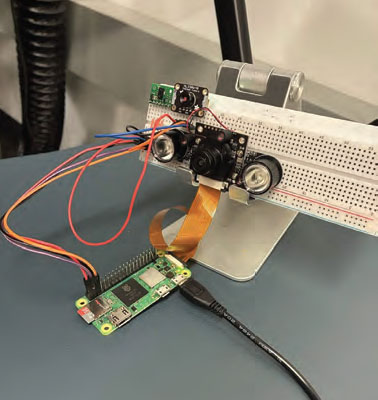
The Wearable Disease Detection System is designed to monitor human interactions and potential exposure events in real time through the integration of multiple sensors and embedded computing devices. The system utilizes a distributed network of wearable subsystems equipped cameras to detect nearby individuals, estimate proximity, and identify human presence.
The system will continuously monitor interaction events and capture relevant data such as distance, duration, and location of contact. These events will be processed using onboard computing and computer vision algorithms to determine meaningful exposure interactions. The collected data will be transmitted wirelessly to a central processing unit, where it is aggregated, analyzed, and stored in a secure database. This enables the system to maintain up-to-date records of user interactions and potential exposure risks.
A user interface, accessible through a web or mobile application, will provide visualization of interaction data, including timestamps, proximity measurements, and frequency of contacts. By combining wearable sensing, edge computing, and data analytics, the system aims to enhance situational awareness and improve public health safety by enabling early detection and tracking of close-contact events.
Voice Assisted Navigation for Blind
Team Name
Equinox Inc.
Team Members
Joshua Nwazue
Tyler Woods
Diego Arreguin
Internal Sponsors/Mentors
Dr. Pradhumna Shrestha
Dr. Robin Pottathuparambil
Udayasai Ramineni, Lab Manager
Abstract
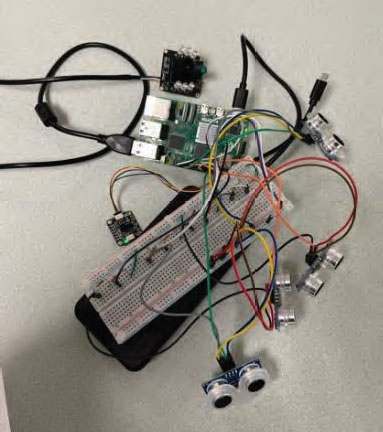
The Voice Assisted Navigation System for Blind is a system that provides real-time indoor navigation guidance for visually impaired users while using computer vision, ultrasonic sensors, voice interaction and navigation instructions. The system continuously monitors the user’s surroundings using 4 HC-SR04 ultrasonic sensors to detect any obstacle or person within a 2 meter distance using a NanoDet light computer vision model. If the system detects within a 2 meter distance, the NanoDet model will turn on, classify the obstacle/person, and alert the user through Bluetooth connected headphones with a description and distance measurement. Navigation is implemented by creating georeferenced node/edge graphs of indoor locations (UNT Discovery Park and Walmart) using QGIS. The path is calculated using A* path finding algorithm from the users starting position to their desired destination. While the user is navigating, their movement gets tracked by the BNO-085 IMU, ensuring they are navigating safely to their destination. All the data processing, algorithm execution, and model implementations are ran locally on a raspberry pi 5 microcontroller to ensure no data storage, processing, or external transmission of visual or audio feed occurs preventing privacy. A speech-to-speech model enables the system to be fully hands-off and voice activated, enabling the user to use commands to start/stop navigation, choose a location, input a desired destination, and listen to navigation commands. The system and components are all mounted on a lightweight vest powered by a lithium ion battery capable of keeping the system running for at least 4 hours. The Voice Assisted Navigation System for Blind delivers a safe, comfortable, and reliable solution that empowers visually impaired users to navigate throughout indoor environments with confidence.
FireWatch - Early Wildfire Detection
Team Name
FireWatch
Team Members
Wesley Boyle
Kevin King
Zayden Owens
Internal Sponsor/Mentor
Dr. Pradhumna Shrestha
Abstract
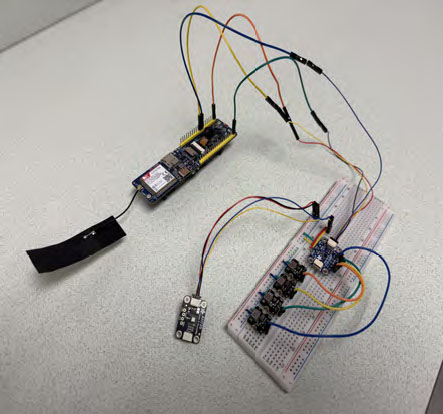
The FireWatch Early Wildfire Detection system is designed to monitor areas at risk
of wildfire by deploying self-sustaining, small, and affordable stations that will
measure the air quality of specific gases and smoke particulates resulting from smoldering
and/or active wildfires & reporting the current conditions on concern to FireWatch’s
database. The FireWatch sensor suite will periodically probe the area in five minute
intervals for the following air qualities: carbon monoxide, methane, smoke particulates,
a general panel of VOCs, humidity, and temperature. Based on the rates of change in
these qualities and alignment with wildfire air conditions, the system will create
an alert, which will then package the measurements of current conditions and send
them to the FireWatch backend via cellular connection. For posterity of information
in non-alert conditions, the system will also communicate air quality data with the
server every hour. Along with air quality data, the FireWatch system will also include
a high quality photo and the current GPS coordinates of the respective device within
the data communication package. A user-oriented, publicly available web application
dashboard communicates with FireWatch’s backend, displaying alerts (with associated
station(s)), sensor data, and photographs of current and past conditions. Users of
FireWatch will also be able to subscribe to AWS SNS messaging alerts for stations
of personal concern, notifying
PRISM - Parking Recognition with Infrared Sensing & Monitoring
Team Name
Prism
Team Members
Mario Cortinas
Asha Liban
Jonathan Natvi
Chance Cruz
Internal Sponsor/Mentor
Dr. Pradhumma Shrestha
Abstract
PRISM is a smart parking monitoring system that integrates hardware sensing, AI-based
vision, cloud data management, and a user application to provide real-time occupancy
tracking. Infrared (IR) sensors at lot entry and exit points detect vehicle movement,
while an AI-enabled camera validates events to improve accuracy.
All data is transmitted to a centralized cloud database, where occupancy and system
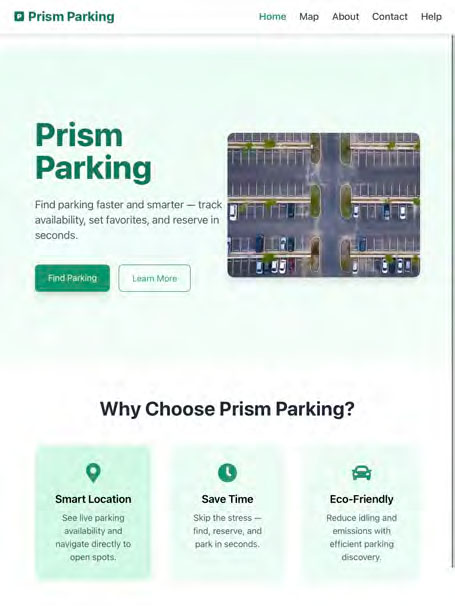
status are stored and updated in real time. A web and mobile application allows users
to view parking availability, visualize lot status, and access system insights.
By combining hardware, AI, database infrastructure, and an interactive app, PRISM delivers a scalable and efficient solution for modern parking management.
BlindEye - Indoor Navigation
Team Name
Rush Hour
Team Members
Daniel Eaker
George El-Khoury
Ismail Samara
Johnpaul Okafor
Internal Sponsor/Mentor
Dr. Pradhumna Shrestha
Abstract
To assist blind and visually impaired people with indoor navigation, BlindEYE is a wearable smart eyewear system that combines a camera, time-of-flight sensor, haptic bracelets, and on-device audio processing. Users provide voice commands that are processed locally to recognize target signs, including restrooms or exits, while the device uses directional haptic feedback to alert users of approaching obstacles. When the device recognizes a target sign, it provides the user with detailed audio instructions.
FamiliarFeeds - Smart Pet Feeder
Team Name
sWitch Lab
Team Members
Kirsten Guillory
Revigya Joshi
Grayson Kippes
Bailey Thibodeaux
Sean Yoon
Internal Sponsor/Mentor
Dr. Pradhumna Shrestha
Abstract
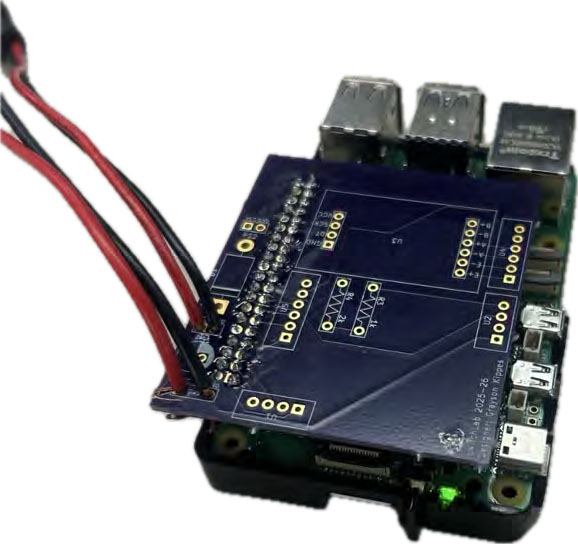
The FamiliarFeeds system is designed to provide a smart and automated way to feed pets by integrating peripherals and a mobile application. It monitors food levels, feeding activity, and environmental conditions inside the feeder to maintain accurate and consistent feeding. Peripherals such as weight, ultrasonic, temperature, and humidity sensors continuously collect data to track food availability and overall feeding status. The feeder follows scheduled feeding times set by the user through the mobile app, while also allowing manual feeding when needed. Data collected from the device is transmitted wirelessly and stored in a secure database which allows real-time synchronization between the feeder and the mobile application. This allows users to view feeding history, portion sizes, and feeder status at any time. The system also includes a camera with AI-based pet recognition to identify which pet is being fed which improves accuracy in multi-pet households. All data, including sensor readings and feeding events, is securely stored for reliability and tracking. The mobile application provides an easy-to-use interface for monitoring and controlling the system. Users can schedule feedings, view live updates, and receive notifications for feeding events or low food levels. These notifications include helpful details such as timestamps and feeder status. FamiliarFeeds enhances pet care by combining automation, real-time monitoring, and intelligent features.
A Modular Smart Plug System
Team Name
Socket
Team Members
Abhijeet Chahande
Anurag Chemakurthi
Harrison Gallo
Dylan Throckmorton
Internal Sponsor/Mentor
Dr. Pradhumna Shrestha
Abstract
This project presents the design and implementation of a modular Smart Plug system
that enables scalable, flexible, and autonomous control of household electrical devices.
The design consists of three primary components: a central Hub, a Base unit connected
to a wall outlet, and multiple modular Nodes that provide additional controllable
outlets. These components communicate through a combination of wired and wireless
protocols, allowing users to monitor and control power usage through a mobile application
or directly via the Hub interface.
The Smart Plug system addresses the limitations of traditional smart outlets by introducing
a modular interface and multi-device coordination. Each Node connects physically using
a USB-C connector, enabling seamless expansion without requiring additional wall outlets.
The Hub, powered by a microcontroller with wireless connectivity, serves as the communication
bridge between the Base and Nodes and the mobile application, supporting real-time
monitoring, control, and multi-room scalability.
The system has a focus on reliability and safety. It incorporates features such as a physical kill switch, automatic fallback to safe power levels during communication failures, and overcurrent protection mechanisms. Additionally, the system supports secure authentication, ensuring that only authorized users can control connected devices.
By combining hardware modularity, wireless networking, and user-friendly software, this project delivers a flexible and scalable solution for modern home energy management. The Smart Plug system enhances convenience, improves safety, and provides a foundation for future smart homes.