 University of North Texas

Electrical Engineering - Spring
Design and Development of a Head-Tracking FPV Camera Control Board
Team Members
Karla Frias
Jacob Shillingburg
Martins Ugoh
Internal Sponsors/Mentors
College of Engineering
Dr. Namuduri
Abstract
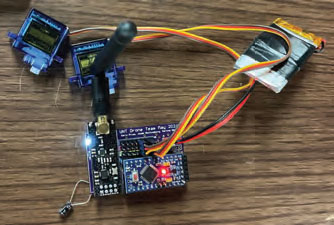
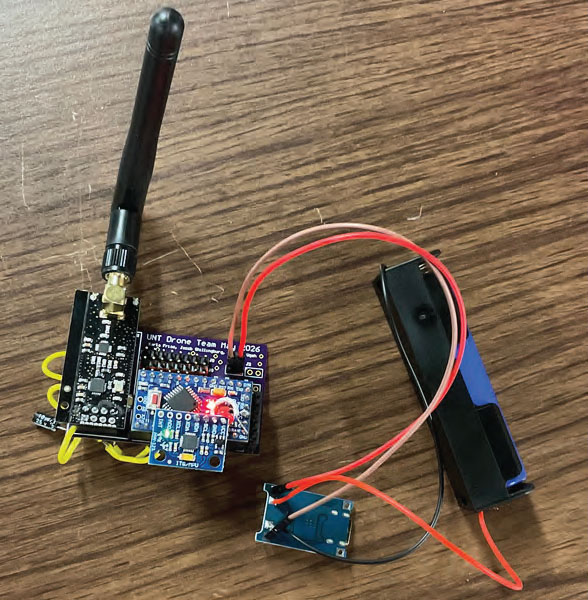
Our project presents the design and development of a head-tracking FPV camera control board for real-time remote viewing, with an emphasis on first responder support. The system allows an FPV camera to follow the natural head movements of a user, improving situational awareness and creating a more intuitive viewing experience for remotely operated systems such as drones. In emergency situations, this technology can help first responders inspect hazardous or hard-to-reach areas remotely before direct entry.
The design integrates embedded control, servo motor actuation, wireless communication, and a custom printed circuit board in a compact form factor. Our project focused on receiving head-tracking input, processing motion data, and transmitting control signals to a gimbal system for pan and tilt movement. The final result demonstrates the feasibility of a custom control board for FPV camera positioning and provides a foundation for future improvements in stabilization, communication range, and UAV deployment in emergency response applications.
Wind-Solar-Battery Backup Power System
Team Name
Smart Home
Team Members
Wyatt Thrasher
Eliud Martinez
Emmanuella Osei
Ibna Adhi
Internal Sponsor/Mentor
Dr. King Man Siu
Abstract
The problem we are addressing with our project is the frequent power grid failures across the state of Texas, leaving homes without power for extended periods of time. The solution to this problem is the wind-solar-battery backup power system that would initialize upon the disconnection of the main power system. For our projects creation specifically, we decided to focus on DC power by designing a DC-DC Boost Converter that would allow us to adjust and control the output voltage. In terms of the implementation of our project, the wind turbine and solar panel both are operational and recharge the 12.8 V LiFePO4 rechargeable battery as expected, and we have the battery then connected to the converter. The converter is then connected to a 12 V DC fan, which allows us to visualize the increase and decrease of the voltage output due to the speed of the fan being directly proportional to the voltage.
Solar Food Cart
Team Members
Sean Hash
Anthony Tran
Jose Villa
Internal Sponsor/Mentor
Dr. King Man Siu
Abstract
The Solar Food Cart presents the design and development of a solar-powered food cart that provides an environmentally friendly and portable solution for mobile food vending. The proposed system integrates a solar panel, battery storage, inverter, mini stove, and refrigeration unit to supply reliable off-grid power for cooking and cooling. With an emphasis on sustainability, the design aims to reduce dependence on fossil fuels while maintaining functionality and affordability. The solar array and battery system are engineered to support up to 1000 W of cooking power and maintain refrigeration temperatures between 2–8 °C for at least four hours. The food cart frame is designed to support a total load of 100 kg and remain easily movable by one person. This project demonstrates the potential for renewable energy integration in small-scale commercial applications, promoting sustainable practices in everyday food vending operations.
Tracking System
Team Name
Smart LoCATor
Team Members
William Borton
Ayse Colakoglu
Rayanna Morton
Stuardo Quinones
Internal Sponsor/Mentor
Dr. Sensong An
Abstract
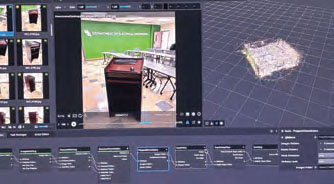
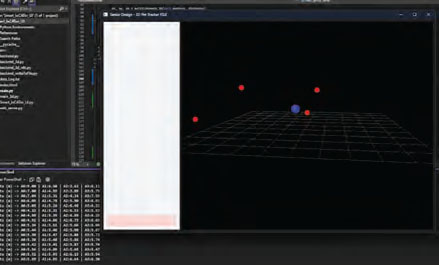
This project includes a tracking sysytem implemented using Ultra-Wideband (UWB) technology, Time Difference of Arrival (TDoA) algorithms, and photogrammetry. Due to the nature of UWB, this product is more precise than GPS and less suceptable to interference than Bluetooth. Distances from anchor points to the tracker/tag are filtered using a nonlinear least squares algorithm. From this data a 3D visual is created. A user friendly web app will provide easy accesability to the tracker’s past and present location on this 3D map. We aim to texture the 3D map by using photogrammetery proccesses to mirror the environment that the tracker is in.