 University of North Texas

Materials Science and Engineering
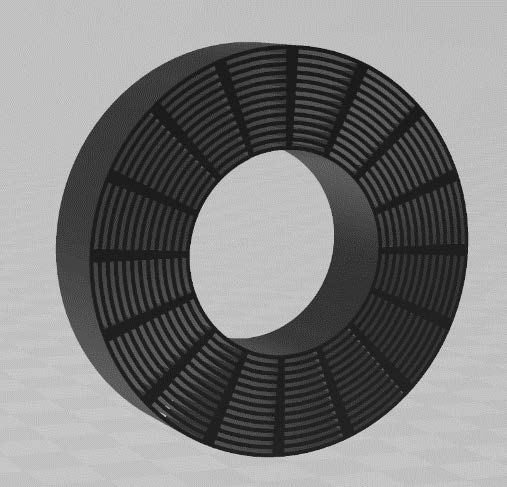
Additive Manufacturing of Fe6.5Si Transformer Cores
Team Members
Abdul Al Fahdi
Tao Hu
Ali Zayaan Macknojia
John Tran
Internal Sponsors/Mentors
Dr. Raj Banerjee
Dr. Narendra Dahotre
Dr. Sameehan Joshi
Abstract
Additive manufacturing (AM) is a growing and emerging field for replacing traditional processing techniques of transformer cores. Producing transformer cores using traditional processing with compositions greater than 3 wt.%of silicon in iron is limited due to increases in brittleness, cracks, and failure of casted Fe6.5Si. The advantages of using higher silicon contents are improved resistivity and soft magnetic properties. This project tackles the difficulties of AM for Fe6.5Si printed parts. These difficulties includes pores, cracks, lack of fusion, and many more defects during the printing process. Laser power, scan speed, hatch-spacing, and scan pattern are optimized to produce relatively high density Fe6.5Si samples. The magnetic properties of the printed samples are measured using a vibrational sample magnetometer. Combined results of physical properties, characterization methods, and magnetic measurements are considered for the printing of a low porosity and functional toroidal transformer core.
Acknowledgments
The project members acknowledge the services of the UNT’s Center for Adaptive and Agile Additive Manufacturing faculty for assistance with equipment operation.
Design of a Process to Diamond Hardface a Ceramic
Team Members
Samuel Brooks
Roberto Liam Menchaca
Landry Westrich
Drake Mitchell
Internal Sponsors/Mentors
Dr. Thomas Scharf
Christian Gracia
Jonathan Rodriguez
Abstract
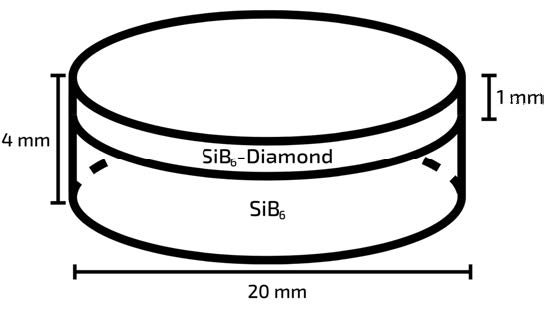
This project designed a process to create a distinct hardface layer of diamond composite bonded to a ceramic substrate in a single Spark Plasma Sintering (SPS) step. Hardface layering is traditionally a multistep process and by reducing this into a single step the economic and ecological effects of reducing total sintering time will be a net positive. Samples were made at multiple sintering temperatures for each layer of the composite. From these samples we were able to determine the mechanical properties and density of the materials to select the optimal sintering parameters. By determining the density of each layer individually, we were able to calculate the amount of powder needed to fabricate a sample with specific dimensions. The resulting microstructure of the hardface composite showed homogeneous dispersal of diamond particles with expanding layers of intermediate materials bonding them to the SiB6 matrix. The hardface composite bonded to the SiB6 substrate uniformly and the reaction formed a denser intermediate phase. The result was a repeatable process to successfully fabricate an ultrahard diamond-ceramic composite hardface on a ceramic substrate in a single SPS step.
Introducing Porous Structure into Liquid Crystal-Elastomers
Team Members
Yuheng Wang
Guanying Li
Yubing Chang
Internal Sponsor/Mentor
Dr. Xiao Li
Abstract
The liquid crystal elastomers (LCEs) are a group of polymer materialswhich combineorientational properties and rubbery elasticity properties. These unique properties combination give the LCEs material capability of reversible and programmableshape change under external conditionssuch as temperature, UV light and electric stimulus. Hence, LCEs are ideal material that could be utilized in manufacture of the self-driven actuator with complicated deformation. In our design, we will focus on the LCE synthesis composition development and the design of LCE actuator with self-driven deformation under different temperaturesand introduce porous structure to improve the response sensitivity and enlarge the deformation of the LCE actuator.
Design of Degradation-Resistant Amorphousalloys for Bio-Implants
Team Members
Rawan Al Sulaimi
Olivia Williford
Peumi Ratnayake
Internal Sponsor/Mentor
Dr. Sundeep Mukherjee
Abstract
Currently bio-implants are susceptible to degradation in aggressive physiological environments such as the human body. Amorphous alloys have become a new strategy to circumvent degradation from wear loss. For this design project we will create amorphous Cobalt-Phosphorus(Co-P) to be coated onto copper substrates through electrodeposition. The goal is for this material to outperform biocompatible Stainless steel (SS316L) in terms of wear resistance. The change from nanocrystalline to amorphous during the electrodeposition process is caused by the phosphorus (P) content in the alloy, the material is fully amorphous at 10 at% P. Samples with 10-20 at% P were electrodeposited and characterized; SEM data showed uniformity in Co and P content throughout the substrate. Increasing P content increases the hardness which affects the tribological properties. Hardness was tested using nanoindentation technique, amorphous Co-P with 20 at% P -highest P content- showed most hardness compared to 10 at% P and SS316LL. The wear tracks were scanned using 3D optical profiler for visualization and calculate wear volume loss of the alloys studied in different systems. Wear tests were performed in dry and wet physiological environments showed that Co-P alloys had lower wear rate by more than an order of magnitude than conventional used bioimplant alloy SS316L. Similarly, the Co-P alloys showed lower coefficient of friction than SS316.
Acknowledgments
We would like to give special acknowledgement to Chaitanya Mahajan for his help and guidance throughout the project. We would also like to give thanks to Pei Ziyu for helping us with our wear rate data.
Additive Manufacturing of Inconel 718 Using Selective Laser Melting
Team Members
Devin Davis
Chase Hoherz
Jason Summers
Internal Sponsors/Mentors
Dr. Aidin Imandoust, mentor
Prithvi Awasthi, mentor
Dr. Srinivas Aditya Mantri
Shelden Dowden
Abstract
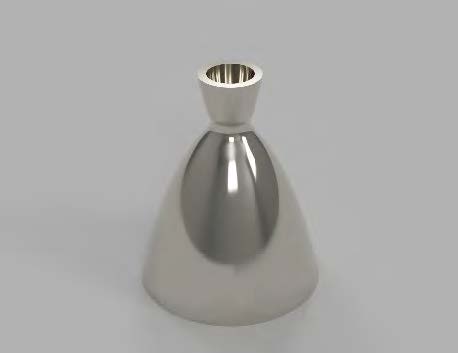
Additive manufacturing (AM) is becoming more prevalent as the technology expands. AM offers advantages over traditional manufacturing by reducing part completion time, reducing material waste, offering remote manufacturing, and the ability to print complex structures. However, complex geometries make print parameter optimization difficult which can often require several iterations. Additionally, AM parts do not have equal mechanical properties in all directions, most notably the vertical direction. The goal of this project is to design and optimize selective laser melting (SLM) printing parameters for Inconel 718 nickel-base superalloy, to reduce the directional dependence of mechanical properties in rocket nozzle geometry.
Acknowledgments
We thank the University of North Texas and the Center for Agile and Adaptive Additive Manufacturing (CAAAM) for making this project possible.
Ultra-High Temperature Ceramics for Hypersonic Vehicle Applications
Team Members
Slater Caldwell
Ernest Cubit
Jessica Harris
Zane Wright
External Sponsor/Mentor
Evan Ober
Internal Sponsor/Mentor
Dr. Samir Aouadi
Abstract
The ever-growing momentum of the private space industry has brought ideas such as commercial interstellar travel close to becoming reality for the public populace. This, in turn, has created an equally increasing development of advanced technology applications designed to increase hypersonic vehicle performance for the intensive operating conditions of re-entry environments. However, implementing these performance applications demands significant increases in the thermal properties required of the structural material.
Therefore, the goal of this project is to design a structural component material for the thermal protection system used in hypersonic vehicles with sharp leading-edge applications for improved aerothermal performance in harsh oxidizing re-entry environments.
Acknowledgments
Many thanks for Dr. Samir Aouadi, Dr. Nigel Shepherd, Dr. Marcus Young and graduate student Evan Ober for assistance and guidance for our Senior Design Project.
Electronic Ceramics for 5G Applications
Team Members
External Sponsors/Mentors
Internal Sponsors/Mentors
Abstract
New materials must be made to accommodate new 5G standards. To accomplish this, there will be a rising demand in the design of high-Q dielectrics with zero thermal coefficient of resonant frequency. The impact of this material will result in an antenna that is capable of transmitting more data than conventional metal antennas. This increased data rate will allow more people and devices to communicate facilitating a faster more interconnected world.
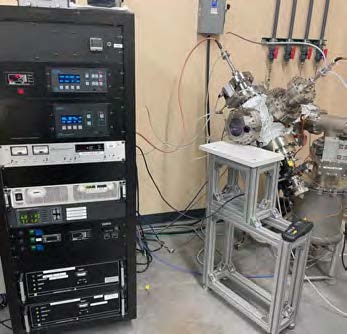
Our goal is to employ co-deposition via radio-frequency magnetron sputtering and pulsed laser deposition to produce a thin film of Li2TiO3 and ZnO to reach a target composition of .7Li2TiO3-.3ZnO. This material has shown that the quality factor (representation of energy loss due to dielectric polarization) is high enough to handle 90,000 GHz, 40,000 GHz over the minimum quality factor literature recommends for the new 5G standards. While the material has a temperature coefficient of resonant frequency of zero (the electrical properties will not change due to temperature changes).
Grown thin films were characterized by EDS, XPS, and XRD to determine the composition and degree of crystallization of our deposited thin films.
Acknowledgments
We would like to acknowledge David Garrett for training on SEM, Saul Sepulveda for training on XRD, and Corey Arnold and Renzo Sanchez for assistance in gathering XPS data.