 University of North Texas

Mechanical Engineering Technology
Anti-Tamper Handwheel


Team Members
Eduardo Quintana
Caleb Stephenson
Leduar Avelar
Jowel Malik
External Sponsors/Mentors
Jason Wipf
Bobby Bobeck
Internal Sponsor/Mentor
Dr. Seifollah Nasrazadani
Abstract
Master Flo Inc. was founded in 1979 with a focus on the manufacturing of valves, pipeline, and pipe fittings. The company is constantly adapting to fit the needs of their customers; because of this, our team was appointed to analyze how to improve the protection system of a valve handwheel to prevent the mechanism from any theft or tampering. Handwheels being tampered with have been a major issue in the oil and gas industry for many years and there has been no cost-effective solution to this day. Our team has created a design that is free spinning handwheel when not in use and can be engaged at the user's expense to prevent tampering of any kind. Based on the collection of data that was provided by Master Flo sponsor Mr. Jason Wipf, there has been no cost-effective way of protecting a valves’ handwheel from theft or tampering. Our group was set out to create a valve protection system with specific design criteria. The group was asked to create a mechanism that is not expensive, easy to install by engineers and technicians, and doesn’t cause any changes to the original design of the handwheel. The final design created will be tested over its safety, functions, stress response, and how easy it is to install or uninstall the handwheel. Our final design was created to be used with numerous different size valves and is meant to be universal. After nine months of designing, planning, and fabricating, our group was able to create a mechanism that can spin freely when not in use and is able to engage with a magnet mechanism when needed. Our group successfully followed the criteria and designed a part that prevented any tampering to the handwheel.
Anti-Cavitation Choke Trim


Team Members
Jimmy Weng
Javier Campos
Geoffrey Balkcom
Juan Lira
David Sanchez
External Sponsors/Mentors
Master Flo Valve (USA) Inc.
Jason Wipf
Bobby Bobeck
Internal Sponsor/Mentor
Dr. Maurizio Manzo
Abstract
In today’s world there are many minor issues that could be solved or reduced with new or improved technology. A common issue that impacts many oil and gas companies is cavitation.
The goal of this project is to reduce the cavitation occurring inside the valve. In our situation, when the fluid is released by the needle and enters and contacts the choke trim, cavitation occurs. The pressure created by collapsing bubbles is the main factor of cavitation and what we want to eliminate.
Our design mitigates pressure inside the valve and has its own direction of flow to reduce cavitation. This design will prolong the life of valves and ultimately save the company time and money.
Anti-Erosion Choke Trim

Team Members
Jesse Slyder
Adalberto Perez
Aaron Johnson
Abdulmohsen Alhammad
Jarret Theriot
External Sponsors/Mentors
Jason Wipf - Master Flo
Bobby Bobeck - Houston Oilfield Equipment
Internal Sponsor/Mentor
Leticia Anaya, PhD
Abstract
Tasked with engineering a choke trim to resist the erosive effects of oil and gas production, the team determined that an unconventional flow path could reduce velocity at the vena-contracta therefore reducing particle impact velocity along the choke trim.
SOLIDWORKS® flow simulation was utilized to model design iterations, resulting in a final design durable enough for usage in the oilfield. The modified valvular conduit, or “Tesla valve,” unlike its namesake, has multiple inlet ports not exceeding 60° to reduce erosion. The changing internal flow direction impeded flow from the inlet, causing reduced rates and increased differential pressure across the 4 inch length of the valve insert Team produced.
The Team did not have a control group to compare the design to. The anti-erosion choke trim that comprised the experimental group, was the only sample data that was tested. With this in mind, it is difficult to compare erosion rates of the Team’s design to existing designs already in use in the industry.
Acknowledgments
Special thank you to Omar Cavazos (PhD candidate) and Balmore Giron for their help.
Low Friction Threading
Team Members
Tanner Rubino
Jacob McAdams
Justin Crader
Jacob Sadler
Guillermo Lara
External Sponsors/Mentors
Master Flo Valve Inc.
Jason Wipf
Bobby Bobeck
Internal Sponsor/Mentor
Dr. Diana Berman
Abstract
Master Flo Valve Inc. is a global oil and gas flow management company that strives to lower costs and optimize production through reliable products. They specialize in choke valves, control valves, actuation, and automation. Our team has been tasked with finding a way to reduce friction experienced by their valve threads. These valves are under a great amount of pressure, maxing out around 10,000 psi. This pressure is causing the threads on the stem of the valves to experience galling. Galling is a form of cold welding, and when this happens the valve can no longer function until a replacement part is installed. Along with lowering the friction forces we are to produce a solution to prevent galling from occurring.
The solution that has been decided upon is to coat the valve threads with a dry lubricant coating. Graphene, WS2 (Tungsten disulfide) and MoS2 (Molybdenum disulfide) are the three coatings being applied. Each of these coatings yield a reduction in friction forces, while also providing a layer of defense between the male and female threads. Since galling is more prone between like metals, the barrier provided by the dry coating will lessen the likelihood of galling taking place. By coating the threads instead of choosing to manufacture new threads out of a different material, we have significantly lowered the cost of implementation.
Acknowledgments
Special thanks to Jason Sadler, Carlos Hernandez, and Mason-Dallas Inc. for their help and support.
3-D Printed Molds for Manufacturing of UAV Blades

Team Name
UAV Technologies
Team Members
Sean Evans
Kevin Garcia
Gage Jones
Alex Arellano
Alonso Rodriguez
External Sponsor/Mentor
Army Research Laboratory (ARL)
Internal Sponsors/Mentors
Dr. Hector Siller
Cesar Chavez Tolentino (PhD candidate)
Abstract
The Army Research Lab (ARL) has tasked us with creating a 3D printed mold in response to a growing demand of drone propellers. The purpose of this project is to create a mold that will be used to make UAV blades in a more cost efficient and timely manner. The UAV blades will be tested using a wind tunnel and aero acoustic chamber. The data from the manufactured UAV blade test will be compared with commercial blades and modified to compete with blades in the market.
The mold has been additively manufactured using a FDM 3D printer. It will be made using a thermoplastic. The blade itself will be made by pouring a mixture of epoxy resin into the mold. The mold is smoothed using PolySmooth to make sure the blade has the right texture.
The goal of this project is to have the blade be able to compete with commercially sold UAV blades in terms of performance and durability. This will allow the Army Research Lab to make their own propellers without having to outsource and is especially needed overseas where materials take time to arrive onsite.
Laboratory Equipment for Single-Phase Liquid and Two-Phase Immersion Cooling
Team Name
Hydra
Team Members
Jacob Banda (Team Lead)
Deisy Yanez
Seth Angelone
Conner McEllhiney
Brian Rodriguez
Timothy Nga
External Sponsor/Mentor
ASHRAE
Internal Sponsors/Mentors
Dr. Bostanci, Advisor
Laura Almara, PhD candidate, Mentor
Abstract
With this project we are researching and developing a form of liquid cooling for servers that will operate more efficiently and be more cost effective than that of the standard air-cooled system.
With the single-phase liquid cooling system, the server will have tubes that connect the system's pump, radiator, reservoir, and cold plate together. The cold plate will be a unique design created in house using powdered metal bed fusion in order to maximize heat dispersion from the server’s CPU.
With the two-phase immersion cooling system, the server will be completely immersed in a dielectric fluid that will not damage or negatively affect the server. This will take place in a polycarbonate tank sealed with an aluminum lid featuring an attached copper condenser with coolant circulating through it. When the dielectric fluid absorbs heat through boiling and rises as vapor, the condenser will cool the vapor and bring it back to a liquid state ensuring continuation of cooling cycle for the CPU.
Acknowledgments
We would like to thank Dr. Siller for his support in the manufacturing process of a custom cold plate design.
Modular Data Acquisition Training System for Thermal-Fluids Applications
Team Members
William Novinski
Octavio Silva
Travis Causey
Tobechi Iheme
Rodrigo Vivar III
External Sponsor/Mentor
Nuclear Power Institute
Internal Sponsors/Mentors
Dr. Huseyin Bostanci
Bobby Grimes
Abstract
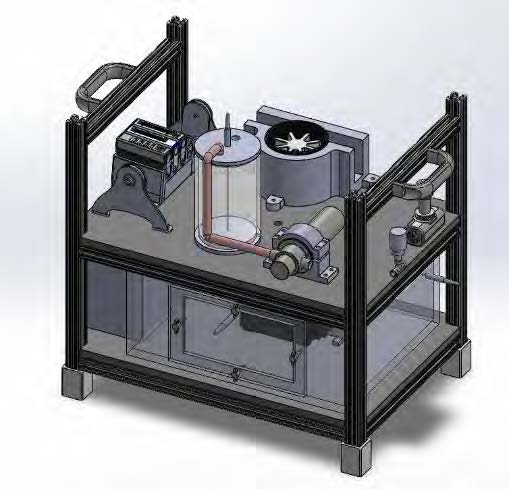
The Modular Data Acquisition Training System for Thermal-Fluids application is a lab testing unit that will aid the University of North Texas conduct and facilitate labs for Experimental Thermal Sciences. The project is proposed by Dr. Bostanci and is sponsored by TEES Nuclear Power Institute.
The testing unit is a closed system that pumps heated water through a small radiator that is located inside a controlled air chamber. A fan attached to the radiator forces air through and cools down the heated water and pumps it back to the water tank to be heated. The system encourages students to utilize NI data acquisition modules and LabVIEW software to set up experimental conditions, control heaters, pump, and fan, and collect data via thermocouples, pressure transducers, and flow meters.
The main objective is for this testing unit to aid students understand and practice data acquisition processes through multiple thermal-fluid experiments.
Cloth Mask Sanitizer

Team Members
NainaThing
Mohamad Khodr
AtoolKhadka
Erick Perez
Judah Thomas
External Sponsor/Mentor
Bobby Grimes
Internal Sponsors/Mentors
Dr. Hassan Qandil
Mechanical Engineering Department
Abstract
The main concept after building this device was the outbreak of Covid-19, when the use of mask uprise. With that there was option of using use-and-throw mask or cloth mask and when masks are used overtime, it can lead to a buildup of dirt and bacteria. This study aims to design and build a device that is time and cost efficient, which kills the active bacteria, and prevent its growth.
To evaluate the necessity of such a device, a brief survey poll was conducted among 37 staff members at Baylor Scott & White in Waxahachie, TX. After the survey, it was determined that the need of this device was not only for Covid-19 cases, but it can also be used for other sanitizing purposes.
The main components of this device are UV-light, steam, and hot air that effectively kills the bacteria ensuring the safety. Based on the components, the device must withstand the temperature changes within it.
Unmanned Aerial Vehicle (UAV) Drivetrain
Team Members
Loren Clary
Amos Hargrove
Megan Boudreau
Trenton Magryta
Joseph Espinosa
External Sponsor/Mentor
Army Research Lab (ARL)
Internal Sponsors/Mentors
Dr. Mark Wasikowski
Bobby Grims
Abstract
The problem to be solved is when a UAV is flying laterally, roughly half the power is required compared to when the UAV is in a steady state of hovering. The end goal is to find a way to switch between one motor running when moving laterally to two motors running when hovering. This problem is theoretically solved when one motor is turned off midflight so that the other motor is the only one propelling the drive train. The ARL tasked this team with finding the control system to solve this problem of making that switch from two motors to one motor possible. This is a unique solution, because it will increase surveillance flight capabilities for the UAV systems.
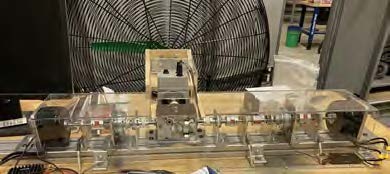
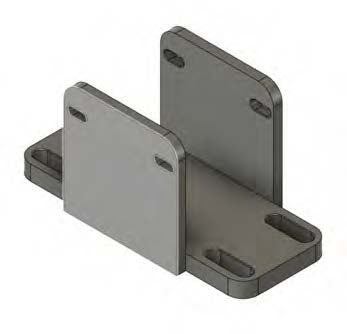
The big hurdle in the path to a control system is having a working bench model to utilize while building the program. This involves two motors, a drive shaft, a differential, and a fan to be driven. Previous teams fabricated the fan blades and safety shields while working on getting the components to function properly. Due to a failing of the original motors, new motors had to be purchased and mounted. The image shown is the most recent iteration of the motor mount being fabricated to get the bench fully operational.
Pneumatically Powered Portable Lifting Device
Team Members
Henry Justiniano
Alberto Ramos
Mason Mikeska
Jorge Moreno
Nathan Shipp
External Sponsor/Mentor
Dr. Mitty Plummer
Internal Sponsor/Mentor
Dr. Mitty Plummer
Abstract
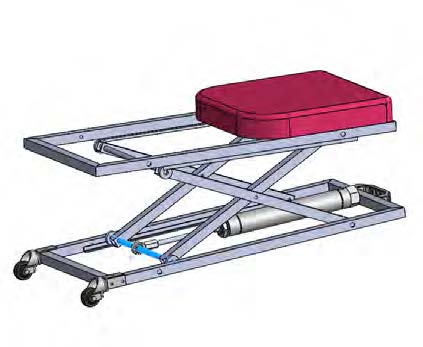
The task given to us was to design and manufacture a portable lift using pneumatics as the method to lift 300 lbs vertically 19 inches. This idea started when our sponsor observed an individual struggling while doing garden work around the house and requiring a chair that acts as a lift to assist getting up and down from gardening. Our main goal was to help lift a person, but it will also be able to help lift other items onto higher surfaces.
The requirements for our lift is to be able to lift 300 lbs., lift vertically 19 inches and sit parallel 4 inches to the ground, be 16 inches wide, portable, lightweight, battery powered and operate using pneumatics.
What makes this lift different from the others is that it will use a rechargeable battery, lift with a click of a button, use a pneumatic cylinder to raise the platform, and it will be at an affordable price. Currently, there are many lifts on the market that use hydraulic cylinders and each one is either more than $500 or are operated manually.
Design Improvements on a Vehicle Extrication Device
Team Members
EanRobertson
Nicolas Olivarez
Heather Clark
Jett Leach
Hussain Aun
External Sponsor/Mentor
Dr. Todd Dombrowski (CEO of SKII)
Internal Sponsor/Mentor
Dr. Reza Mirshams P.E.
Abstract
During the month of February in 2021, Texas endured a devastating ice storm. Driving conditions were poor, resulting in a pile-up on I-35 of 130 vehicles. There were around 5 deaths and 36 hospitalizations attributed to this incident. One casualty was not from injuries sustained during impact, but from hypothermia; first responders were not able to retrieve the passenger from the tangled metal in time.
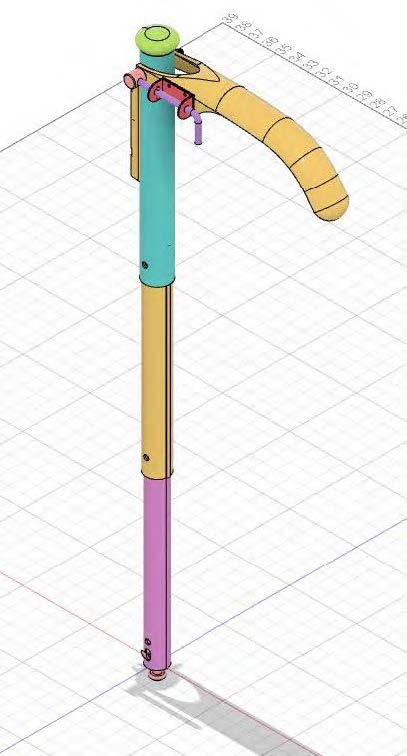
First responders have plenty of tools at their disposal for emergencies such as these but having to switch between them wastes precious time and energy. This proposed multi-functional prototype includes the use of most of these traditional tools, along with added benefits such as a hook for pulling passengers from spaces where arms cannot reach.
The goal is to reduce victim extraction time with a durable, multi-use tool that is still light weight and easily stored in an emergency vehicle.
This is Just Action Kareful Extraction (J.A.K.E.) V3.
Acknowledgments
Dan Cahale for his assistance building prototype V1 & V2 Motus Labs, L.L.C. for access to their CAD/CAM equipment
Motorcycle Carrier
Team Members
Michael Gonzales
Hector Portillo
Andrew Littlepage
Deven Patel
Pearce Polcyn
External Sponsor/Mentor
Motohiker
Internal Sponsor/Mentor
Dr. Leticia Anaya
Abstract
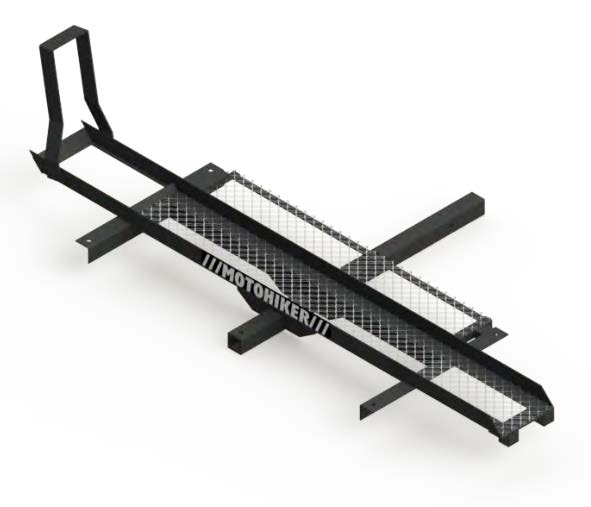
The fabrication of a motorcycle carrier that can more safely transport a motorcycle was our main goal. The motorcycle carrier previously had issues with wigging components, torsion during heavy decelerations and high stress concentrators. This new design will be more rigid and will also allow the user to easily mount the motorcycle by an extended ramp with tilt motion that will tilt the carrier towards the loading side. Once the motorcycle is being rolled up the ramp, the carrier will tilt back. The tilt motion is a unique and effective feature that will help the user apply less body force to safely mount the motorcycle. The idea is to use gravity and center of mass to tilt the ramp. When the bike is fully onto the carrier, the new center of gravity rotates the ramp into position. The carrier then is securely pinned into place. The carrier also utilizes secure tie down locations and follows all street legalities. This is a heavy-duty carrier for all adult size motorcycles; as well as a safe and secured travel for the towing vehicle. This product is unique in its design. Most carriers have a ramp to roll up but for our product the whole carrier tilts over for an easier loading option including a ramp extension.
Acknowledgments
For the guidance and abilities offered, we would like to thank:
Dr. Huseyin Bostanci, Laura Almara (PhD candidate), Rick Pearson, and Bobby Grimes.