 University of North Texas

Computer Engineering
Advanced Spacecraft Lighting Control System
Team Name
UNTitled
Team Members
Ali Hammoud
Alejandro Bacallao
Nicholas Tindle
External Sponsors/Mentors
George Salazar
Dr. Tim Urban
Internal Sponsors/Mentors
Dr. Robin Pottathuparambil
Alejandro Olvera
Abstract
In space, crew members will not be able to maintain their circadian rhythm, so we are creating an advanced lighting system to help maintain that. In addition to maintaining human circadian rhythm, we are also creating profiles to aid growing plants on a spacecraft.
This advanced lighting systems will be part of a network bus to permit control from a central control station GUI and a tablet. We are achieving these goals by having an ecosystem of Raspberry Pi’s to monitor the entire system. We will have a main Pi as our acting server, and the other pi’s to send, receive data between sensors. A touchscreen LCD powers by lineage OS on a Pi4 will also be incorporated to communicate between the user and the server. This will also be app hosted on Android compatible devices.
Each part of the system is designed to work independently, which will provide advantage in case of any errors, malfunctions, or hardware failures. Also, having a main server communicate the information through a controller to the rest of the system will allow for better streamlining and free up resources for other data.
Machine-Learning Human-Computer Interface System
Team Name
HDS
Team Members
Chris Herzberg
Jordan Shrum
Elle-Marie DeFrain
External Sponsors/Mentors
NASA
Texas Space Grant Consortium
George Salazar
Internal Sponsor/Mentor
Dr. Robin Pottathuparambil
Abstract
As we move closer to deep space exploration, the issue of communication times between a spacecraft and the control center makes human monitoring of the crew infeasible. As astronauts are away from home for long periods of time, the concern of performance degradation from both mental and physical ailments is a serious concern. As such, a system to detect degraded performance and notify the user by displaying warnings and offering guidance is necessary. In the case of critical, potentially life-threatening emergencies, the system will need to act quickly to avert serious injury or loss of life. Due to the complex nature of space exploration and unpredictable development of potential problems, the system must also be dynamic in order to adapt to new and changing circumstances. To address this issue, we will be designing a machine-learning human-computer interface system that will learn to properly monitor and if necessary, control the systems by learning how each crew member interacts with the computer systems during optimal conditions. The computer will then be able to detect and take measures to correct any degradation in crew performance without the need for outside human involvement.
Acknowledgments
We would like to thank Dr. Robin Pottathuparambil, Alejandro Olvera, and our friends and family.
Water Monitoring System For Automated Inland Shrimp Production
Team Name
Eagle Squad
Team Members
Fuad Salameh
Joe Selvera
Muna Nwosu
Qiang Si
External Sponsor/Mentor
Dan Combe
Internal Sponsors/Mentors
Dr. Robin Pottathuparambil
Alejandro Olvera
Abstract
The US imports 90% of its shrimp, which is expensive. In 2016, the US imported 603,986 metric tons of shrimp, and in 2019 that amount increased to 698,358 metric tons. The average cost of these imports is around $8 per kg. The goal of this project is to build an automated system for raising shrimp, which in turn will help to reduce the amount of imports the US needs for shrimp, and decrease the cost per pound for imports over time. This project is unique, as currently in the US, there are only a few places that cultivate shrimp inland.
Smart Door
Team Members
JeanAaron Oyima
Marshall Bothwell
Mohammed Khan
Srijan Singh
Tyler Mccall
Internal Sponsors/Mentors
Dr. Pradhumna Shrestha
Alejandro Olvera
Abstract
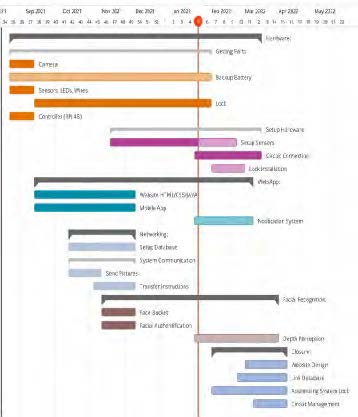
In this project, we seek to make the household security device “The Smart Door”. The Smart Door is a modern alternativetothe old lock and key. The system will use Facial Recognitionto unlock doors instead of a physical key. The system will be integratedto smartphones through apps, through which the user can enjoy featuressuch as looking at lock/unlock logs, checking photos of those who have entered, and use an override unlock in case a guest comes in. The system will have a batterybackup and will be wirelessly connected to the internet.
Lawn Health project
Team Name
BlackCat
Team Members
Joshua Kramer
Jessica Nwachukwu
Enock Omweno
Yahriel Negrete
Arturo Lopez
Internal Sponsors/Mentors
Dr. Pradhumna Shrestha, Faculty Mentor
Alejandro Olvera, Lab Manager
Abstract
The purpose of the Lawn Health project is to provide a low cost, but effective way for people to monitor their lawn. Many people who buy property do not know how to properly care for their lawn, so the Lawn Health system is created to bridge the knowledge gap and help those who already know a considerable amount to improve the health of their lawn even more.
The Lawn Care device is a cube about 6 inches on each side with probes coming out of the bottom that allows you to stake the device into your lawn. It is accompanied by 3 sensors; a temperature sensor, a humidity sensor and a pH sensor. These three sensors are connected to an online database that stores periodic measurements of your lawn. The database is then connected to an app that allows the user to view their most recent lawn health measurement on multiple Lawn Health devices that may be in the lawn. Additionally the app will send a daily notification to the users’ phone that gives a basic summary of the lawns health. If at any point throughout the day a sensor reading falls out of range of a set standard, the app will send an alert to the phone that tells the user which device and which sensor needs attention from the user.
IoT in Agriculture
Team Name
Brain Drain Crew
Team Members
Richard Gallemore
Johnson Nguyen
Izundu Ngwu
Michael Samatas
Internal Sponsors/Mentors
Computer Science & Engineering Department
Professor Pradhumna Shrestha,PhD.
Alejandro Olvera
Abstract
Humans have practiced and developed agriculture for thousands of years to satisfy a critical need - food. Population growth, limited resources and innovation fuel the drive to improve agricultural technology. This report details how we incorporate a 21st century computing technology, Internet of Things (IoT), in agricultural science to aid the farmer.
Our IoT in agriculture project digitizes the concept of monitoring a field farm -the soil conditions, the crops’ health, as well as the surrounding environment. This is achieved by placing sensor clusters that measure different characteristics of the system, such as temperature, moisture levels, pH levels, humidity and report this data to the farmer through a mobile app. Each sensor cluster(node) is an array of sensors connected to a Bluetooth-enabled node. Multiple nodes are strategically spread around the field to collect data about specific areas. This information is sent to a server running a program that analyzes the node data and determines recommendations that offer the best crop performance. These recommendations as well as any concerning statistics are then presented to the farmer via a mobile app.
Although our project is on a smaller scale, IoT in agriculture could be used on much larger farms to improve efficiency. Reducing harvest waste, maximizing resources, and expansive, real-time monitoring are some of the significant advantages this system offers the modern farmer.
Acknowledgments
Much appreciation to Dr. Shrestha and Alejandro for their support and guidance through this process.
Heatmap Monitoring and Alert

Team Name
Heatwave
Team Members
Mohammed Alkahtani
Yashira Crespo
Nekhad Hossain
Katharine Lee
Hemnarayan Sah
External Sponsor/Mentor
RocioRoman
Internal Sponsors/Mentors
Dr. Pradhumna Shrestha
Alejandro Olvera
Abstract
Due to the recent outbreak of Covid-19and its surging variants, it's important to trace the symptoms of the virus, one of the most common being a high temperature. This can be difficult since implementations can result in complicated systems thanks to many variable factors. The specific goal of this project is to create a heat mapping system that utilizes thermal camera imaging to estimate the temperature of a person's exposed skin. By using a thermal sensor camera along with a microprocessor, any person exhibiting a Covid-19 symptom like fever, will be detectable on the camera. Once this detection has taken place, it will be flagged, and a notification will be sent to the administrators so that precautions can be taken to quarantine the area to limit the spread of the infection. This will keep the virus from spreading among the public in large numbers, since exposure in small areas increases the risk of contracting the virus. This system has been designed with privacy in mind and was not developed with any type of identification in mind making it safe for public spaces.
Acknowledgments
Special thanks to Pradhumna Shrestha and Alejandro Olvera.
Healthcare Monitoring System
Team Name
No Signal
Team Members
Owen Westfall
Kerian Akamnonu
Shankar Subedi
Sushan Sainju
Internal Sponsors/Mentors
Dr. Pradhumna Shrestha, Faculty Mentor
Alejandro Olvera, Lab Manager
Abstract
Our Project seeks to solve an issue for those in assisted care where their caretakers would have to always be nearby in order to care for their patients. The problems that result from this include caretakers only be able to take care of a few patients and little idea of what is going on when they aren’t at the location. For us to tackle this problem we are creating a system that will allow the patients to wear a device that will in real time upload their health information to a server for the caretakers to view on an app. This way the caretaker does not have to be present to ensure the patients are healthy as well as they can check up on them if their vitals are not up to par.