 University of North Texas

Mechanical Engineering Technology
LinkUp International Fuel Crane
Team Name
LinkUp International Fuel Crane
Team Members
William Becker
Allison Carlton
Reed Cheatham
Garrett Jonse
Drew Trojacek
Sponsor
LinkUp International
Abstract
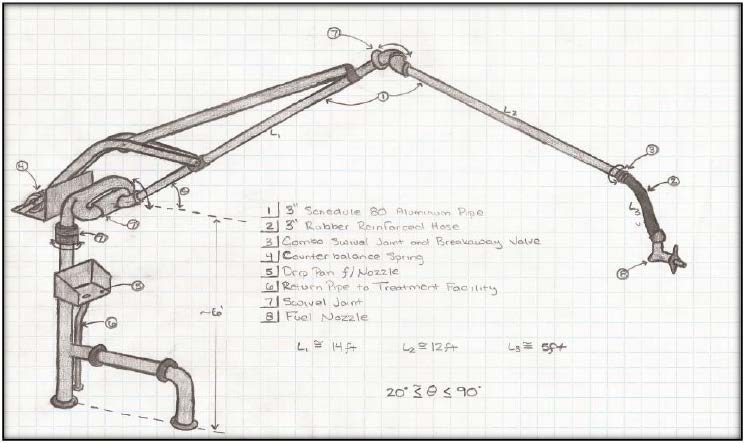
The LinkUp International Fuel Crane is a unique project that will increase the overall efficiency of fueling locomotives in the railroad industry. The ergonomic design is based on the idea of using only mechanical parts that can be maintained regularly in a simplistic and timely manner. Incorporating this idea into each aspect of the device presents many advantages that can be realized daily. When controlling the mechanism, the operator will observe that large amounts of physical exertion are not required in order to manipulate the members, movement of the device is smooth and consistent, and the wide range of positions and distances that can be reached will decrease the amount of resets that are done in order to place the locomotive within reach of the fuel nozzle. Additionally, the mechanical configuration allows for parts to be interchanged and replaced in the field by properly trained personnel. This allows workers to manage and repair necessary parts at any given point in time in order to avoid the equipment being out of commission for an extended period of time. The fuel crane also includes a waste treatment system that is intended to protect from any environmental hazards that may occur.
Formula SAE Suspension
Team Name
Formula SAE Suspension
Team Members
Reid Cloud
Trevor Davies
Clayton Geer
Kevin Hill
Sponsors
College of Engineering, Monster Tool, Bell Helicopter, Mayday Manufacturing, Fastenal
Abstract
The University of North Texas (UNT) Mean Green Racing team is responsible for the
design and manufacturing of the 2016 Formula SAE racecar suspension system. Formula
SAE is a competition composed of only active college students where each participating
University has a team that constructs and tests a small Formula-style racecar based
on set restrictions. The prototype race car is then evaluated for its potential as
a production item for the non-professional, weekend, competition market. This racecar
then enters a competition located in Lincoln, Nebraska to compete against other Universities
in both design and performance. This team is specifically responsible for the steering
system, control arms, shocks, hubs, uprights, anti-roll bar, and tires for this racecars
suspension system. SolidWorks, a type of computer-aided design (CAD) software, is
used to
precisely design these suspension components to meet design specifications. Advanced
suspension software and finite element analysis (FEA) is then used to test how each
design responds to forces, vibration, heat, and other physical effects. This team
was able to build off the foundation laid out by previous UNT Formula SAE teams by
reducing weight, optimizing designs, and refining manufacturing processes. Several
of our sponsors are machining parts to specifications using CNC technology.
Formula SAE - Ergonomics
Team Name
Formula SAE - Ergonomics
Team Members
Travis Kerr
David Gradinaru
Kennith Hindman
David Robertson
Daniel Sieberhagen
William Stephens
Sponsors
Fastenal, Mayday Manufacturing, Wheatridge Manufacturing, Monster Tool
Abstract
A fictional manufacturing company has contracted us to design a small Formula-style race car. The prototype race car is to be evaluated for its potential as a production item. The target marketing group for the race car is the non-professional weekend autocross racer.
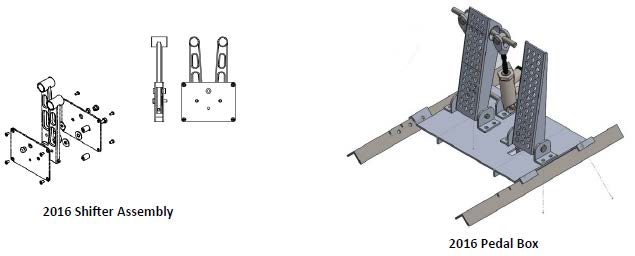
As the ergonomics team it is our task to make the car as comfortable and safe to operate as can be. The areas of the car which we are focused on are the pedal box, shifter/clutch, seat, dash, and harness. There are several rules which we need to take into consideration as we design these different components. One such rule states how much force the brake pedal must withstand, for example. We did a complete redesign of the seat, pedal box and shifter. The seat will be made of moldable foam and set to fit around the driver’s body. The shifter will be simple and quick to use with the ability to up shift in one motion with an auto-clutch mechanism. The pedal box has been made lighter, more efficient and adjustable by using rails.
T4 Impact Innovations
Team Name
T4 Impact Innovations
Team Members
Dennis Tatsch
Kimberly Krueger
Jacobus Peterson
Joseph Thompson
Sponsor
RECARO Aircraft Seating, Inc.
Abstract
Our sponsor requires an impact tester so that they may observe how their aircraft seats withstand routine fatigue and abuse (e.g. trolley cart impacts, falling luggage, or kicking children).
The testing apparatus is built around a pendulum with adjustable weights, and powered by a motor through a series of gears. The swinging arm is allowed to free fall thanks to a clutch mounted to the shaft. A braking system, attached to the rotary shaft, holds the impact arm at the specified height prior to testing, and will stop secondary impacts from occurring afterwards. The side supports adjust vertically, allowing for different impact positions along the seat. The seat itself is secured to a platform immediately in front of the testing apparatus. This platform uses inserts to accommodate different seat designs so that different seat models can be tested. The entire process is automated for repeatability and user convenience. An automated test system was created using National Instruments LabVIEW, which allows for a computer to control and record test cycles. Thanks to this system, an operator can input a specific height or energy with which to impact the seat, and the impact tester would set up and conduct the test automatically.
Manual Clutch Level Displacement
Team Name
Manual Clutch Level Displacement
Team Members
Khoa Bui
Colin Clarke
Luan Nguyen
Rob Rudeau
Abstract
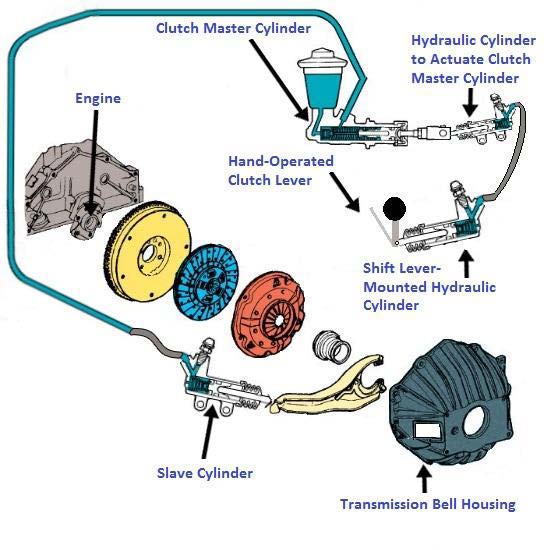
The intention of this project is to convert the foot-operated clutch pedal in a manual transmission vehicle to a hand-operated lever located on the shift lever to allow for use by a single-leg amputee. The team will make a hydraulic cylinder which will convert the new clutch lever movement into enough fluid pressure to activate the clutch assembly. The team will try to make this device as modular and noninvasive to the vehicle as possible, to accommodate users that wish to remove it from the vehicle in the future. Once the initial design is complete and installed, the team will thoroughly test the device in real world situations, such as driving through small towns, highway driving, bumper-to-bumper traffic, and long distance driving. The team hopes to continue testing in high performance driving events, such as autocross, where the driver must react much more quickly than in everyday driving, which would require the clutch operation to be as natural as possible. Upon the project’s completion, the team would like to donate the finished device to a member’s friend that had a leg amputated after being diagnosed with cancer.
Advanced Motorcycle Technology
Team Name
Advanced Motorcycle Technology
Team Members
Luis Bermeo
Jorge Cardona
Anson Donahue
Brandon Johnson
Quentin Mackie
Abstract
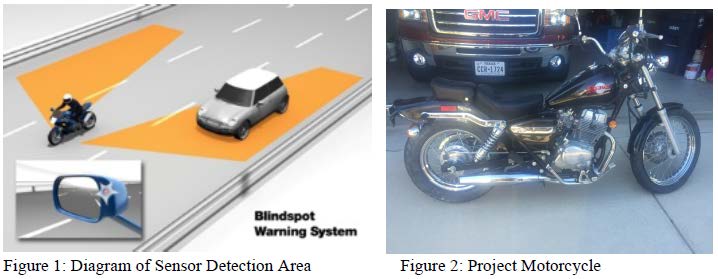
The Advanced Motorcycle Technology team designed a new control panel for a motorcycle
to help with awareness and safety for riders. The team used ultrasonic sensors to
display the distance of other vehicles near the motorcycle. These sensors will give
car drivers awareness of their presence and would then sound the horn and shine a
pulse of light at the vehicle that is approaching the motorcycle enough
to catch the attention of the driver. The taillight will also be reconstructed to
resemble those of a car for better visibility at night. The sensors will be will be
set off by the commands in a microcontroller. The microcontroller will provide different
modes and show different “zones” of distance. The zones will be displayed on an LED
screen that is mounted on the motorcycle. Figure 1 illustrates the desired area of
detection for the sensors. Other issues that were taken care of were the addition
of a built-in stand and a compressor. These will allow the motorcyclist to take care
of a flat on the side of the road with more ease.
Linkup International Project Redesign
Team Name
Project Redesign
Team Members
Angelica Aguilar
James Mason
Peter Tally
Sandeep Joseph
Sponsor
Linkup International
Abstract
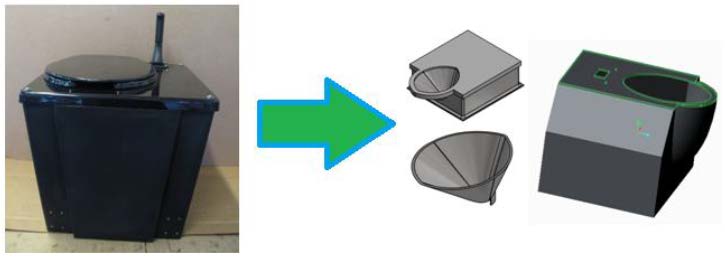
Linkup International enlisted Project Redesign to change selected features on their current locomotive toilet design. The company’s current design allows for easy use and the availability of exchangeable parts in the field. In case there is a problem with the pump, a new lid can be purchased and easily replaced. This reduces down time and increases productivity. Project Redesign was tasked to address four design aspects of the toilet. The toilet height does not accommodate the height of women whose population is increasing in the locomotive industry. With the straight edge on the front of the current toilet, the legs and pants of those using the toilet are touching the holding tank. Another issue concerns the varying bathroom dimensions and door widths due to variety of locomotive models in use. To successfully address these issues, the new locomotive toilet design needs to resemble a home toilet with a round edge design on the front, decrease the height of the toilet or design a stepping stool, maintain the current design’s holding capacity, and be easy to install in all locomotive models. The final toilet design will be approved by Linkup International and locomotive companies invested in this product.
Aeropak
Team Name
Aeropak
Team Members
Tyler Farmer
Jeff Brown
Cory Clark
Michael Lira
Tom Luepke
Abstract
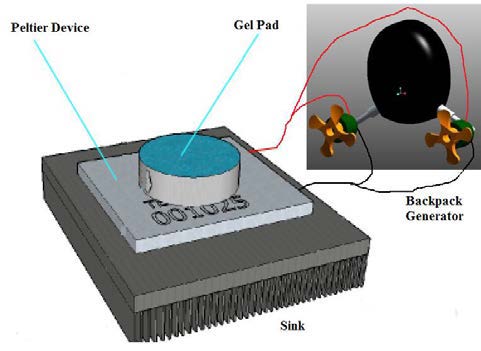
Our project is built around the premise of converting wind energy into electrical energy to power a Peltier device to provide heating/cooling for a wearer of a specialized gel pad armor. The armor is an insert that will be able to be used by any motorcyclist in any jacket to further protect against road rash in the event of an accident.
The largest weather condition many people fight with is temperature. Over half of the group rides a motorcycle on an almost daily basis. All of which have failed to wear full protective gear because of the extreme temperatures. The necessity of being able to protect one’s self while riding is how this project came about. This armor gives people the protection they need, while also providing personal comfort.
Our design is to use a small dc motor generator attached to a wind turbine to generate electricity to power a Peltier device attached to a gel pad to distribute a heating/cooling effect under a protective armor. The generator will be either permanently attached to the motorcycle, or set up in a portable backpack to be able to use the armor on any motorcycle, at any given time.