 University of North Texas

Mechanical and Energy Engineering
SAE AERO Project
Team Name
SAE AERO
Team Members
Jose Carrillo
Cameron Cummins
Gustavo Macias
Hector Martinez
Ampelio Mendez
Sponsor
UNT MEEN/SAE
Abstract
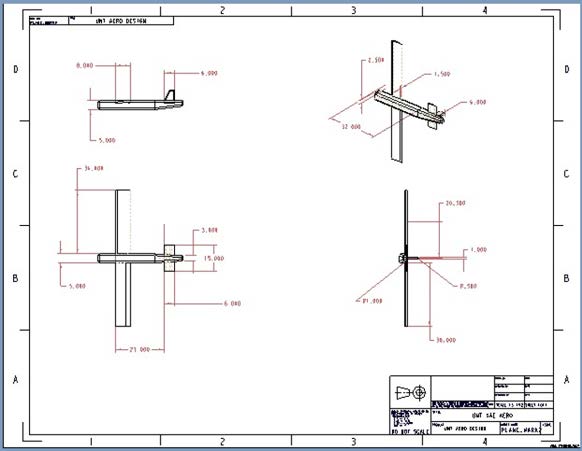
The goal of this project is to create a working remote controlled aircraft able to fly a circuit around an airfield while carry as much cargo as possible. This project follows the rules set down by the SAE AERO competition. This project has involved the use of many types of materials and construction methods. The team has built specific tool such as hot-wire cutters to assist in construction and has also utilized 3D printing and woodworking.
Shell Eco-Marathon Project
Team Name
Shell Eco-Marathon 2016 Team
Team Members
Matthew Carroll
Theodore Scheurman
Kristopher Carmona
Rupesh Budhathoki
Steve Burns
Devin Skelton
Sponsor
UNT SAMPE, Acorn Glass Company
Abstract
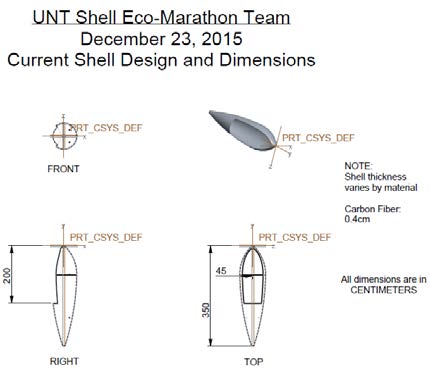
Our team is building a highly fuel-efficient, gas-powered prototype vehicle to enter the Shell Eco-Marathon competition in Detroit during April 22-24. The core components of the vehicle are the frame and the outer body, or shell. The frame will consist of hollow aluminum tubes, and the shell will consist of carbon fiber with a Lexan windshield. The vehicle will have an aerodynamic teardrop shape, with the large end toward the front of the vehicle. This shape, coupled with dimensional requirements set by the competition, make it so that the driver will be almost laying down on his or her back, head above the knees just enough to ensure visibility. The engine will be behind the driver and separated from the cabin by a bulkhead. The wheels will be bicycle wheels to save on weight.
SAE Formula Engine
Team Name
SAE Formula Engine
Team Members
Justin Vincik
Clayton Jalili
Christopher Whitehead
Pawit Jullawatilert
Sponsor
Go Engineer, Peterbilt, SGA, ETEC, NGK, DeatschWerks, SolidWorks, SAE
Abstract
The SAE Formula Engine Team is a part of the UNT Mean Green Racing Formula SAE organization.
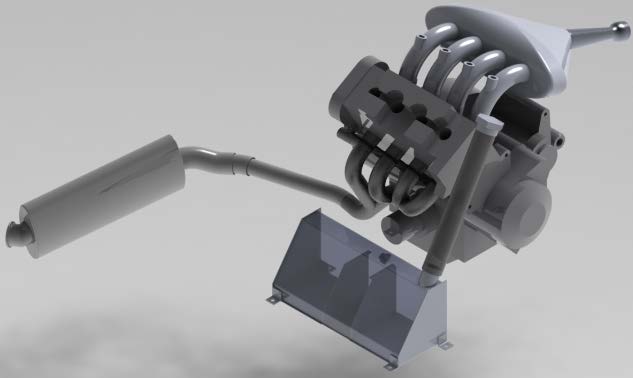
We are responsible for redesigning a new intake, exhaust, and fuel tank for the 2016
Formula SAE car within the constraints of the competition rules. The scope of the
SAE Formula Engine team is to improve performance by shifting the torque curve peak
to 7000 rpm. This power range is more suitable on a small, technical track. At the
same time, the components are designed to be light-weighted and easily manufactured.
For the intake design, vast improvements have been made to the intake manifold by
adding bell mouths and using flow simulation. By changing the intake’s mounting orientation,
the center of gravity for the car has been lowered. The final version of the intake
will be printed by our Go Engineer sponsor using ULTEM 1010 resin. The exhaust runners
have also been rerouted for weight reduction and easier access to the oil filter.
Additionally, the fuel tank has been redesigned to prevent fuel starvation.
The new designs will be implemented onto the 2016 racecar and tested at the 2016 SAE
Formula Student Competition in Lincoln, Nebraska on June 15-18, 2016.
ASME Human Powered Vehicle 3
Team Name
ASME HPVC Team 3
Team Members
Ryan Burch
Armstrong Ekpete
Thomas Rather III
Martin Steenbock
Sponsor
ASME
Abstract
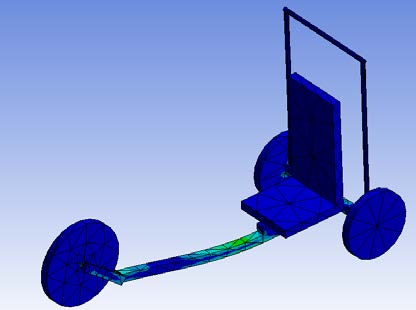
The goal of the project was to develop a simple, safe and cost effective human powered vehicle that served a practical and functional purpose for the transportation of people and goods. With the construction of the human-powered vehicle being designed for reliability rather than speed, the prototype implemented the idea of less moving parts to minimize the inevitability of part replacement. Eliminating the equipment based solely on speed allows the vehicle to function in a practical manner for operators of multiple age groups. The prototype specifications of HPVC Team 3 allow the vehicle to carry a maximum load of 250 lbs. The design has an adjustable frame that can fit operators with various reach, height and length. The target specifications for HPVC team 3 were as follows: speed - 25 mph, weight - less than 60 lbs., length - 70 in., and height - 49 in.
IAM3D Challenge Project
Team Name
IAM3D Challenge Team
Team Members
Christian Gilbreth
Jake Popkin
Tristan Sartor
Abstract
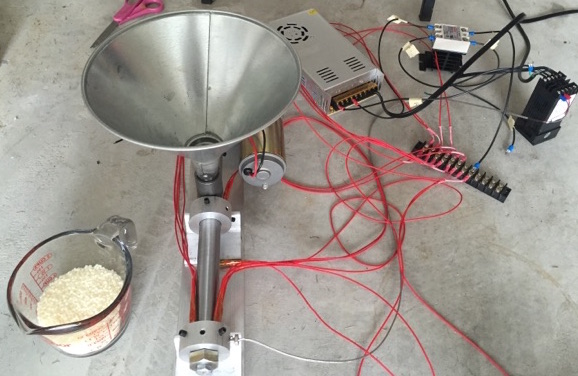
Our goal was to design, build and test a prototype of a polymer extruder machine that
will prepare scraps of plastic to be used in 3D printing. There was an emphasis on
keeping costs low, enabling hobbyist users to re-use their own discarded 3D print
projects. This would save users money and benefit the environment by increasing the
amount of plastic recycled.
The design begins when a user loads plastic pellets into the hopper. These pellets
then drop into a steel tube where they are melted to a controlled temperature that
varies depending on the type of material used. Seven heaters work in unison, with
a thermocouple measuring the temperature. A solid-state relay is attached to the thermocouple,
giving users the ability to set a desired temperature. The melted plastic will then
be pushed through a nozzle by a rotating screw, which is attached to a motor. This
is the extrusion process, which will shape the material into a long filament that
can be spooled.
Stout International Easy Breaker
Team Name
EZ-Breaker
Team Members
Jose Pineda
Nicholas Huggins
Jacob Essy
John Mora
Israel Gonzalez
Victor Muro
Gayland Waindim
Sponsor
Stout International LLC
Abstract
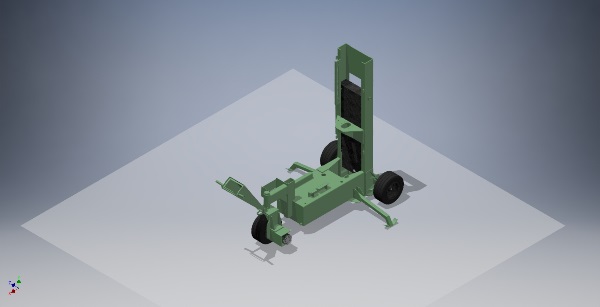
The EZ-Breaker team's goal is to redesign a working machine to the specifications of the Stout International LLC. Our goal is to improve the EZ-Breaker machine by redesigning the machine with the wanted improvements. The team will provide completed CAD drawings and build a new redesigned EZ-breaker machine using the new CAD drawing. The objectives are:
- Stainless-steel hinge on hammer cabinet.
- Add grease fittings along the hammer track to improve the greasing system.
- Create hose system near bottom for easy access and reduce clog difficulties.
- Gusset on wheel assembly.
- Create a 3” cut out on hydraulic tank for easy cleaning and draining of the hydraulic tank.
- Electromagnetic proximity sensor to make user aware of problems machine may have
- Install indicator LED’s for troubleshooting.
- Include fuses to protect sensors.
- Access door on control arm for easy access to electrical components, hydraulic hoses and levers Vulcanized rubber to absorb 1100 lbf exerted on the machine from the hammer drop.
- Safety Lights and warning stickers for safe operation in the work environment.
- Include other improvements where necessary.
ASME Human Powered Vehicle 1
Team Name
Human Powered Vehicle Team #1
Team Members
Nicholas Croker
Anthony Taylor
Andrew Wright
Quintin Zipper
Jacob Bagwell
Sponsor
ASME
Abstract
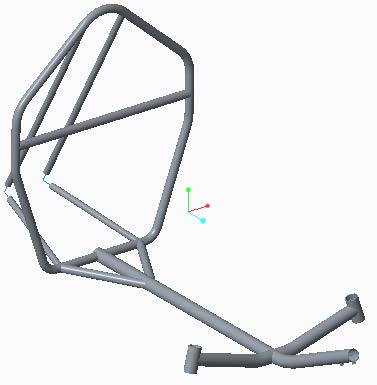
We are team #1 for the UNT chapter of ASME designing a Human Powered Vehicle to compete in the ASME HPV competition. The scope of the project includes designing an original human powered vehicle meeting structural, safety, cost, and weight regulations outlined by ASME. Our design will be based off of a recumbent trike made from 4130 alloy steel that will be as simple and easy to maintain as possible using an original designed frame and steering system that incorporates traditional bike parts. Our main engineering goals will be to meet specific crash safety and load bearing requirements using a roll bar integrated into the frame while still being light weight. Our engineering goals for form and functionality will be to design a steering and power transfer system that is efficient and simple to use while still being comfortable to ride.
RASC-AL AADS
Team Name
RASC-AL AADS Sub Group
Team Members
Philip Branz
Drew Fisher
Amber Medina
Shane Summers
Abstract
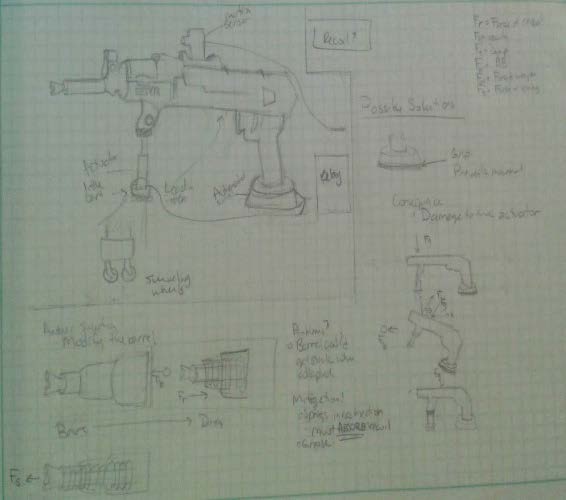
The Automated Asteroid Defense System (AADS) is intended to defend a space station from asteroids that are on a collision course. The AADS changes the asteroid’s trajectory so it will not collide with the station. Due to monetary and time constraints, the team will build a miniaturized AADS and test its capabilities by hitting moving targets on a windmill system.
DOE Race to Zero Challenge Project
Team Name
Texas Green Team
Team Members
Adam Miller
Katie Welch
Alyssa Sylvester
Anissa Kappayil
Skylar Andre
Abstract
The Texas Green Team (TGT) is participating in the Department of Energy’s Race to Zero Challenge to design a “Zero Energy Ready Home” (ZERH). The ZERH program is focused on creating a home that is hyper-efficient and, with the addition of solar panels, will become net-zero or positive. The TGT will incorporate new technologies and training techniques to assist Habitat for Humanity Denton in advancing homebuilding for the North Texas community.
Biomass Gasifier
Team Name
Biomass Gasifier
Team Members
Brodie Coleson
Justin Cox
Madden Mengwasser
Kevin Niamkey
Kelsey Sanders
Liu Qi
Abstract
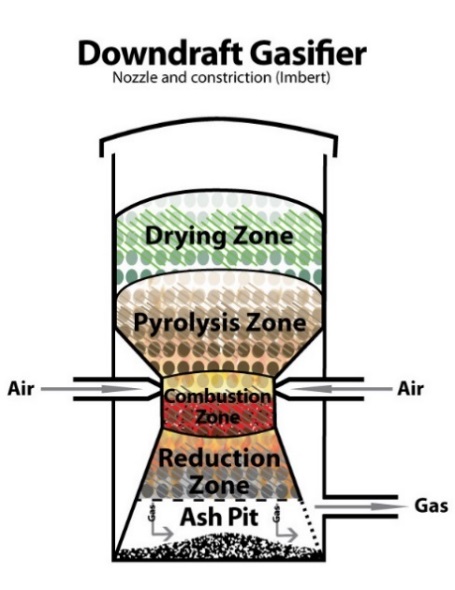
Our team has the goal of creating a gasification chamber that will burn several different types of biomass to produce the most efficient form of syngas. In order to show that the syngas created by the gasifier was effective, a small scale paper recycling system will be built. The goal is to have the syngas power a water pump that will run water to the paper recycling system. Tests will be run to see which syngas created from the types of biomass is cleaner and creates more power so we can see how to make the gasifier the most efficient. Our group would like to create a machine that will utilize renewable resources and create cheaper, more abundant energy.
Spinal Fixation System
Team Name
Spinal Fixation System
Team Members
Firas Asfoor
Alex Carmen
Jamie Carson
Jalyn Nickerson
Sponsor
Orthofix
Abstract
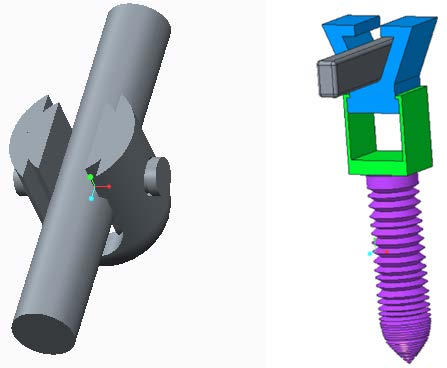
The goal of the project is to design a system that holds a rod in place on a patient’s spine as a solution for medical disorders such as scoliosis and degenerative disk disease. With help from our sponsor, Orthofix, and advisor, Ruth Pierson, a design is created and tested to the ASTM standard (1717 & 1798).
Paragon Human Powered Vehicle
Team Name
Paragon HPV
Team Members
Eric DeLaPaz
Thomas Payton
Caleb Flucker
Christopher Weatherspoon
Abstract
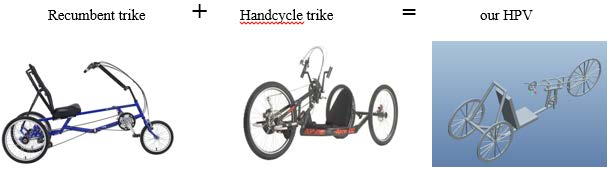
To design and construct a fully functional, plausible, innovative human powered recumbent tricycle, to compete in the American Society of Mechanical Engineers Human Powered Vehicle Competition utilizing previous designs and successful vehicles to create an original mechanically sound vehicle. Objectives are:
- Create a vehicle that is solely powered by a human operator
- Have space in or on the vehicle to carry a package
- Build a safe and cost efficient vehicle
- Offer a solution to increase power from typical HPV design
- Accommodate a rider of height 5’5” to 6’1”
- A roll-bar protection system
- Include an enclosed body
There are two separate drivetrains one for the rear axle and an independent drivetrain for the front wheel. The center hub of the rear axle drives the two rear wheels which are powered the rider's legs. The rider's arms, power and steer the HPV front wheel.
Automated Aquaponics System

Team Name
Automated Aquaponics System
Team Members
Zachary Cole
Joshua Conner
James Masler
Matthew McIntosh
Jonathan Rogers
Sponsor
Mark Smith
Abstract
The purpose of this project is to automate an aquaponics system to produce organic food with minimum labor and maintenance. We will be building on an already proven concept of aquaponics by automating the system to automatically heat and cool itself and the surrounding green house, as well as send data to the client about the condition of the system such as temperature, pH, humidity, etc. The design for this system will use two Intermediate bulk containers (IBC’s) as the fish tank and the grow bed by cutting the top ten inches of each of the totes and flipping it over to create the grow beds. The water will be pumped from the bottom of the fish tanks to the grow beds where it will be filtered by the plants and then it will trickle back into the fish tank. This system will be monitored by Raspberry Pi and Arduino controlled sensors. The Raspberry Pi and Arduino will also control any heating or cooling of the system.
Natural Fiber Boat Hull

Team Name
Natural Fiber Boat Hull
Team Members
Adil Dadabhoy
Troy Eakins
Michael Hackett
Robert Miller
Alexander Nuanes
Sponsor
Molded Fiber Glass (MFG); MultiCam, Inc.; Hemp Solutions
Abstract
Our team decided to set up future design teams for success by focusing only on the design, fabrication, and testing of the boat hull in order to give future design groups a head start on this massive undertaking. We didn’t want to make a simple fiberglass hull, because the process is already proven. Here we began to broaden our scope by deciding to incorporate natural fibers into the fiberglass matrix. Natural fiber benefits include: lower cost, light weight composites, and overall less harmful to the environment, but they absorb water and do not have quite the strength capabilities of traditional fiberglass. Through tensile, bending tests, and trial and error our team will create the ideal combination of natural and glass fibers to obtain a high strength to weight ratio.
Our team has been fortunate in that we were able to procure a sponsor in MFG molded fiberglass company in Gainesville Texas they have given us not only advice and guidance, but materials for the boat hull build. In addition, MultiCam, Inc. has also assisted us with the fabrication of our prototype by cutting our first designs with the use of a state of the art 4 axis CNC router. A company known as Hemp Solutions has been vital by suppling a large quantity of matted hemp fibers to be the bulk material of our boat.
Currently our team is in the midst of building our first scaled down model. We are excited and eager to produce a full scale build for our underclassmen to use in upcoming years at the Solar Splash Competition.
Trophy Truck Project
Team Name
Trophy Truck
Team Members
Stephen Watts
Adam Lunn
Jerod Bond
Glen Glass
Howard Hunter
Abstract
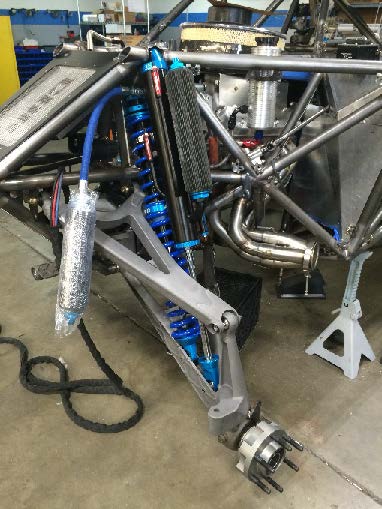
Our project involves optimizing the front suspension of an off-road racing Trophy Truck. Unlike most forms of racing, there are no design specifications other than safety rules. While the current suspension works well, it had some room for improvement. Some of the problematic areas included: clearance and durability issues, as well as corrosion. All such problems were isolated to the upper a-arms. This is what we chose to be the focal point of our project.
Encore Wire Cyclone Barrel

Team Name
Encore Wire Cyclone Barrel
Team Members
Sarah Forester
Teresa Gaitan
Samantha Stodola
Sponsor
Encore Wire
Abstract
Encore Wire sells a product called wire cyclone barrels. These barrels contain wires of different gauges that are put together in the barrel so that the user can pull out several wires at once. This is useful for several industries (especially construction) and Encore has numerous interested buyers. However, the product does not work as well as intended. The different wires tangle around each other in a manner similar to twisted strands in rope, and the wires can knot around each other because of the possible overlap of layers. The practicality is then outweighed by the hassle. There are several different changes in both the barrel and the production line that Encore has tried, but that hasn't brought any permanent solutions. Our group in an attempt to remedy this problem continually made quick iterations of possible solutions. We were able to do rapid prototyping by using materials and procedures that were similar in function but not in cost or durability. Eventually we found that one of the simplest solutions was the most effective.