 University of North Texas

Electrical Engineering
Fuel Tank Level Sensor
Team Name
Fuel Tank Level Sensor
Team Members
Miguel Bartolini
Paul Smith
Benjamin Yosten
Abstract
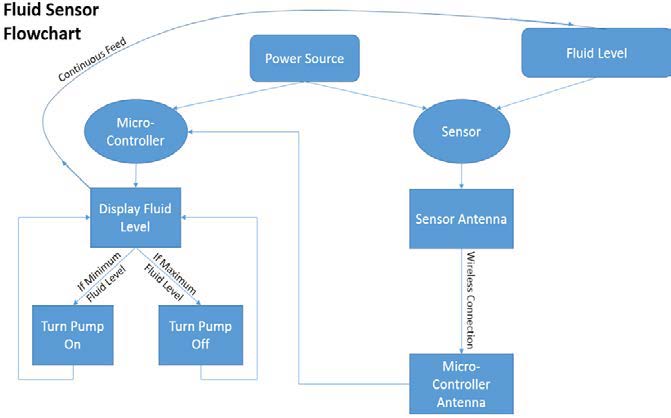
Our design will help improve fuel level systems to help people that own a vehicle of any source or machinery. Our design will tell them a much more precise and accurate reading of their fuel tank. Knowing exactly how much fuel is left will allow people to have better control of their time. How? Simple, the current system has a major problem of accurately representing the actual fuel level. To fix this problem, our design will be based off a sensor detecting the distance between the lens of the sensor and the surface of the fluid. The data will be transmitted via wirelessly and sent to the microcontroller to be displayed. This will allow the user to know the exact amount of fuel left in the tank, resulting in a more efficient way to refill your tank. In time, this will result in a positive improvement of time, money and car usage. In addition, we are proposing to add a secondary tank system. This idea consists of adding another fuel tank to resupply the main tank, while measuring the amount of fuel level on it as well. Therefore, we can create and control the fuel-pumping in-and-out of both tanks.
Object Detection
Team Name
Object Detection
Team Members
Jonah Reyna
Cyra Castro
Sponsor
Kamesh Namuduri
Abstract
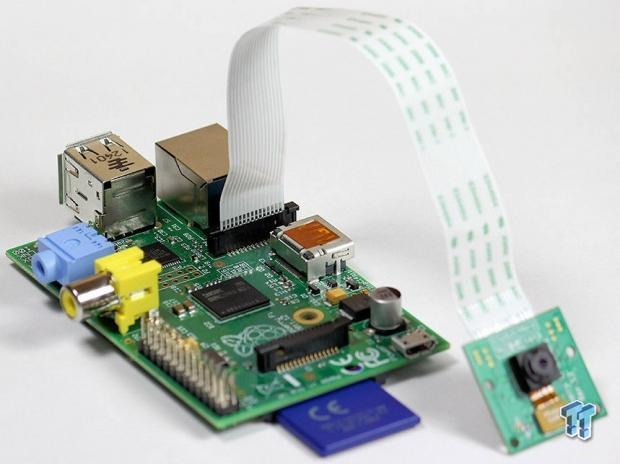
Our senior design project will be an object detector for the visually impaired. The idea to do this project came from our sponsor Kamesh Namuduri. We want to make it easier for the visually impaired to be able to tell when obstacles are going to be in their path. We will be using a raspberry pi device along with a camera and monitor to create our object detector. The raspberry pi will work as our processor for the information being received by the camera and will give the information to the user. We will be giving the information from the camera to the user by audio communication such as headphones or a speaker through the raspberry pi. We will be using opencv to program the raspberry pi along with python. The programs will help us to process the images given by the camera to tell the user when there is an object that will be in the way of their path. The device we are making is going to be small and portable for the visually impaired user to be able to carry around with them. The ultimate goal is to make the lives of the visually impaired easier by easily detecting obstacles in their way.
NASA Challenge Project
Team Name
NASA Challenge Team
Team Members
Craig Johnson
Michael Gardner
Johnna Sargent
Jose Rodriguez
Muneer Ajzair
Patrick Kowalczyk
Sponsor
Kamesh Namuduri
Abstract
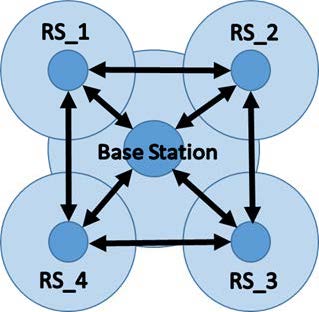
For our Senior Design Project, we will design a framework for communication on Mars. In conjunction with a graduate student team, who is designing an efficient base station using the RF Blade, we will research two approaches to reach our goal. Our choices are to use either a Wifi network or a cellular communication grid. We will test the Wifi network using Wifi enabled devices and for the cellular system, we will use standard phones.
Mesh Tracking and Automation System

Team Name
Mesh Tracking and Automation System
Team Members
Casey Nalley
Youssif Mahjoub
Abstract
Mesh networks provide a quick and easy to implement a connectivity solution that is highly adaptable to any environment. We propose the use of a mesh network as well as a variety of sensors and wireless communication technologies to create a low cost tracking, counting, and automation system for people, connected devices, and objects. As a first milestone in our project we would like to create a low cost system that is very easily implemented and combines several different technologies to accurately count people and devices in a variety of environments. The second milestone would add the ability to make use of the information gathered in milestone one for real time automation and to extend the capabilities of the system to also count and ascertain the location of objects through the use of low energy Bluetooth beacons or other near field communication technologies.
Enerteck Catalyst Doser
Team Name
Enerteck Catalyst Doser Team
Team Members
Gavin Bakshi
Andres Tamez
Osias Hernandez
Mohammed Al Odaily
Sponsor
Pete Peterson with Enerteck
Abstract
Enerteck is a company based out of Stafford, Texas which produces a product called Enerburn. Enerburn is a catalyst which improves the efficiency and omissions from diesel engines. When considering the application of this product to the diesel trucking industry Enerteck has found this to be very difficult in creating a scheduled delivery of the product to the their Diesel Trucking customers. This issue arises from the missed use of the product when diesel truck drivers fill their trucks with fuel they do not always dose the fuel with their catalyst. Enerteck would like to automate the process with a digital control system which would automatically detect fill up events within the diesel fuel tank and would dose the tank with catalyst according to how much fuel has been added to the tank. Secondly Enerteck would like the Catalyst Doser that is developed to have the ability to be wirelessly connected via GPS/Cell Tower so that the Doser can be monitored for low catalyst level or problematic events. This would essentially open up the diesel trucking market for this company if this system can be developed and implemented successfully.
Autonomous Range Sensing Vehicle
Team Name
Autonomous Vehicle Team
Team Members
Salman Alkarni
Ahmed Abdelmoneim
Sponsor
University of North Texas
Abstract
The scope of our project revolves around designing an autonomous range sensing vehicle to assist the disabled in navigating through indoor structures. This autonomous vehicle accomplishes two main tasks: First, the vehicle automatically navigates a preprogrammed route. Its second task is to sense objects along the route and avoid them. As a senior design project we want to develop something that will be helpful in solving a real world problem. There are numerous applications to autonomous systems especially in the field of assisting the disabled. The idea of our design is to integrate a robot platform* with a raspberry pi along with a range sensor all in one system. We are going to program the raspberry pi on the system to make the vehicle navigate without the use of a controlling device. The sensor detects obstacles that the vehicle may encounter and the integrated system avoids it accordingly.
Low Cost Robotic Arm
Team Name
RMS Robotics
Team Members
Rene Hernandez
Muhammad Azam
Stefen Hancock
Sponsor
Yan Wan
Abstract
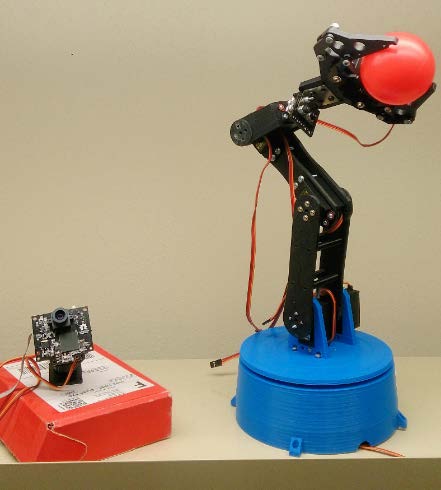
In the modern industrial world, autonomous machines are common in almost any workplace. Most of the machines are designed for a single purpose or task. We want to create a robotic arm to sort colored objects autonomously. Our main focus for the design of the robotic arm is to keep it low cost without sacrificing quality and functionality. A machine capable of sorting objects by color can be used in various scenarios and settings from supply chain management to manufacturing or even in the common household.
Robotic Myo-Electric Impulses
Team Name
Robotic Myo-Electric Impulses
Team Members
Jason Hart
Taveesh Jaiswal
Ashashmi Masoudi
Mahmoud Salman
Abstract
To serve as a final capstone of their learning in electrical engineering, students must group together and produce a physical project. This project is a culmination of the technical knowledge learnt and also a chance to learn project implementation and management. Each group, in collaboration with a faculty advisor, is tasked with develop a technical project. Our project for our senior capstone aims to create a robotic arm that is capable of being controlled through muscle contraction. This project can potentially benefit those with limited mobility and disabilities and has the possibility of other applications.
The user will apply the EMG electrodes to the location on their body that best suits their needs. The electrode pads come in groups of three; so for example, the pads are placed on the bicep and elbow. The two locations on the bicep act as signal inputs while the elbow behaves similar to a ground. The patches are then connected to an amplifier circuit where the signal will go from 0-0.5 mv to 0-3.5V. The amplified signal will then go into a microcontroller that will interpret the input from the amplifier circuit and calculate a corresponding PWM signal. The PWM signal goes to a driver. The driver is able to operate 16 different servo motors at the same time. The robotic arm contains 7 servo motors. The servo motors will then move the robotic arm. Each motor moves the arm a different direction.

Dual-Strange Compressor Pedal
Team Name
Dual-Strange Compressor Pedal
Team Members
Matthew Walton
Sean McLellan
Sponsor
Victor Trotter
Abstract
Dynamic compression is used to reduce the dynamic range of an audio signal. Several factors affect how the compression sounds, including attack time, release time, amplitude threshold, and compression ratio. Many guitar players like to have multiple configurations of these parameters depending on what the musical situation calls for. Through a partnership with Trotter Controls, we have designed a simple solution for guitarists seeking a versatile compression solution and high fidelity.
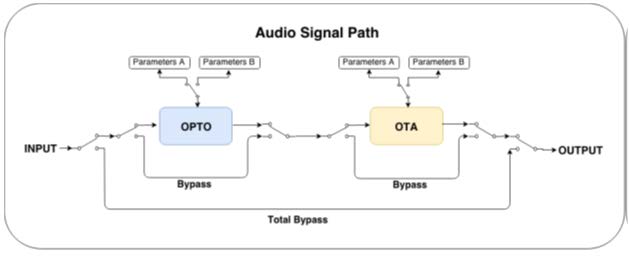
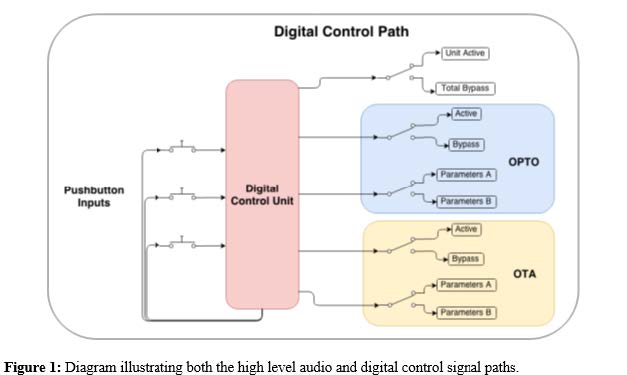
Our solution incorporates two different analog compressor circuits in series. The first stage will be designed around an Operational Trans-conductance Amplifier (OTA), and the second will feature an opto-coupled detection circuit. Both of these designs are inspired by classic compression circuits often used in performance and recording applications. Each stage of compression can be switched between two configurations and bypassed independently (see Figure 1). Additionally, the entire module can be by- passed. The switching will be handled by a PIC16F677 micro-controller and triggered by momentary switches. Though the switching logic is digital, the signal path will remain analog. LED indicators will alert the user the current state of the unit for each stage of compression.
Occupancy Modelling
Team Name
Occupancy Modelling
Team Members
Adam Frankling
Octavio Lujuan
Ovie Onoriose
Zikra Toure
Sponsor
Dr. Jesse Hamner
Abstract
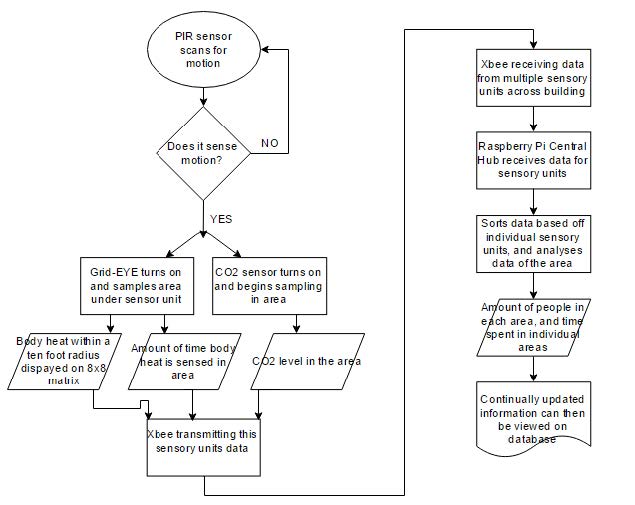
We are designing a system to track and measure occupancy patterns in Willis Library at UNT. We are doing this by creating a network of devices based on the Tiva Launchpad that currently interface with IR and CO2 sensors to observe where people are spending the most time. The devices will be positioned throughout the library, powered by Power over Ethernet adapters and communicating using xBee wireless technology which allows us to be very flexible when it comes to positioning them. The data will be sent wirelessly via xBee to a central unit composed of a raspberry pi that will store and analyze the data received. Analyzing this data will provide us with an estimate on the occupancy in the monitored areas in the library. This data will be useful when planning where to put furniture, displays, and other amenities around the library to maximize their usefulness.
SatNOGS Antenna System
Team Name
SatNOGS Antenna System
Team Members
Alex Carr
Tyler Cerrato
Houston Chapman
Buu Duong
Abstract
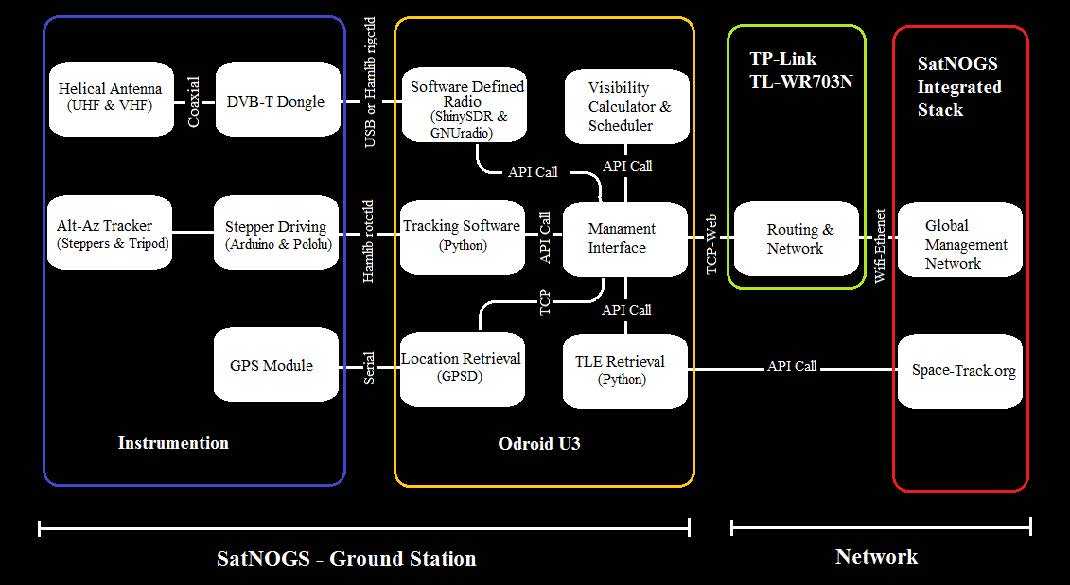
Inspired by the idea from the SatNOGS team, we decided to build a SatNOGS antenna system for our senior design project. The idea is to provide the capability for low-cost experimentation in space communication by creating full coverage of Low Earth Orbit (LEO) satellite networks. SatNOGS transmits its data onto the SatNOGS database. The SatNOGS database is an open source satellite transmitter database with information received from all satellites currently detected. This database will then allow users to continually track their satellite and acquire their desired information. Along with building the system, we have also decided to modify and improve the software and hardware for an overall better system. Our current plans to improve the device include adding a GPS, improving the printed circuit board process, and modifying the design of the antenna.
Mobile Multi-Hop Mesh Network
Team Name
Mobile Multi-Hop Mesh Network
Team Members
Henry Johnson
Tashanique Jones
Jonathan Ericson
Darius Hawkins
Pranav Chary
Abstract
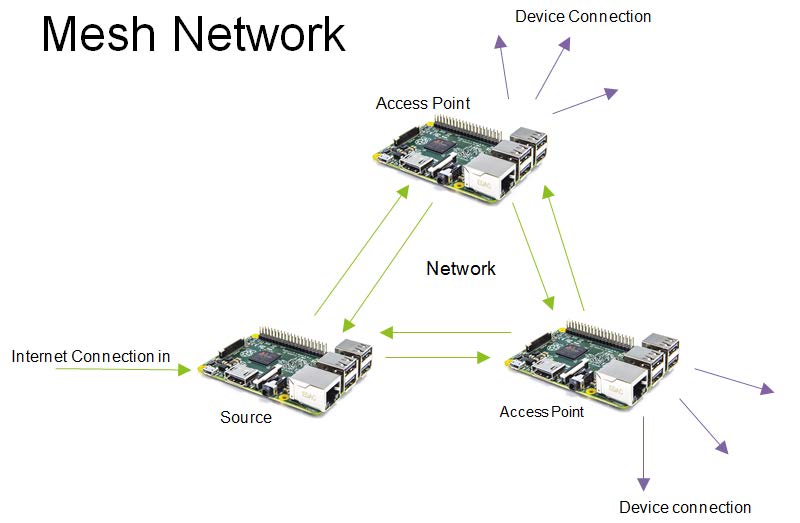
In many disaster areas people are left without any means of communication. Cell towers and Internet connectivity is damaged or impaired leaving a communication dead zone, meaning no phone calls or Internet/Wi-Fi connections. The point of this project is to create network coverage that has multi-hop functionality, otherwise known as a Disruption Tolerant Network (DTN). This will allow for a form of communication that is low in cost, high in quality and requires minimal setup time.
In order to accomplish this, the following components were used; Raspberry Pi’s, Wi-Fi dongles and an Internet source. These components created a source node and a series of access points that is called a mesh network. If one of the access points were to fail the network reroutes itself allowing any device that’s connected to maintain its association, hence disruption tolerant.
Accurate and Precise Control of Brushless DC Motor
Team Name
Accurate and Precise Control of Brushless DC Motor
Team Members
Jonathan Cotton
Michael Kitchens
Michael Schuster
Abstract
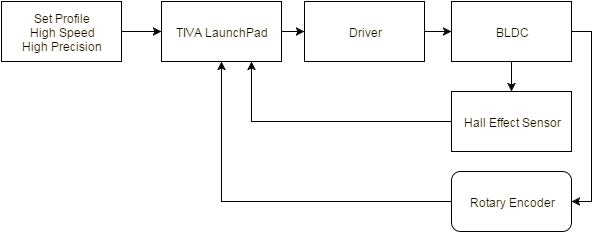
An accurate and precise motor controller for a brushless dc (BLDC) motor using a mix of hardware and software. This controller combines high speed modes with accurate control for use in CNC operations. The driver changes from high speed mode to fine control using a closed loop control system. Stepper motors provide a high degree of accuracy but do not offer good options for speed. During an operation where a large change in position is needed and precision is required to finish the operation such as in industrial robotics a BLDC motor may be used with the driver to get both the speed and accuracy desired. Examples of where this controller would prove useful are milling machines and 3-D casting and printing machines.