 University of North Texas

Electrical Engineering Technology
Edison and the IoT
Team Name
Edison and the IoT
Team Members
Chris Harris
George Dunson
Sponsor
NSF (partial support)
Abstract
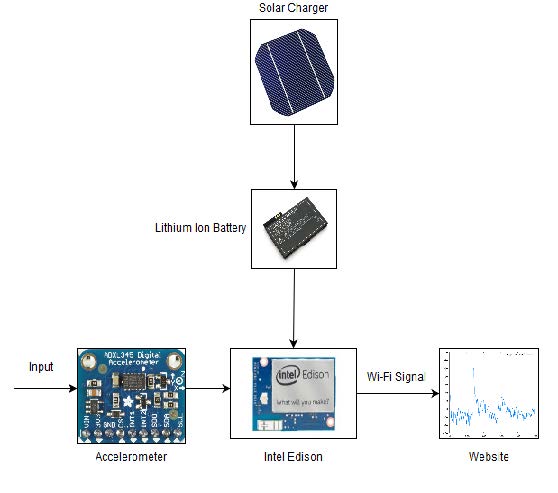
The IoT Enabled Wireless Sensor Network for Structural Health Monitoring is a system of nodes that can be deployed on a bridge or building to measure extremely subtle movements in any direction. The nodes collect and process the data before pushing it to the cloud to be reviewed by a local or remote user. Each node includes an Intel Edison development module as well as an Analog Devices ADXL345 accelerometer to measure movement. Each node also stores a copy of the recorded data to its SD card before sending it to the server. In each sensor network there is one master node and multiple slave nodes. The master node is responsible for identifying each node in the network and associates the data recorded to its unique identifier. The master node can also manage and monitor the status of each node in permanent sensor networks. This is useful to provide longer battery for the network by putting the nodes into low power mode when needed, or to alert the user (local or remote) of any problem with the network or a specific node so that it can be addressed as soon as the issue arises.
UNT SAE Car Telemetry
Team Name
UNT SAE Car Telemetry
Team Members
Tony Mcjohnston
Russel Rice
Justin McClesky
Abstract
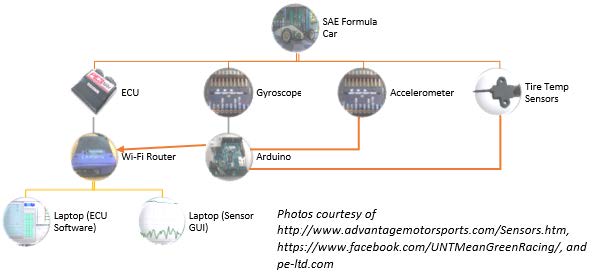
Our project is an attempt to acquire real-time wireless data from the UNT SAE Formula car from a distance of about 1500 feet, which is the length of the SAE Formula track used for tournaments, without the need for antenna towers around the track. The data we will be acquiring will be the ECU data and data from sensors added to the vehicle. The sensors we will be adding are a Gyroscope/Accelerometer/Magnetometer for determining the speed and acceleration of the race car, and tire temperature sensors for the rear tires. A simplified flowchart of our project is shown in the figure.
Remote Water Leakage Detection
Team Name
Remote Water Leakage Detection
Team Members
Robert King
Robert Walters
Dustin Black
Abstract
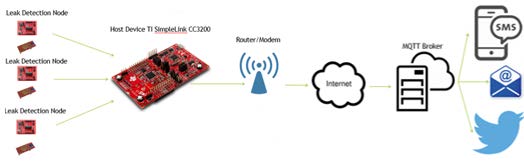
Unchecked, a leak can quickly turn into large amounts of water gushing into a home or business damaging the structure, electrical wiring, or belongings. Our goal is to create a water leak detection system that will alert users of leaks in real time through an IoT network. Our leak detection network first starts with a series of leak detection nodes which consist of the MSP-EXP430G2 LaunchPad board with a 430BOOST-CC110L SubGHz RF Radio to communicate with the host board. They communicate with the host TI Simplelink CC3200 with a CC110L RF Booster. These radio boosters are for the Sub1-GHz communication between the host and node devices. After communicating its data to the host, this data will then be sent via Wi-Fi to a router/modem and sent out to the internet. This data will then be communicated to the user via a MQTT broker. The data path for this is shown in the diagram.
M Cubed
Team Name
M Cubed
Team Members
Eleazar Mendoza
Betson Mathew
Sayed Mawazeb
Abstract
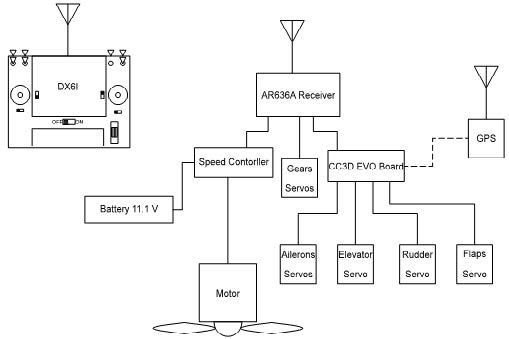
The objective of our team is to modify a remote controlled airplane to be able to fly on auto pilot. We begin with a six channel controller necessary to control all of the components to get the airplane in the air. The last channel on the control is used to switch the airplane into auto pilot so that it will fly unmanned. An on-board GPS will communicate with the CC3D master board to control the components on the airplane on their own. We will be using a P-51 Mustang RC scaled airplane for this project. The components that will be used for the autopilot are shown in the figure.
A Raspberry Pi Cluster for High-Performance Computing
Team Name
Design, Implementation, and Characterization of a Raspberry Pi Cluster for High-Performance Computing
Team Members
Ralph Walker II
Michael Vistine
Katy Rodriguez
Abstract
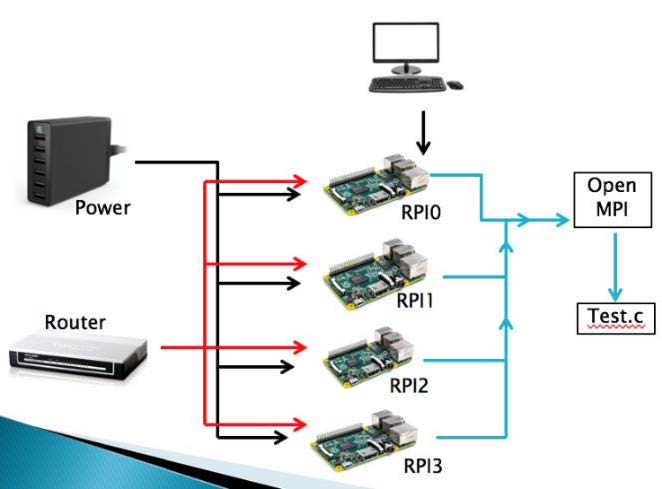
For our senior design project, we are testing high-performance computing using the latest Raspberry Pi model 2. The Raspberry Pi 2 offers a powerful 900 MHz quad-core ARM CPU that we will be testing to its limits by running different test such as wired vs. wireless networking, number of cores vs. execution time, and chip temperature vs. clock speed. The wired design is set up with 1 master pi talking to the 3 other slave pi’s via a router that we are using as a switch. The master pi runs the testing program while it is connected via SSH to the slave pi’s which are the main horsepower. Our program is compiled with the Open MPI parallel computing protocol.
IoT-Enabled Sprinkler System
Team Name
IoT-Enabled Sprinkler System
Team Members
Arebria Burr
Kevin Scott
Diandria Wright
Abstract
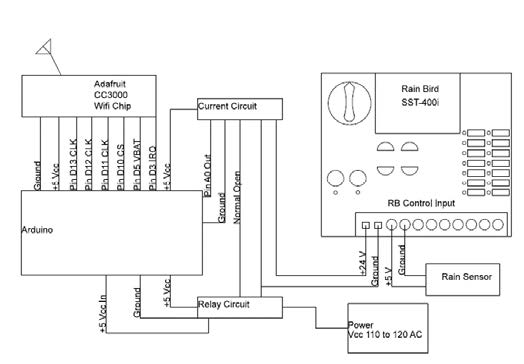
This project designs and implements an Internet-of-Things (IoT) enabled sprinkler system for residential applications. A local microcontroller provides control through relays to turn the sprinkler system on or off. The microcontroller board (Arduino-based) communicates via a WiFi shield with the Internet. The user can check the status of the system remotely via an app and can control the function of the system as well as collect statistics.