 University of North Texas

Mechanical Engineering - Fall
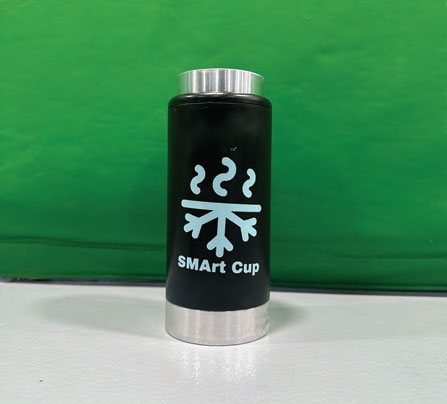
Elastocaloric Shape Memory Alloys for Insulated Tumblers (SMArtCup)
Team Members
Taylen Mathis
Melany Almeida
Benicio Swann
Ben Chavez
Jonathan Lopez
Internal Sponsors/Mentors
Ravi Sankar Haridas
Shkhar Jha
Rajiv Mishra
Abstract
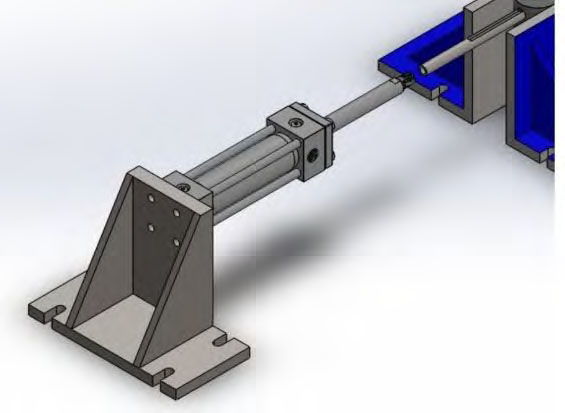
The UNT Center for Friction Stir Processing has developed Solid-Stir Extrusion (SSE), an advanced solid-state manufacturing process. SSE transforms feedstock into extrudate with reduced power demands and versatility across materials. However, the current SSE setup, using linear actuators, results in inconsistent material properties due to imperfections in the extrudate. Our project introduces hydraulic press actuators for a continuous, consistent feed, which aims to enhance extrudate quality by eliminating these imperfections. This solution is designed to support high performance and uniform mechanical properties, addressing key limitations of the existing setup.
Hydraulic Press for Actuators in Solid-Stir Extrusion
Team Members
Taylen Mathis
Melany Almeida
Benicio Swann
Ben Chavez
Jonathan Lopez
Internal Sponsors/Mentors
Ravi Sankar Haridas
Shkhar Jha
Rajiv Mishra
Abstract
The UNT Center for Friction Stir Processing has developed Solid-Stir Extrusion (SSE), an advanced solid-state manufacturing process. SSE transforms feedstock into extrudate with reduced power demands and versatility across materials. However, the current SSE setup, using linear actuators, results in inconsistent material properties due to imperfections in the extrudate. Our project introduces hydraulic press actuators for a continuous, consistent feed, which aims to enhance extrudate quality by eliminating these imperfections. This solution is designed to support high performance and uniform mechanical properties, addressing key limitations of the existing setup.
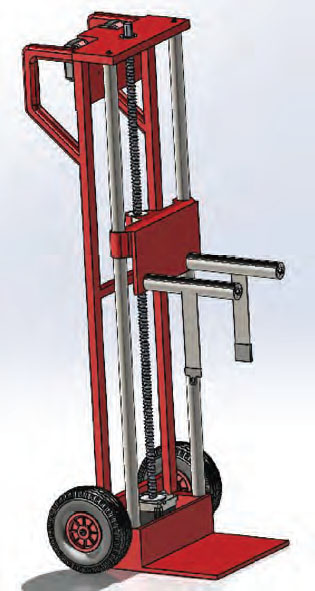
Oversized Assembly Lift
Team Members
Brandon Messer (Team Lead)
Chris Gomez (Secretary)
Simon Creley
Nicholas Long
Huy Nguyen
External Sponsors/Mentors
Charles Ward, Continuous Strategic Improvement Mgmt.
Discount Tire Company
Internal Sponsors/Mentors
Dr. Xiaohua Li
Mechanical Engineering Department
Abstract
Discount Tire Company works on an estimated 32 million cars every year. Of those millions of cars, a significant amount of those vehicles have oversized assemblies (wheel and tire). These assemblies, depending on the size of the tire or wheel, can weight anywhere from 100-200 pounds and can range from 34 to 42” in diameter. Discount Tire seeks to reduce injuries of its backroom technicians and allow for the easy lifting of the assembly on and off the vehicle while it is lifted. The company seeks to have injuries reduced to minimal, if not zero. To best set employees up for success, an oversized assembly lift is designed to meet this goal.
PiezoClean V6: Self-cleaning Solar Tile
Team Members
Ashaya KC
Kyler Dratwick
Justin Kelly
Kale Martin
Cristian Wray
External Sponsors/Mentors
Solar PiezoClean
Maher Maymoun
Ramiz Qamar
Amer Aljahran
Rama Ayoub
Internal Sponsor/Mentor
Dr. Maurizio Manzo
Abstract
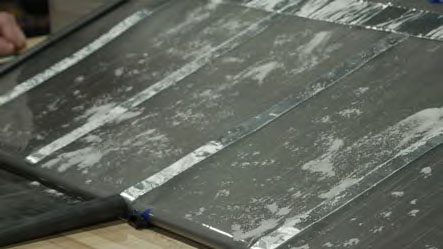
A vibrating film element is stretched over a commercial solar roof tile as a cleaning device. The thin, transparent, film made of poly-vinyl Difluoride (PVDF) contains piezoelectric properties that allow the film to be vibrated by inducing a high voltage across the film surface. To achieve this, a power unit encased in an ABS box delivers the necessary voltage for proper vibration. The unit consists of a 36V PSU, a 160W dual-channel audio amplifier, and a 6-63 turns ratio Control Transformer. The audio amplifier can take auxiliary input to induce vibration across a range of frequencies, producing different tones, and levels of vibrations. Stretching and holding the film is achieved through a composite frame that fits onto a Tesla solar roof tile. Made with ASA plastic, the frame provides not only excellent UV resistance for outdoor applications, but is also high impact resistant, and provides a sleek attractive look that blends-in with the roof tile’s aesthetics. The frame consists of two parts, a water-resistant electronics bar holding the power connection, and a retaining sleeve, securing the film. Tabs on the frame are used to secure the film in place, while clamping screws are used to secure the housing to the tile. Clamping forces are cushioned by a 0.5 mm lining on all contact surfaces between the housing and the glass-top of the roof tile. In application, sunlight passes through the film, but dust and other particulates will accumulate on the film surface instead of the roof tile. When the film vibrates, the dust cascades off the "waterfall" edge which provides a seamless drop onto lower units or the ground.
The Plantry
Team Members
Daniel Abfalter
Jacob McCoy
Joseph Rocabado
Brophy Sommerford
External Sponsor/Mentor
Boterna Vertical Farms LLC.
Internal Sponsors/Mentors
Mechanical Engineering Department
Dr. Xu
Dr. Hassan
Abstract
The Plantry is intended to provide consumers a more convenient way of growing their own fruits and vegtables.
A durbale structure was designed to withstand the outdoor elements to effectivley house an automated control system for optimal plant growth through a series of devices that regulate water, temperature, nutrient levals and humidity.
The reltivley lightweight inexpensive device makes it a practical solution to combat the issues of food scarcity in comunities with suboptimal conditions for crops.
Slider Crank Engine Mechanism
Team Members
Justin Barnes
Gabriel Gonzales
Daeyoung Song
Diego Tarango
Gerrell WIlliams
External Sponsor/Mentor
Dr. Muhammad Dado
Internal Sponsors/Mentors
Rick Pierson
Hassan Qandil
Abstract
The slider-crank engine mechanism, originally conceptualized by Dr. Mohammed Dado from the University of Jordan, efficiently converting linear reciprocating motion into rotational motion. Widely utilized in internal combustion engines, its simplicity and robustness have made it an essential study in motion and force transmission. This project aimed to optimize the slider-crank mechanism to enhance engine efficiency by up to 20%. Using Computer-Aided Engineering (CAE) simulations, a prototype was developed to validate the design's motion and to find room for improvements. These improvemants/enhancements included splitting the engine block for 3D printing, integrating bearing housings, and performing thermal and frequency analyses to ensure material durability under extreme conditions. The use of DFA (Design for Assembly) and DFM (Design for Manufacturing) principles, streamlining the assembly processes and optimizing material selection.
For commercial use and mass assembly high-quality materials, such as high-strength alloy steel for shafts, heat-resistant aluminum alloy for engine cylinders, and forged steel for the crankshaft, were strategically selected for their durability and cost-effectiveness. Our fabrication methods consisted of a varoity of different methods, including waterjet cutting, 3D printing, and lathe machining, all within a budget of $1,200. Each of the aluminum gears were precision-cut, while the engine's components were 3D-printed allowing us to create the intricate shapes. These innovations collectively ensure the mechanism's reliability and practicality.
Solar Panel Sidewalk
Team Members
Ellis Covington
William Lemmons
Esteban Ramos
Mason Rudolph
Xiyao Yan
Internal Sponsor/Mentor
Hassan Qandil
Abstract
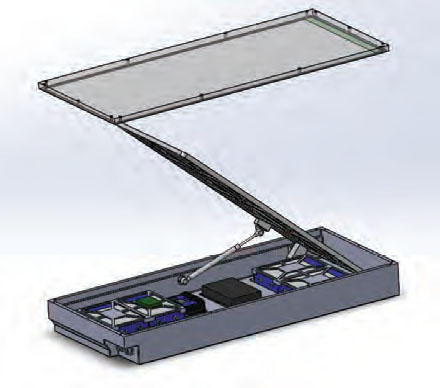
With our product we wanted to design a device that can do something with the wasted potential of solar energy on public walkways. Our device would use solar power to improve an average sidewalk. These improvements would be features such as light, a display, and clean energy. Our display would allow for local businesses or cities to use the sidewalk for advertising purposes or announcements. The final design includes an acrylic protective top cover, LED display screen, and an arrangement of solar panels. The LED display will be above the solar panels which still allows light to come through. The solar panels will be on a liftable shelving unit in order for easy maintenance. During the day our product will be storing energy and at night we will be using that energy to display advertisements to the public.