 University of North Texas

Computer Engineering - Spring
Smart Power Connector
Team Name
Bionic X
Team Members
Alex Sneed
Isaac Gregory
John Gitahi
Justin Mariki
Nicholas Bright
Internal Sponsor/Mentor
Pradhumna Shrestha
Abstract
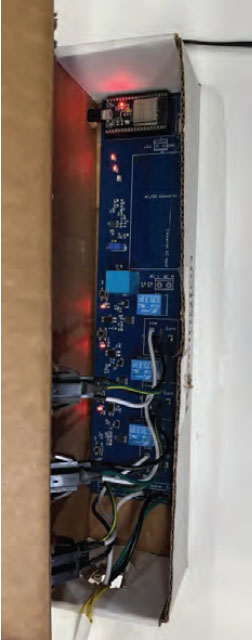
Do you have important equipment that requires power to be closely monitored? Often power strips today offer surge protection but are controlled manually; or, if they are operated remotely, are limited in the amount of information and functionality they deliver to the user. Our project introduces a next-generation smart power strip with additional features that allow a user to easily monitor the items they have plugged in. This includes typical smart technology, such as scheduling and plug control via an app, as well as more versatile functionality such as power monitoring, per-outlet usage history, a programmable power threshold, and safe charging capabilities for preventing overcharging. Combined, our smart power connector empowers users with improved visibility into their power usage plus upgraded control and flexibility over every plug’s operations.
Intelligent Speedometer System
Team Members
Nadir Elkhaldi
Praneet Nadar
Faisal Qaloob
Internal Sponsors/Mentors
Dr. Pradhumna Shreshta
Abstract
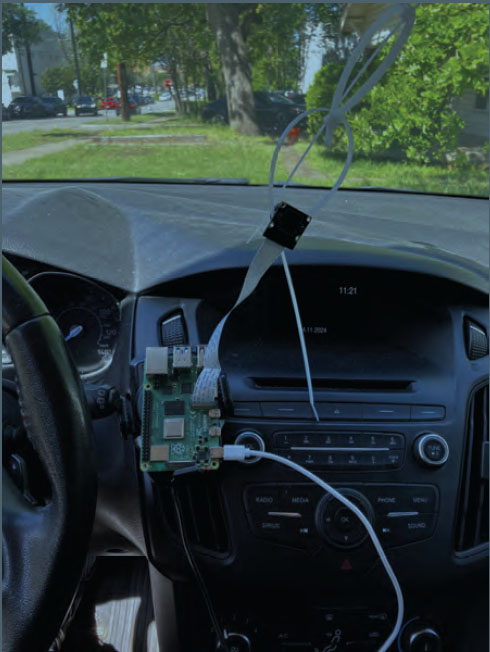
This project presents the development and implementation of an Intelligent Speedometer system as a senior design project for our bachelor degree, leveraging Raspberry Pi, artificial intelligence (AI) libraries, a camera module, and an Android application. The primary objective of this project is to design a sophisticated yet accessible solution for accurately measuring vehicle speed in real-time, incorporating AI algorithms for enhanced performance. The system operates by capturing live video feed of the road using a camera mounted on the vehicle, which is then processed on the Raspberry Pi platform using AI libraries such as OpenCV. These AI algorithms are trained to detect and track moving objects, enabling precise speed calculation based on changes in position over time. The Raspberry Pi communicates speed data wirelessly to an Android application via Wi-Fi, providing a user-friendly interface for displaying the vehicle's speed in real-time, along with additional features like historical data logging and visualization.
Smart Parking Monitoring System

Team Name
Seg_Fault
Team Members
Abdullah AlAbdullRazzaq
James Dagley
Ledwin Lares
Amy Phan
Judith Nivetha John Wilson Raj
Internal Sponsor/Mentor
College of Engineering
Abstract
The Smart Parking Monitoring System (SPMS) is designed to provide a comprehensive solution for monitoring vehicle entry and exit within parking facilities. By accurately counting cars entering and exiting parking zones, SPMS facilitates the efficient utilization of available parking spaces, reducing congestion and minimizing time wasted searching for parking. Its hardware simplicity ensures cost-effectiveness, ease of maintenance, and seamless integration: enhancing the parking experience for drivers. With the future of SPMS, manually searching for parking will become a thing of the past.
Deep-Sight
Team Name
Spark
Team Members
Josh Mears
Garrett Nawrocki
Yoofi Honny
Jean-Charles Hekamanu
Tyrese Palmer
Internal Sponsor/Mentor
Dr. Shrestha Pradhumna
Abstract
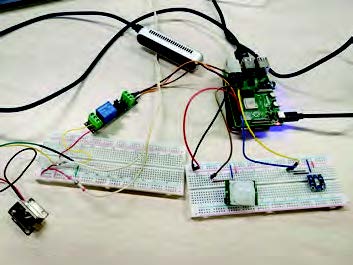
This is a smart door which opens via face recognition technology. This technology is designed to use the cloud for storage and an application feature which can send live updates to the user, allow the user to manually unlock the door through the app, and many other seamless features to give the user higher protection to outside threats. This door is designed to make it easier for people as well as making it more safe for them to enter/leave their homes.
This system consists of a IR camera sensor which will alert the facial recognition camera to first take a photo of the person trying to enter the locked door and logg it into the system s database, then it will identify the person to see if it is or isn't an allowed user. The application has features which will alert the user if there is access granted or a denied user trying to enter the door. The captured data, including images and access logs, is securely stored in the cloud which will ensure data integrity, and accessibility from anywhere.
Acknowledgments
Benjamin 'Sylvie' Edgar and Dr. Shrestha Pradhumna
Heatmap and Alert System
Team Name
Three to Two
Team Members
Mckenna Hicks
Anthony Bruno Tringalli
Shreeya Subedi
Aaron Jacob
Daniel Jaramillo-Alejo
Internal Sponsor/Mentor
Dr. Pradhumna Shrestha
Abstract
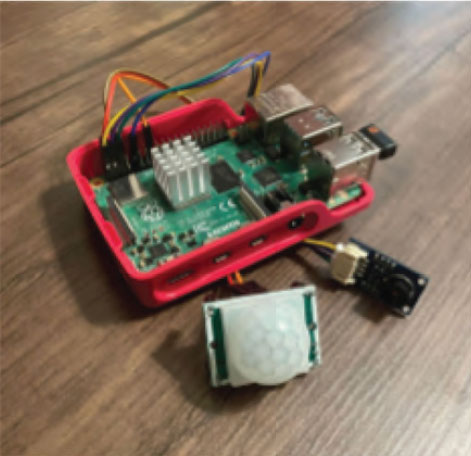
The goal of this project is to create a heatmap and alert system. The temperature of individuals and objects in a room will be caught on multiple heat sensing cameras that will be placed around rooms. The heat sensing map that the cameras will make together will connect and send their information to a database where a website can gather its data. Once you connect to this website you will be able to see the overlay with a number of high temp individuals in each room. The camera's embedded system will also take note of when there are areas where the temperature is higher than average and report this. The database will record and store these significant temperatures. On top of the website, there will be a mobile app that also allows you to see the overlay with a number of high temp individuals in each room. The mobile app will also have a notification alert system that will let you know if there are any temperature changes of note in the heatmap area. The heatmap will also be overlaid on top of the buildings map, to allow a fuller picture of the rooms. The measurements taken by the camera will also be categorized to allow for better tracking.
Acknowledgments
We would like to acknowledge our friends and family that have guided our team and supported us every step of the way.
Programmable Electrical Switch, Dimmer, & Power Outlet for Appliances
Team Name
A2B
Team Members
Ashwini Patel
Ben Edgar
Alex Dillinger
External Sponsor/Mentor
Mathew George - MR Smart Solutions, Inc
Internal Sponsor/Mentor
Dr. Robin Pottathuparambil
Abstract
As we understand more about the results of our actions and how they impact the environment, we see that we need to make efforts to produce less waste. One of the top waste-producing industries is energy. The best way that we can directly contribute to producing less waste is by using less energy in the places that we have the most direct impact, such as our home.
This project aims to produce smart light switches, dimmers, and power outlets that can be programmed to minimize electricity usage. With these devices, a person could set a timer for their devices so that they turn off after a designated time period. They could also set a schedule for when devices turn on or off to ensure that they are off when they are not in use. A person can use our mobile app to generate a report to see how much energy they use and how much it has differed from day to day. They can use the app to lock our devices to prevent them from being physically used. Additionally, we have implemented Amazon Alexa and Google Assistant functionality within the mobile app so that a user can control these devices using voice commands for additional convenience.
While there are already other devices like these on the market, we have attempted to provide feature-rich variants that are also cheaper than what currently exists and thus lowering the barrier to entry for integrating these devices into more homes.
Power Termination, Diversion and Notification using COSMIC (Carbon Monoxide - Smoke
- Interrupting - Circuit)
Team Name
Atlas
Team Members
Emmanuel Eze
Alberto Rosas
Tanner Roberson
Samuel Thomas
External Sponsor/Mentor
Dan Combe
Internal Sponsor/Mentor
Dr. Robin Pottathuparambil
Abstract
Annually, 1.1 million burns require medical attention in the US. Approximately 40,000 require hospitalization, and of those, 10,000 die from these injuries. Current measures with smoke and fire alarms are insufficient. We need to terminate power to circuits immediately when CO, Smoke, and other gasses are present, then we need to divert the power to begin the evacuation of hazardous gasses while we notify homeowners, business owners, EMS, and other authorities of the threat.
The COSMIC Home System aims to reduce the harm caused by toxic gas leaks by creating an innovative home device that can be installed right onto a two-gang light switch box. The COSMIC Home System comes down to four subsystems:
- Sensor: This device can be mounted onto a two-gang light switch box and detects carbon monoxide (CO), carbon dioxide (CO2), ammonia, temperature, and humidity. The sensor displays this information on an OLED screen on the front of the device. If a toxic gas crosses a threshold, the sensor will alarm using two buzzers and send the data to the Cloud using Wi-Fi or 4G/LTE cellular data. Furthermore, if power is cut from the sensor, the backup battery will continue monitoring toxic gases.
- Actuator: This device can be plugged into any three-prong wall outlet and electrical device. The actuator will shut off power to any connected device should a toxic gas threshold be exceeded. The actuator could turn on a connected device, such as a fan, using the configuration switch, should a toxic gas threshold be exceeded.
- Cloud: The Cloud interfaces will all devices and stores data regarding toxic gas incidents, as well as sending notifications when any threshold is exceeded.
- Mobile App: This app interfaces the COSMIC Home System with the user, allowing the user to see live data from the sensor devices as well as set custom thresholds for each device.
Acknowledgments
Special thanks to Dr. Robin Pottathuparambil for his mentorship and support during
the design
and implementation of the COSMIC project.
Electronic PCB Debugger
Team Name
BMP PCB
Team Members
Branden Hart
Parker Spivey
Michael Donohoo
External Sponsor/Mentor
Anora Labs
Internal Sponsor/Mentor
Dr. Robin Pottathuparambil
Abstract
BMP PCB Testing will be building a hardware software infrastructure using a cloud-based application. Using a programmable multimeter, power source, and a few Arduino boards, we will display passing/failing test cases based on recorded voltage, current, continuity. Our project is a software interface to run dedicated hardware remotely from a computer. The recorded data will be stored in a server format utilizing MongoDB. The interface will be written in React and interfaced with Python FastAPI to connect all systems. Our primary goal is to demonstrate a working prototype that allows a computer to sign in and run the software through the cloud from a server, this software provide simple commands that take these measurements from hardware connected to PCBs.
PCB Pick and Place System
Team Name
JFL
Team Members
Jailene Contreras Marquez
Lap Nguyen
Fernando Zavala Ortiz
External Sponsor/Mentor
Anora Labs
Internal Sponsors/Mentors
Robin Pottathuparambil
Ross Pulliam
Abstract
One of the most important parts in the manufacturing of semiconductors and circuit boards is the testing procedures they go through. Traditional testing methods depend heavily on manual labor to place circuit boards on a test tray. This results in several problems including time consumption, quality control issues, safety concerns over workers and cost inefficiencies.
Our project aims to automate the process of picking up and placing Printed Circuit Boards to a test tray by using computer vision and a suction mechanism to solve these challenges. It will offer increased efficiency for the manufacturing process by eliminating the need for manual intervention. It will also increase quality control of the circuit boards and reduce the safety risks of workers associated with doing repetitive tasks.
Reduction in time consumption will also lead to reducing the cost of testing and increasing production output.