 University of North Texas

Electrical Engineering - Fall
Wireless Power Transfer Using Coils
Team Members
Andrew Coulombe
Obinna Dike
Tyler Radichel
Internal Sponsor/Mentor
Dr. Sensong An
Abstract
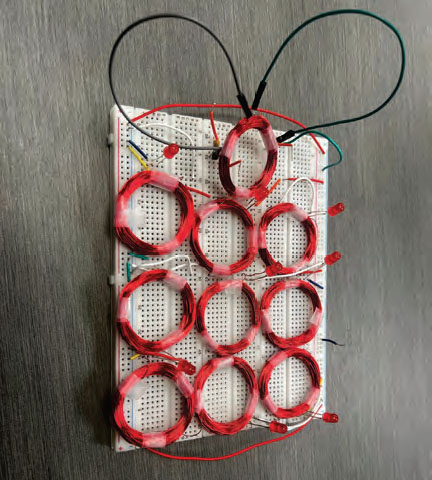
We have created a system that uses coils to transfer power wirelessly. This is shown through a connection to a grid of lights that mirrors the coil’s position. The system is set up on a stage prototype, with LED coils below the stage and the power coil inside an object on the stage. As the object moves around the stage, the lights above the above light up and vary in brightness based on the distance to each LED coil. This creates the effect of the lights following the object as it moves around the stage.
Mortar Color Identifying Device
Team Members
Daniel Garcia
Eriberto Muro Sonora
John Andre Arrojado
Armando Hernandez
Internal Sponsor/Mentor
Dr. King man Siu
Abstract
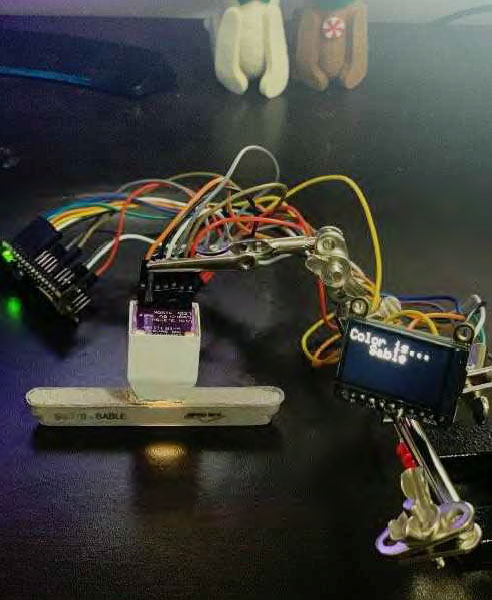
The masonry industry, while deeply rooted in tradition, faces challenges in matching mortar colors for repairs, especially when the color only reveals itself after drying. Currently, masons rely on experience or expensive sample kits to match colors, both of which can lead to inconsistent results. Our project aims to design an accessible, handheld device that uses spectroscopy to precisely identify and replicate mortar colors. Ultimately resulting in enhancing both accuracy and ease of use for professionals and amateurs alike.
The proposed device integrates a color sensor, Arduino Nano microcontroller, Bluetooth connectivity, and a database of color "recipes" to guide users in mixing the correct mortar composition. Our design focuses on affordability, portability, and usability, ensuring it can be mass-produced at a low cost while still providing reliable performance. Constraints include working within the Arduino ecosystem, ensuring power efficiency, and achieving compactness.
The device will undergo several prototyping stages, with key deliverables including a fully functional system, a mobile application, and Bluetooth integration for remote user interaction. Our project not only addresses a practical need but also incorporates ethical considerations related to safety, quality standards, and the potential misuse of the device for financial gain.
Increasing accuracy of load-pull measurement setups for RF devices using reflectionless
high-pass filters
Team Members
Robert Valois
Eli Gabaldon
Olasubomi Borishade
Internal Sponsor/Mentor
Dr. Hung Luyen
Abstract
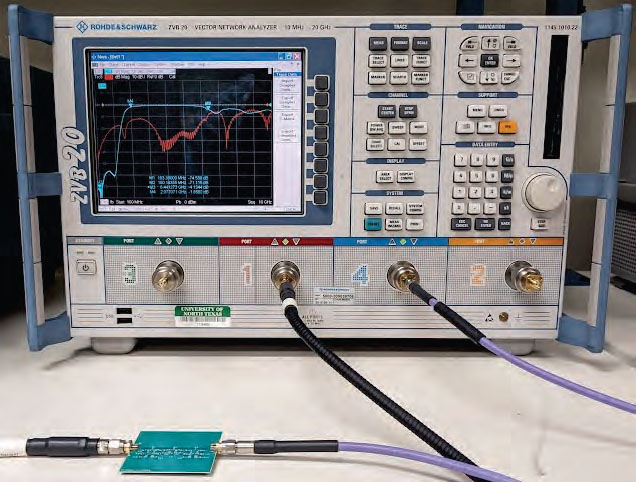
There is an industry need for increased accuracy in the load-pull measurements of RF devices to meet the stringent expectations of customers. The opportunity to increase accuracy was identified in absorbing the signal reflections caused by elements in the load-pull setup that negatively impact the characterization of devices under test. A high-pass reflectionless filter made of passive components was conceived, simulated, fabricated and tested for the intention of use in load-pull test measurement setups. Our filter suppresses out-of-band reflections below 2.3GHz and provides high transmission coefficients with specified scattering parameters between 2.3 and 6GHz. This device also acts as a protective measure for devices under test in an industry standard RF test setup.