 University of North Texas

Mechanical Engineering Technology
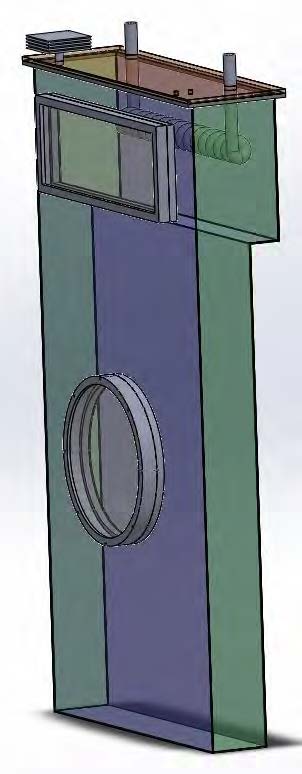
Laboratory Equipment for Two-Phase Immersion Cooling
Team Members
Shelby Maverick
Simbisai Kaiboni
Xavier Villalobos
Travis Copeland
Jameel Haddad
Hasan Al Sadiq
External Sponsors/Mentors
ASHRAE
3M Mentors:
Mr. Phil Tuma
Dr. Jimil M. Shah
Internal Sponsor/Mentor
Dr. Huseyin Bostanci
Abstract
The objective of this project is to provide a more efficient, energy saving, and environmentally safe cooling method to implement into data centers cooling strategy. Implementing a two-phase immersion cooling method will reduce energy consumption, reduce noise pollution, and be environmentally viable.
In this approach, electronic components are submerged into a pool of dielectric liquid featuring a low boiling point (30-60℃). The liquid boils on the surface of the heat-generating components, and as vapor bubbles rise, they passively and effectively transport the heat away. This method achieves higher heat transfer rates/power densities, and has very compact and flexible packaging options. Compared to conventional air cooling, two-phase immersion cooling provides a much simpler system, reduced capital and operational expenses, reduced environmental impact, and higher efficiency, and energy savings (>90% electricity savings).
Acknowledgments
Special thanks to Rick Pierson and Bobby Grimes for helping answer all our manufacturing questions!
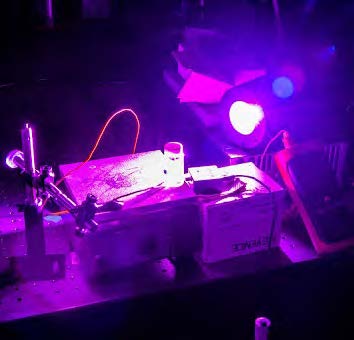
Laboratory Equipment for Optical Sensing Systems-Based Spectroscopy
Team Members
Jonathan Smith
Jalen Winborn
Abbas Alqallaf
Cody Letz
Shariff Ello
External Sponsor/Mentor
The American Society for Engineering Education
Internal Sponsor/Mentor
Dr. Maurizio Manzo
Abstract
The objective of this project is to determine how accurate a spectrometer is when compared to more conventional techniques regarding measuring pressure and temperature. Utilizing a spectrometer can potentially save companies money and precious time, in order to measure temperature and pressure differentials, while also showing a real time view for change in readings. The approach for this project will be to create an easy-to-follow lab manual in order to successfully complete experiments in the classroom, utilizing the Ocean Vue Spectroscopy Education Kit.
The team will be utilizing Rhodamine 6G Dye in conjunction with a portable spectrometer, and 2 light sources with known wavelength intensities. The readings measured by the spectrometer will be compared with data collected with a thermocouple (a more accurate thermometer).
The team will also be creating a 3D printed material and utilizing Pressure Sensitive Paint (PSP) in conjunction with the Ocean Vue Spectrometer to measure pressure differentials among different parts of the material. The data collected through using the PSP and Spectrometer will be compared to CAD simulation in the SolidWorks Program to ensure accuracy in measurement.
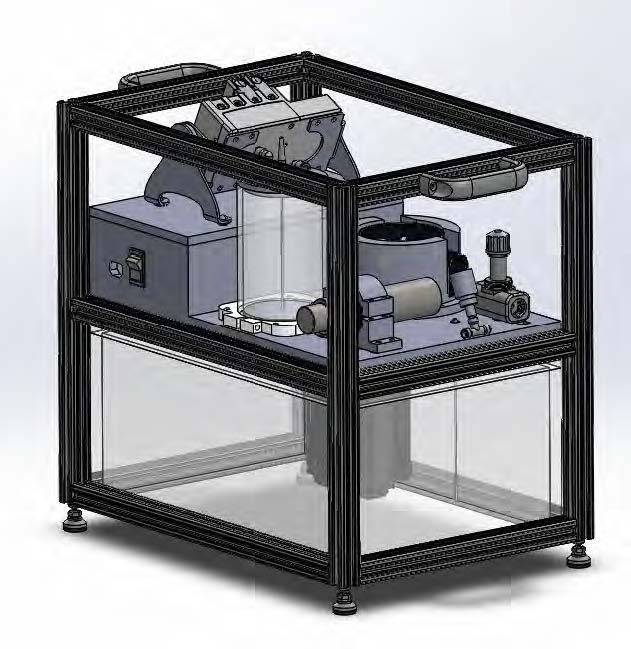
Modular DAQ Training System for Thermo-Fluids Applications
Team Members
Tomi Arenyeka
GabinoBencomo
Joshua Dorsey
Austin Watson
Joshua White
AimanKhan
Internal Sponsors/Mentors
Engineering Technoloy Department
Dr. Huseyin Bostanci
Abstract
The goal of the project is to build six modular, multi-functional data acquisition
(DAQ) training sets for thermo-fluids applications. By applying the principles of
thermodynamics, fluid mechanics, and heat transfer, an experiment thermo-fluid systems
setup will be created to be integrated with the virtual simulation
program, LabVIEW.
Currently in the senior level course Experimental Thermal Science (MEET 4360), the
fundamentals of data acquisition and LabVIEW are briefly covered with no physical
apparatus to work with. This limits the student hands-on experience with the experiments
that involve data acquisition and important measurements.
With the creation of the DAQ training modules, the lab facilities will be enhanced
and students in small groups of five or six together can have more practical capability
in acquiring measured and recorded data as well as instrumentation in different thermo-fluid
areas.
Acknowledgments
Special thanks to Rick Pierson and Bobby Grimes for timely advice and assistance.
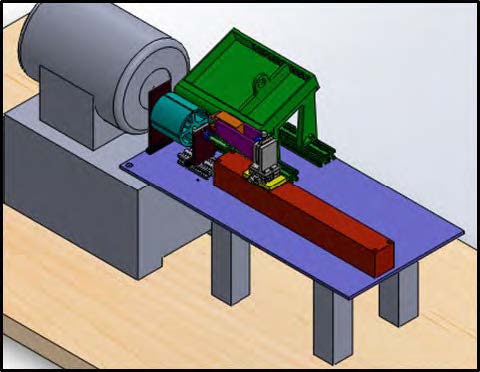
Hopper and Actuator for Rotary Swager
Team Members
Elyssa Reeves
Bryce Bonanno
Adam White
James Koonce
Adam Tollison
External Sponsor/Mentor
Epimed
Internal Sponsors/Mentors
Dr. SeifollahNasrazadani
Dr. Rabah Aoufi
Abstract
Epimed is a medical device manufacturing company located in Dallas, TX that provides high-quality specialty devices for pain management. They are designing a new product that requires a cold-forged, rounded-tip needle. Currently, Epimed is outsourcing the process of forging these needles which is costing them several thousands of dollars per lot (1000 needles). The focus of this project is to create an automated system to use with Epimed’s rotary swager to bring this process in-house and reduce production costs. The needle sizes we are working with are 7-inch 16 gauge needles and 3.5-inch 18 gauge needles. Our team has created an automated system utilizing a linear actuator, provided by Epimed, to feed each needle into a barrel from a hopper, insert the needle into the swager with a gripper and the linear actuator, and dispense the swaged needles into a bin. This automated system is controlled by a PLC to allow for continued development and the addition of different size needles. With the completion of this project, Epimed will save over $3000 after just the first lot.
Acknowledgments
We would like to thank Epimed and Dr. Seifollah Nasrazadani for supporting us throughout this project and giving us the opportunity to take on this challenge. We would also like to thank Scott Courtney, process engineer from Epimed, and Dr. Rabah Aoufi for assisting us with the electrical components.
Microgravity Gas‐Liquid Separator for the Liquid Amine CO2 Removal System
Team Name
X-hab
Team Members
Alyssa Sarvadi
Balmore Giron
Nick Frease
Fernando Primo
Hannah Whitehead
External Sponsors/Mentors
National Aeronautics and Space Administration
Dr. Darrell Jan, NASA Ames
Dr. Cable Kurwitz, Texas A&M
Internal Sponsor/Mentor
Dr.HuseyinBostanci
Abstract
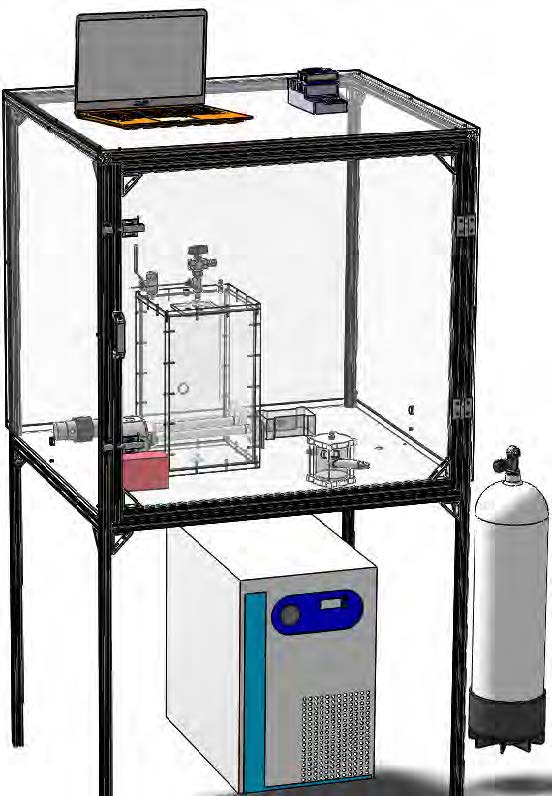
The X-Hab 2020 Academic Innovation Challenge has selected eleven senior design teams
from colleges across the US to demonstrate working prototypes for exploration systems
and habitation. UNT has been working on the creation of a gas-liquid separator for
an air revitalization system. Air revitalization technology is used to support
spaceflight by removing CO2 from enclosed systems to maintain breathable air. Separating CO2 from enclosed environments in space application is extremely important because if
the CO2 levels in an enclosed cabin exceed certain levels, death by hypercapnia can occur.
The ISS currently uses solid sorbents in their air revitalization system to aid in
CO2 removal from the enclosed cabin, however solid sorbents are difficult to handle in
microgravity environments and the system in which they are used with requires a large
amount of energy. This project demonstrates vortex phase separator technology for
removing H2O from a CO2 stream, which is a vital subsystem to NASA’s current air revitalization system and
could replace the need for use of solid sorbents. This would ensure an innovative,
reliable, compact, and energy efficient air revitalization system for gravity independent
manned exploration.
Acknowledgments
The X-Hab Team would like to thank Mr. Bobby Grimes, graduate student Sania Shaik, and undergraduate student Charlie Wang for their hard work and dedication to the X-Hab project.
Design and Manufacturing Concepts of UAS Morphing Structural Elements
Team Name
Project Aquila
Team Members
Jadon Morris
Braylon McCarty
Adam Greig
Ali Alfayez
External Sponsor/Mentor
CCDC Army Research Laboratory
Internal Sponsors/Mentors
Dr. Hector Siller
Dr. Nandika D’Souza
Abstract
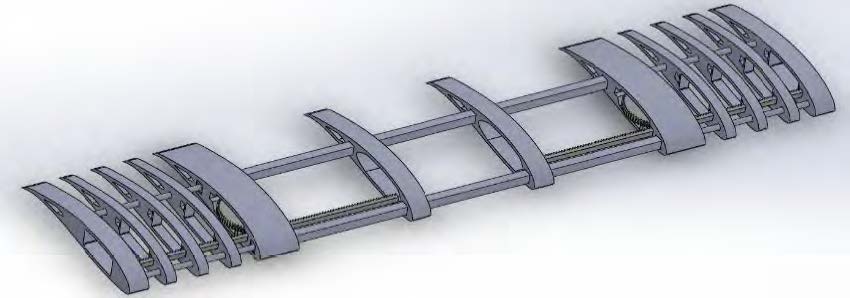
In order to more effectively use the limited battery power of an Unmanned Aerial System, this team has been tasked with developing an airfoil for a hybrid system with both multirotor and fixed-wing flight capabilities. This system was developed as a modern method for small payload delivery over moderate ranges, and as such required the reliability and maneuverability of a multirotor vehicle –which allows vertical take-off and landing –as well as the more robust flight-range capabilities of a fixed-wing system.
This team has been specifically assigned to create an airfoil for this system that not only can be rapidly reproduced, ideally using additive manufacturing, but also has mechanical components allowing for in-flight control of the airfoil’s physical properties. The primary property the team hopes to effectively control is the airfoil’s length. By extending and contracting the airfoil in a linear fashion from each end, the team hopes to provide a variable surface area which will allow finer control over the amount of lift and drag provided by the airfoil. In order to minimize drag caused by mechanical components, the airfoil’s extension mechanism is completely internal, and all components with the exception of motors can be 3D printed and assembled by hand.
Acknowledgments
Project Aquila thanks Dr. Hector Sillerfor his guidance and assistance in the development of this system.
Versatile Platform for Measuring Aerodynamic and Aeroacoustics Characteristics of
UAS
Team Name
Unmanned Intelligence
Team Members
Austin Ciervo
Mostafa Alqamr
External Sponsor/Mentor
Army Research Laboratory
Internal Sponsors/Mentors
Engineering Technology Department
Dr. Hector Siller
Abstract
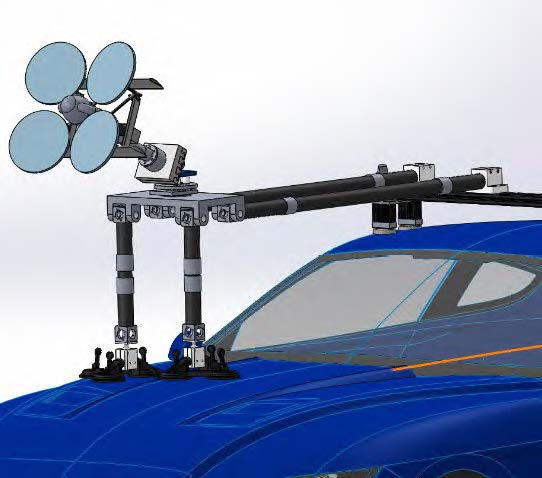
Hybrid unmanned aircraft systems (UAS) that incorporate the design features of fixed wing vehicles and rotorcraft do not require additional control systems to enter and exit the transition flight. Such control systems require more attention as the interaction of rotor jets and wings can change the generated lift force during the transition, which might cause loss of altitude. Unmanned Intelligences’design project is to develop and manufacture a test platform to evaluate the aerodynamics and aeroacoustics of UASs. The UAS will transition from a vertical takeoff to horizontal flight by manipulating motor RPMs and pitch angles of the rotor blades and wings. In order to perform tests, the aircraft must be fixed in place on a platform which will then have the capability to mount on various automotive vehicles. The vehicle will then accelerate to approximately 40 mph to simulate airflow over the UAS. A load cell will collect data from the forces acting on the wings. Such data will be used to calculate the required parameters to perform a successful flight transition.
Acknowledgments
We would like the give a special thanks to Dr. Hector Siller, Dr. Hamid Sadat, Dr. Xinrong Li, Dr. Kamesh Namuduri, Dr. Diana Berman, Dr. Huseyin Bostanci, Ph.D. student Cesar Chavez and the Army Research Laboratory for the continuous support and guidance throughout this project.
Portable Handheld Antimicrobial Treatment Device
Team Members
Christopher Gibson
Nicholas Greene
Dalton Richey
Jonathan Lopez
Elijah Nisar
External Sponsor/Mentor
Dis.In.Fx Inc.
Internal Sponsors/Mentors
Dr. Hector Siller
Dr. Maurizio Manzo
Abstract
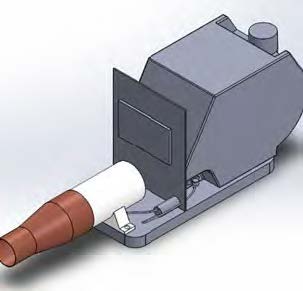
Portable handheld antimicrobial treatment devices are manufactured in many different ways with multiple application methods. Currently, Dis.In.Fxis operating with the use of multiple sprayers depending on the type of application needed. Some devices are needed for extended use such as treating gymnasiums, work-out facilities, while other applications require intermittent use with high portability. As of now, there is no portable handheld antimicrobial device on the market that utilizes both wall power and/or a rechargeable battery. In addition, Dis.in.fxwants to manufacture the portable device for itself and future retail sales. With this new design, application of the antimicrobial solution will result in less time at jobsite which increases the companies profits as well.
UNT FSAE Rear Spool Differential
Team Members
Zachary Cline
Matthew Peralez
Daniel Duncan
Ali Al Kadem
Monty Grabner
Internal Sponsors/Mentors
Engineering Technology Department
Professor Ali Nouri
Mr. Rick Pierson
Mr. Bobby Grimes
Abstract
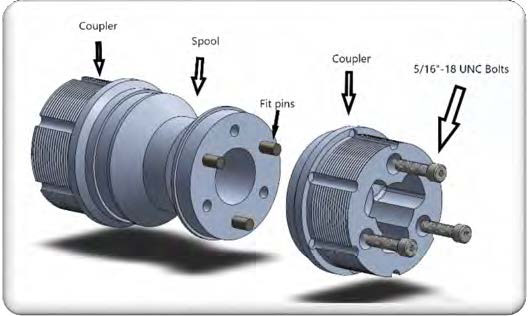
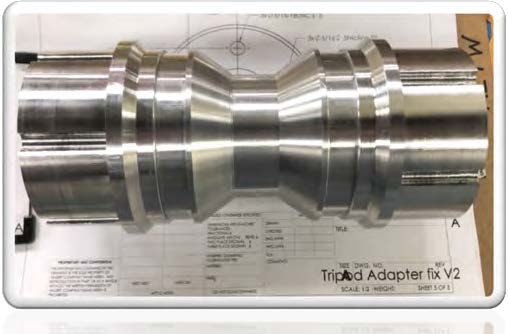
The differential is a key mechanism for providing vehicular stability and mobility in any drivetrain. The purpose of this project was to design a lightweight, cost efficient rear spool differential for UNT Mean Green Racing to use during the Formula SAE Lincoln national competition in summer 2020. This project investigates the transitioning process from limited slip differential (LSD) to a lightweight rear spool differential. Doing this it will decrease the weight, cost and component count of the racecar. By reengineering the rear differential this produces a more efficient energy transfer to the wheels, preventing any loses that may occur when taking turns at high speeds. The dynamics of the limited slip differential (LSD) is quite simple, the LSD design loses power around turns because the outer most wheel lifts off the ground, which transitions all the power from the inside to the outside wheel. Implementing the rear spool differential allows the UNT Mean Green racing team to not only evenly distribute power between the wheels but will put them across the finish line faster earning more points for competition.
Easy‐to‐Use Bluetooth Music System for Senior Center
Team Members
Hassan Alnasser
Egue Essoh Desire Romero
Sharon Arowolo
External Sponsor/Mentor
Dr. Mitty Plummer
Internal Sponsor/Mentor
Dr. MittyPlummer
Abstract
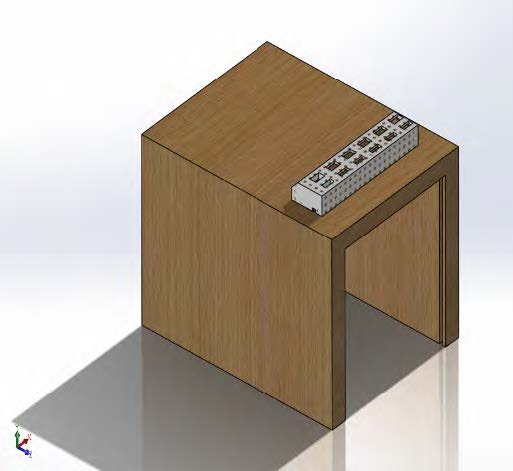
This project deals with the development of the senior boom box for chair aerobics exercise class. Initially cassette tapes were being used to play songs during exercise class. There are many problems with this device, one being that it was producing a static sound. Additionally, the client wasted time changing in between songs, as they could not be stored in a specific order in that device. Therefore, the idea to design a Boom Box was developed, which contained multiple USB ports with switches to play the songs, along with a stop button. Songs could be arranged in order on multiple USB sticks, and a specific song could be played by pressing a single button, which has the capability to reduce the efforts made by senior citizens to turn on the music system. Not only the box is easy to use but also it will have its own speaker, which will allow the client to play music from it directly. In addition to that , with the use of the Raspberry Pi’s Bluetooth system, the box can be connected to the Senior Center’s sound system allowing the client to play songs through it as well.
HVAC System Design at 1401 Elm St
Team Members
Abdulmuin Alanazi
Chukwuemeka Uzor
Fredi Sanchez
Mohammed Alzayer
External Sponsor/Mentor
H & G System
Internal Sponsor/Mentor
Dr. Maurizio Manzo
Abstract
Heating, ventilation and air conditioning (HVAC) technology are among the modern solutions developed for the purpose of achieving indoor and vehicular environmental comfort. The air-conditioning units achieve this by offering thermal comfort for all building occupants by ensuring warmth and the air quality are within the acceptable limits while improving productivity, reducing the amount of energy usage and thus cutting on the cost of the bills.
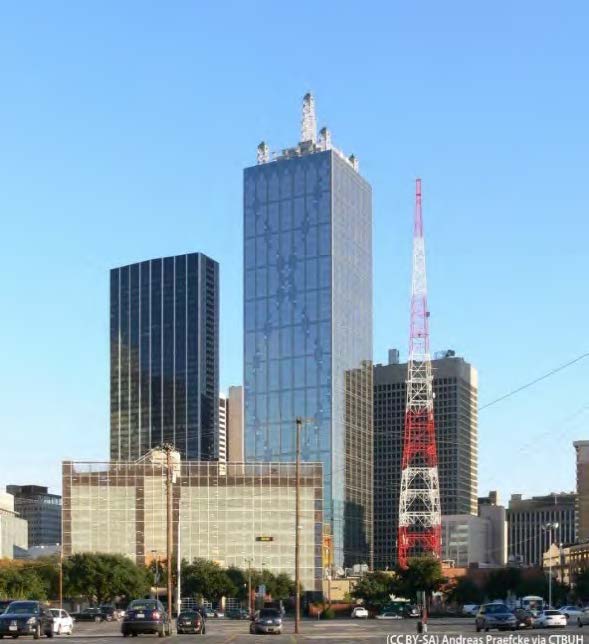
In this project, HVAC system for Drever building, Downtown Texas was redesigned by employing a type of HVAC technology known as Variable Refrigerant Flow(VRF). The software used for obtaining project specifications of the components for this project was the AutoCAD software. Daikin system helped with the fabrication of VRF HVAC unit while the H&G helped in installation of the unit at Drever building.
Acknowledgments
Special thanks to Mr. Grant Yaney, President of H&G Systems, for his constant guidance throughout the process of bringing the project to life.
Mobile Stand for Trap Machine
Team Members
Johnathan Floyd
Mohammed Almajed
Kamel Albahrani
Abdulhadi Almmarri
External Sponsor/Mentor
Dr. MittyPlummer
Internal Sponsors/Mentors
Dr. Hector Siller
Mr. Bobby Grimes
Abstract
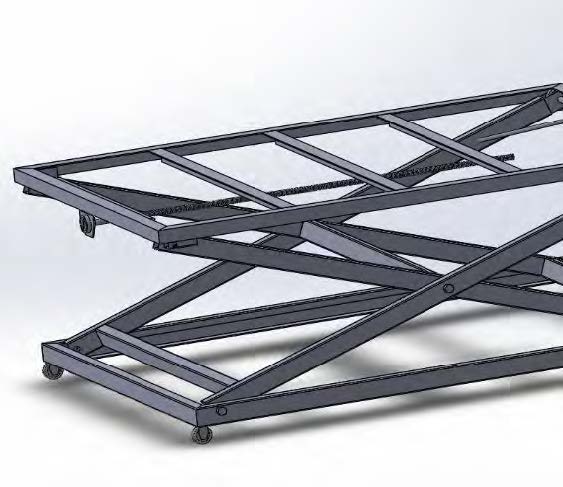
Nearby gun ranges are being flooded by fast rising water causing the ranges trap launchers to be water logged, leading to expensive repairs or replacement of the launcher. The ranges gave design requirements of lifting the launcher six feet off the ground, be mobile enough that the stand can be moved around easily to give verity to the locations that the targets come from when costumers come to shoot and with a budget of $600. Attempts by previous design teams were not able to properly address the problem, being too short or not mobile enough to fulfill the needs of the range. Our teams design will fix the root of the problem cheaply and effectively, with our scissor lift that can hold the weight of a fully loaded launcher at the required six foot height to prevent the launchers from being water logged. While the wheels that have been chosen will give it enough mobility to be moved around easily by the employees of the ranges.
Fire Hose Auto-Roller
Team Members
David S. James
Jomique Johnson
Luis Martinez
Olawunmi Olasoju
External Sponsors/Mentors
Denton Fire Department
Battalion Chief David Boots
Internal Sponsors/Mentors
Engineering Technology Department
Prof. Ali Nouri
Abstract
The Fire Hose Auto-Roller is a device custom-built to serve the needs of our Denton community by improving the working efficiency and conditions of the Denton Fire Department. Fire hoses of 5-inch diameter, used for bringing water from a fire hydrant to a pump truck, are very heavy (up to 1000 pounds per 100 feet when full) and time-consuming to drain, roll, and store by manual labor, and the weight poses a safety risk for the fire fighters who have to handle them. The Fire Hose Auto-Roller will be capable of rolling, draining, and brushing clean the outside surface of hoses at the push of a button. The rolled hose can then be retrieved easily for storage on a truck or at the fire station. The device will be made of as few custom components (that is, as many off-the-shelf components) as possible to allow for easy maintenance and parts replacement by its end users. Its winch motor may be powered by either a battery or the electrical outlets on-board fire trucks. Other designers have made devices which can reel in any size of hose but are mounted to trucks, or which are portable but can only reel in 2.5-inch-diameter hoses and must be walked along the length of larger-diameter hoses, but the Fire Hose Auto-Roller will have the power to reel in any size hose up to 5 inches in diameter while being portable enough to move around training sites or be used at the scene of a fire fight independently of fire trucks.
Acknowledgments
Our sincere thanks go to UNT ETEC, Prof. Ali Nouri, Dr. HuseyinBostanci, Mr. Rick Pierson, the Denton Fire Department, Battalion Chief David Boots, and our community and loved ones for all the input and support which have made this project possible.
EtherCAT CNC Plasma
Team Members
Austin Wilson
Scott Crum
Ryle Jersey Mercado
External Sponsors/Mentors
ExtraTech
MultiCam
Engr. Andy Cordell
Internal Sponsor/Mentor
Prof. Rabah Aoufi
Abstract
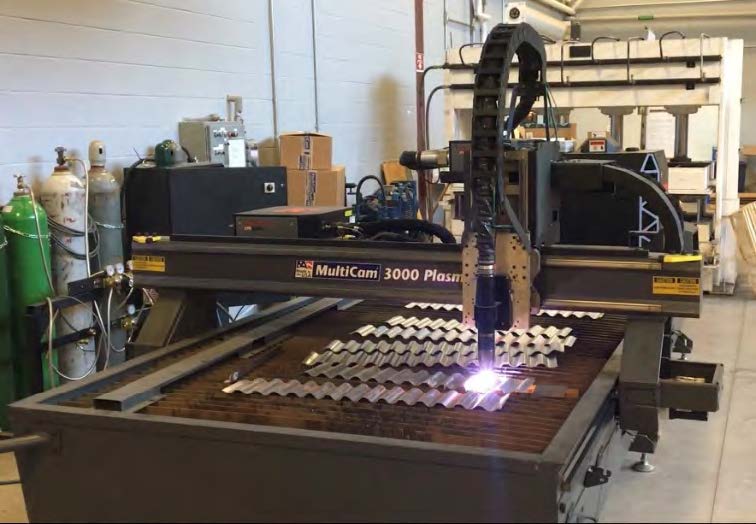
Ethernet for Control Automation Technology (EtherCAT) is an Ethernet-based fieldbus system supporting both hard and soft real-time computing requirements in automation technology. The project team’s objective was to upgrade MultiCam’sComputer Numerical Control (CNC) Plasma Cutting Machine system’s software and incorporate EtherCATtechnology to produce a faster and modernized system. The projected plan consists of analyzing of the machine’s performance with applied modifications via code, conducted through testing and debugging. Many benefits will be produced once the upgraded system is fully implemented, including higher performance, easier access, a reduction of cost for hardware, short data update times with low communication jitter and remote debugging configuration issues will be available.
SAE Formula Design Parts
Team Name
UNT Formula Electric
Team Members
Saleh Alatwah
Majed Aljuhani
Belal Baamour
Ali Almarzooq
Internal Sponsors/Mentors
Engineering Technology Department
Dr. Nourredine Boubekri
Dr. Reza Mirshams
Abstract
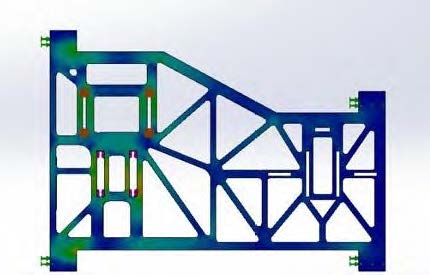
The objective of this project is to build a pedal box, firewall, and floor panel for University of North Texas formula car to participate in the Formula SAE competition.
SAE is the Society of Automotive Engineers. It is a US-based organization and has international events. SAE has been founding since 1905. The SAE formal race is a big event that happens every year. It is an opportunity to allow graduate students to show off their engineering skills. The senior design project formula SAE car is a project to design a formula car according to the SAE competition rules.
Acknowledgments
Dr. Huseyin Bostanci