 University of North Texas

Electrical Engineering
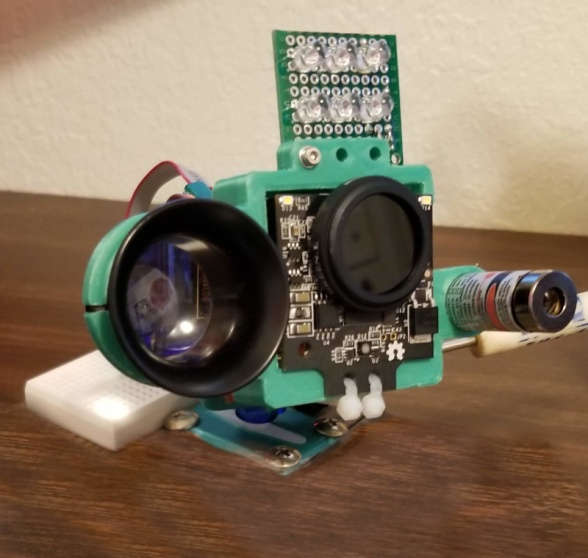
Small-Platform High-Datarate Remote Communications (SHRC)
Team Members
Jeff Calloway
Nathan Collins
Riley Cotrell
Ethan Murrell
Internal Sponsor/Mentor
Colleen Bailey, PhD
Abstract
Free space optical (FSO) communication systems can be used to transmit at high data rates while being immune to electromagnetic interference (EMI) that is typical in radio based communication systems. Current radio frequency (RF) transmission systems are flooding the usable spectrum, causing it to become overcrowded and inconvenient to use. This results in an increased noise and potentially lower bandwidth within a desired frequency range. This spectrum crowding results in RF transmission interference by adjacent transmissions. In addition to EMI/EMC immunity, FSO provides increased network security due to it's enhanced directed transmission schema. The free space optical transceiver (FSO-TRx) systems proposed in this paper will help to solve these problems with a modular and scalable design.
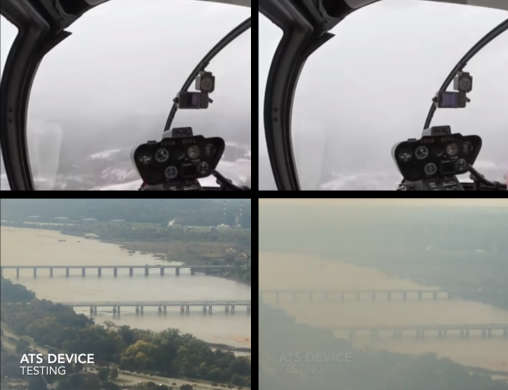
Aviation Training Systems (ATS) Device
Team Members
Eric King
Zachary Walker
External Sponsor/Mentor
AT Systems LLC
Internal Sponsor/Mentor
Colleen Bailey, PhD
Abstract
An improvement to an existing device is proposed to simulate Degraded Visual Environments (DVI) and Inadvertent Instrument Meteorological Conditions (IIMC) during live flight training to improve operator response to non-ideal conditions. This method utilizes a phototropic material attached to the pilot’s communication headset that modulates transparency based on voltage supplied. The current system is described along with a proposed design to expand application into to the civilian sector.
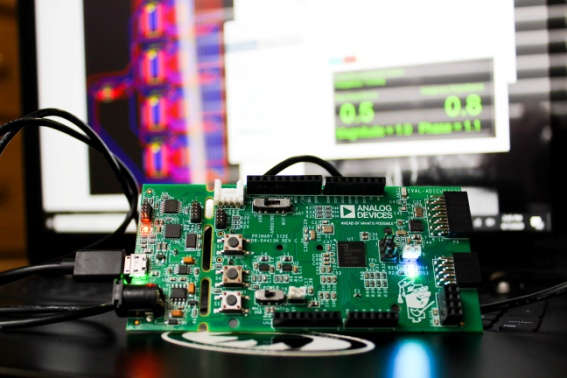
A Microelectrode Impedance Measurement System using AD5940 Evaluation Board
Team Members
Linh Nguyen
Jose Arreguin-Martinez
Bernabe Rangel
Ho Thuy Tien Le
Internal Sponsor/Mentor
Dr. Ifana Mahbub
Abstract
Electrical pulses in the human brain are collected for analysis using micro-electrodes. Micro-electrodes must maintain a low impedance to achieve high-quality measurement results. A challenge in long-term neural signal recording studies can be the degradation of the coating or corrosion in the metal of the electrode. The outcome of such degradation along with corrosion or interference may be an increase in the impedance of the electrode. High electrode impedance causes an increase in low-frequency noise, which consequently decreases the signal-to-noise ratio. Therefore, it is crucial to test the electrode impedance for quality purposes. A bio-impedance monitoring system be used to solve this challenge by investigating the condition of the electrodes and estimating the effects of the spurious signals caused by the motion artifact, cellular damage, or electrode degradation. This project proposes the design of a new device called ElectroZ that performs electrode impedance measurements on a wide frequency range and at a manageable cost. ElectroZ is developed as a bio-impedance measurement system to measure both real and imaginary parts of the impedance of the electrode using the AD5940 as the main component.
Morph Wing Mechanism Control
Team Members
Deja Fowler
Hae Jin Kim
Ana Morales
Danah Omary
Joel Salas
Internal Sponsor/Mentor
Dr. Gayatri Mehta
Abstract
The concept of morphing wings is a relatively new study under research at the Army Research Lab (ARL). Morphing wings allow for lateral extension and retraction whereas most wings on UAVs are fixed. Changing the aspect ratio of the wings changes the lift to drag ratio for better flight. As part of a bigger project involving teams in Material Science and Engineering (MTSE), Engineering Technology (ETEC), Mechanical and Energy Engineering (MEEN), we were responsible for designing a system to control the extension and retraction of the morphing wings. Working with stepper motors the ETEC team chose and wings they designed, we implemented a system that adjusts the motors according to data from a proximity sensor and uses Bluetooth connected to a microcontroller for manual wireless control.
Low-power Wearable Vocalization Sensors for Effective Rehabilitation of Aphasia Patients
Team Members
Tyler Vornberg
Zaryab Shah
Yuyang Lu
Jacob Makelke
Internal Sponsor/Mentor
Dr. Ifana Mahbub
Abstract
Aphasia is an impairment of language, affecting the production or comprehension of speech and the ability to read or write. While there is no cure, patients with Aphasia generally undergo speech therapy as part of the recovery process. However, once they are discharged from the hospital, they often stop practicing and lose all of the gains they made in therapy. To address this issue, our project team has designed and built initial iterations of a small, wearable, low power device capable of detecting speech by measuring the vibrations in one's larynx. The system incorporates a piezoelectric sensor and microphone, the signals of which are amplified and transmitted to a separate platform where it is analyzed to determine when the user has spoken and for how long. With this device, doctors would be capable of monitoring their patients from afar and collect data on the effectiveness of different treatments or forms of therapy. Future iterations of the product may include the ability to transmit the data wirelessly to one‘s smartphone where it could be analyzed and stored.
Automatic Room Light System with Remote Monitoring and Data Logging
Team Members
Hussain Aljuhaif
Mohammad Al Qahtani
Internal Sponsor/Mentor
Dr. Parthasarathy Guturu
Abstract
A cost effective automatic room light system with remote monitoring and data logging feature is proposed in this Project. A flexible design approach is used where the design can be changed according to requirements in less cost. The light will automatically be turned on and off by detection motion. The current status of lights can be monitored by the user on a mobile phone. The per hour data will be logged in SD card. A prototype design is introduced along with the circuit implementation so that it can be beneficial for the users.
Renewable Power System Dry Cell HHO
Team Members
Lucas Kilpatrick
Tyler Pendarvis
Benjamin Huddleston
Internal Sponsor/Mentor
Professor Miguel Acevedo
Abstract
This report will detail our research and testing of our hydrogen fuel cell system and its results when powering a 2-stroke engine. The inspiration of our system is to be able to realize the feasibility of implementing a similar system in a rural setting as a way to renewably fuel farm equipment. We have assembled the whole system in a manner that it will be easily portable and able to be moved by any user. We will analyze the output and make projections as to the efficiency of our design.
Development of UAS Aerodynamics and Aeroacoustics Measurement Platforms
Team Members
Alexander Toops
Marcos Morales
John Manzano
Martin Cruz
Internal Sponsor/Mentor
Dr. Xinrong Li
Abstract
Propellers are a major component of unmanned aerial systems (UAS), and their design can greatly affect the performance, efficiency, and noise of a UAS. Unique propeller designs are necessary for deployment on UAS with both forward flight and hover operating modes as the design criteria differs for each of these modes. This project aims to assist in the production of these propeller designs by contributing meaningful test data to improve and refine each design iteration, and to identify flaws in the manufacturing process. We use a combination of load cells, electronic speed control (ESC) telemetry, and audio analysis to evaluate the design prototypes. The goal is to produce efficient and low-noise propellers capable of maintaining strong performance for both operating modes in cooperation with mechanical engineering, materials engineering, and engineering technology. Overall, through the tools we had combined with multiple departments we have successfully established a meaningful design platform to test the data needed for producing a capable UAS.
Reconfigurable Antenna
Team Members
Rodney Alvarez
Omolara Griffon
Marco Juarez
Luke Sparkman
Internal Sponsor/Mentor
Dr. Ifana Mahbub
Abstract
The rise of drone usage for commercial and military purposes has given us the opportunity to work on new drone technologies. Our objective is to develop a reconfigurable antenna for short distance drone-to-drone communications, of about 1 km, and long-distance drone-to-base-station communications, of about 10 km, and switch from one mode to another mode. Nitol material will be used to create our antenna which will change shape and in turn, change the mode of communication from the short distance to long-distance communication and vice versa. Reconfigurability is the focus of our antenna design as a reconfigurable design will be able to serve the purpose of two individual antennas, while only using one antenna. This gives the advantage of using less power and less physical space while implemented in a drone.
Low Cost Low Maintenance Mask Aligner For Fabrication of Multilayer Microfluidics
Device
Team Members
Chukwuma Iroegbu
Mitchell Boling
Zachary Green
External Sponsor/Mentor
Plexon
Internal Sponsor/Mentor
Dr. Ifana Mahbub
Abstract
Multilayer photolithography is very important in the micro fabrication of multi-height photoresist master molds for microfluidics devices, which is used in fields like, micro-electro-mechanical systems, micro total analysis systems, sensors, and other applications. This system is very high in cost and maintenance. Combined with the expensive and space-consuming installation requirements required for a multilayer photolithography system has made it difficult for small laboratories and companies to manufacture microfluidics in-house. At the center of the multilayer photolithography fabrication is a mask aligner, which essentially provides accurate mask-to-wafer alignment and generates uniform ultraviolet illumination over an exposed photoresist surface. Typical commercial mask aligner is very costly and heavy. In this work, we present a low-cost custom built mask aligner that will be used in the in-house UNT cleanroom.