 University of North Texas

Mechanical Engineering Technology
Formula SAE Aerodynamics
Team Name
Aeromotive Technologies
Team Members
Kyle McDougal
Byron Hameline
Nick Luciano
David Perry
Jeb Owens
External Sponsors/Mentors
Polaris Machinery Group
Duna USA
QA1
SIEMENS
Peterbilt
Fastenal
Solidworks
Thermoforming Process Products
Internal Sponsors/Mentors
UNT Mean Green Racing
Dr. Maurizio Manzo
Dr. Leticia Anaya
Abstract
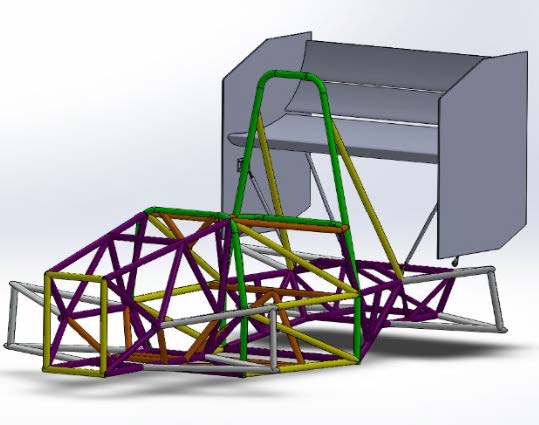
Aeromotive Technologies was formed at the request of Mean Green Racing (MGR), the UNT Formula SAE Team. Our team was tasked with holistic research and development of an aerodynamic device for the Formula SAE car. We have successfully developed a way for the MGR to efficiently research, choose, prove, manufacture and mount a rear aerodynamic device (inverted wing). MGR will now be able to use our methods and data to quickly and accurately determine the most efficient wing elements and aerodynamic end plates for their situation and prove their theoretical efficiency before manufacturing using advanced simulations verified by manual calculations. Our team also identified the most economical manufacturing methods based on MGR’s financial restrictions and manufacturing capabilities. Finally, we used MGR’s current chassis models to design a mounting method consistent with their current rules and mechanical restrictions.
Acknowledgments
We would like to thank our advisor Dr. Manzo for supporting us throughout this project and special thanks to research assistant Chris Mullins for his help with Ansys Simulations.
Peterbilt Cab Air Tester
Team Name
B & P Process Solutions
Team Members
Brandon Thieme
Pramson Kurien
External Sponsors/Mentors
Peterbilt Motor Company
Thomas Ford
Tyrone Thompson
Internal Sponsor/Mentor
Dr. Hector R. Siller
Abstract
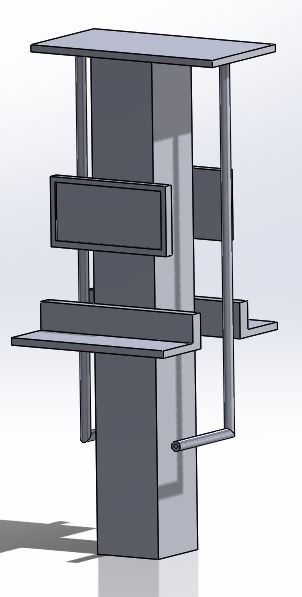
The brake check process is critical for Peterbilt and the safety for everyone on the roadways. Due to the importance of this check, it is crucial for the operators performing the test to not be distracted or have anything that would interfere with their performance. Unfortunately, that is not the case for Peterbilt right now. On average, the operators performing the test will spend roughly sixty-seven seconds trying to track down and fix an air leak related to the cab of the truck. Therefore, we are currently looking to implement a cab air tester to drastically decrease the amount of non-valued time by 50-90% the operators spend fixing air leaks before being able to complete the brake test. This project will not only benefit the company and its reputation for producing safer more reliable trucks, but it will also save the company thousands of dollars in labor and warranty costs. The yearly labor savings from this air tester would be roughly $50,000 and the warranty savings are projected to be around $35,000.
Tolerance Analysis of Computer Aided Design (CAD) Softwareand Mechanical Manufacturing
Team Name
Expect Excellence
Team Members
Katherine Austin
Samantha Bernal
Thomas Cozza
Agustin Zavala
External Sponsor/Mentor
Raytheon
Internal Sponsor/Mentor
Dr. Leticia Anaya
Abstract
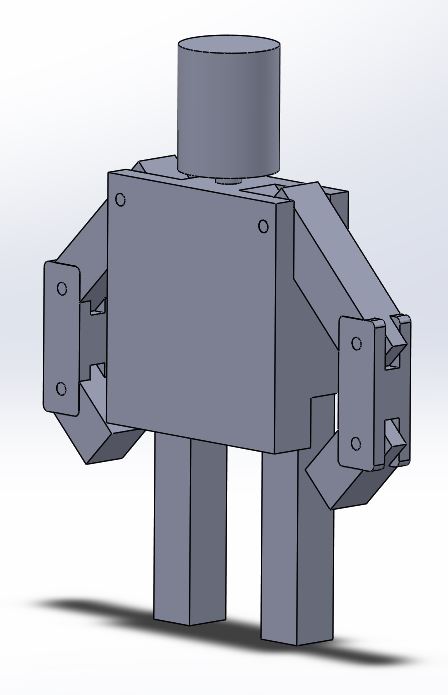
Tolerance Analysis is the study of how variations in part dimensions contribute to the dimensions of a finished product or assembly. Tolerances are analyzed in order to evaluate geometric dimensioning and tolerancing (GD&T). It’s important to pay attention to GD&T since incorrect tolerances can add up, costing companies time, money, and material.
We were approached by Raytheon in 2017 to help their analysis team research improve the methods used to perform proper tolerance analysis. They have pointed out that many companies are faced with the same issues concerning the parts and pieces of various components not assembling properly. The best way to find a solution to this issue by comparing the effectiveness of different CAD softwares in their ability to perform tolerance analysis. This way, we can find the most accurate software that companies can use, or at least show the pros and cons in each one. The data acquired in each software will then be compared to geometric hand calculations and theoretical ANOVA data to prove validity. This project is a continuation of the previous year’s work, and is expected to continue into the 2019/2020 school year.
The tolerance analysis and dimensioning must be done in consideration of the standards depicted in ASME Y14.5-2009.
Pressure Indicator for Fire Sprinkler - Team 4A
Team Members
Marc Chapman
Brett Boydston
External Sponsor/Mentor
American Innovative Products Incorporated
Internal Sponsors/Mentors
Dr. Maurizio Manzo
Dr. Bostanci Huseyin
Abstract
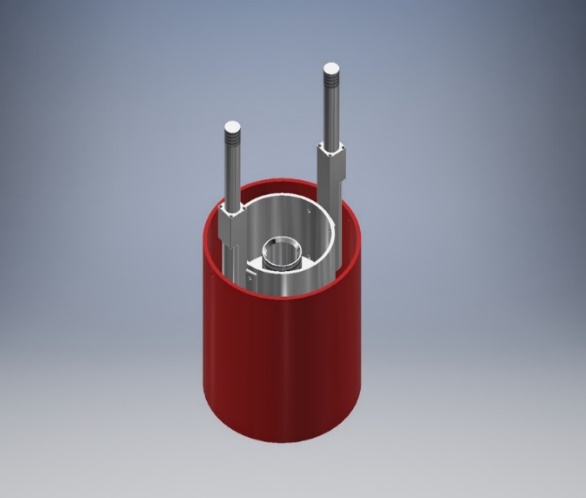
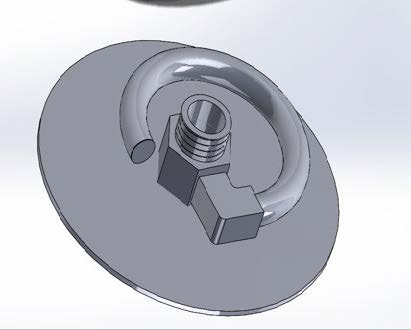
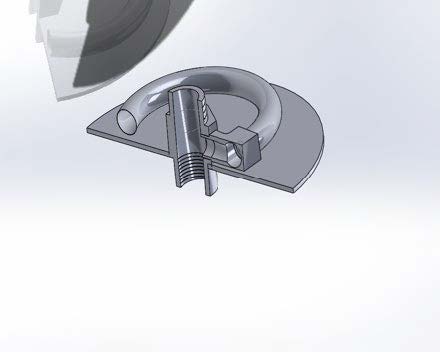
PIFS is a self-contained pressure indicating device that is fitted onto a new or existing fire sprinkler system. It is designed to visually indicate whether an individual fire sprinkler head is under the correct amount of water pressure as specified by the NFPA 13’s codes and regulations. The device will be placed between the water pipe and the sprinkler head. When the water system is turned on, water will flow into a pipe adapter that is connected to two hydraulic pistons. As the pressure builds, the hydraulic piston rods will extend and lift the red indicator sleeve into the ceiling. If the pressure drops below the required amount for an individual sprinkler head, a spring of a certain strength inside the piston will extend, pushing the piston rod back into the piston shell and cause the indicator sleeve to drop below the ceiling. When the indicator sleeve is exposed, it is displayed as a 360-degree ring around the sprinkler head, maximizing its potential to be seen. The main objective of PIFS is to insure safe, simple, fast, and affordable ways to check if your safety system is functioning properly.
Pressure Indicator for Fire Sprinkler - Team 4B
Team Members
Hassan Alekhwan
Hussain Alatwah
External Sponsor/Mentor
American Innovative Products Incorporated
Internal Sponsors/Mentors
Dr. Maurizio Manzo
Dr. Bostanci Huseyin
Abstract
Sprinkler fire systems are installed in multiple commercial buildings, retail stores, factories, institutions, etc. to extinguish fires. Currently, the sprinkler systems installed are 99% effective in preventing fires when they activate and are under the correct amount of water pressure. However, not all systems are as effective as they seem. Some sprinkler heads are not under any pressure when installed, or the heads lose their pressure, and effectiveness because the system has been previously shut off and not re-activated. As of now, there is no way to check if an individual sprinkler head is under any water pressure. In addition, the only way to check an individual sprinkler head is in case of a fire occur and that is the wrong way to test a fire system. However, after the completion of the project (pressure indicator for fire sprinklers), it will be easy to check and fix the pressure amount in each fire sprinkler head. That is, homes, companies, offices and all other buildings will be more safer with our project installed. The only way to protect lives and valued properties in case of a fire is to have PIFS in the building.
Western Extrusions Weight Tester
Team Members
Robert Dorsey
Rashed Aleissa
Jordan Flowers
Nick Pena
External Sponsor/Mentor
Western Extrusions
Internal Sponsor/Mentor
Mr. Ali Nouri
Abstract
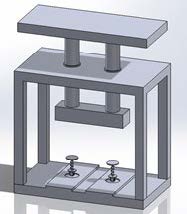
Team 5’s team lead Robert Dorsey managed to acquire a project from Western Extrusions. Western Extrusions extrudes long aluminum pipes that must be lifted out of the way by two employees. The lifting positions have a quick turn over of employees, require extra interviewing of prospective applicants along with extra paperwork and more potential filing of claims if an employee gets injured.
The Western Extrusions Weight Tester provides a method that saves time for Western Extrusions as it allows them to test the overall fitness of the applicants on the spot instead of taking all the applicants to the work area—the extrusion presses. In addition, the Western Extrusions Weight Tester eliminates any candidate that’s not fully fit or not equipped to handle these lifting positions.
The Western Extrusions Weight Tester is relatively compact for its function. This allows Western Extrusions to change the Weight Tester’s environment to wherever they feel is appropriate.
Cam System for Wafer Cutting Operations
Team Members
Jonathan Zaragoza
Julio Adrian Maciel
Johnny, Nguyen
Majed El-Alawy
Cristina Powell
External Sponsor/Mentor
L3 Communications
Internal Sponsors/Mentors
Dr. Leticia Anaya
Dr. Hector Siller
Abstract
L-3 Technologies has worked with UNT students to come up with a project that can enhance the wafer cutting process. Currently methods only allow for singular cuts to be performed on the wafers. The proposed project is to integrate a cutting tool with a table able to move in the X axis that is able to rotate 90°to achieve the desired cut pattern of a wafer. The cutting operation will consist of a first pass cut, then rotating the table 90°and finishing with a second pass cut giving the desired pattern. This operation will cut the waiting time needed for a department to wait on a chip that's needed to be worked on. The cutting tool must be precise, repeatable, and safe to avoid causing any damage to the wafer which effects it usability. A fixture will be constructed to combat this issue to maintain precision and repeatability to the wafer cutting process.A fixture will be constructed to combat this issue to maintain precision and repeatability to the wafer cutting process.
Acknowledgments
This project could not have been completed without the support and participation of L3 Communications, Dr. Leticia Anaya and Dr. Hector Siller.
Project Pressure Wash
Team Members
Carlos Moreno
Justin Domingo
Ali Almenayan
Chris Morrison
External Sponsor/Mentor
Jostens
Internal Sponsor/Mentor
Dr. Leticia Anaya
Abstract
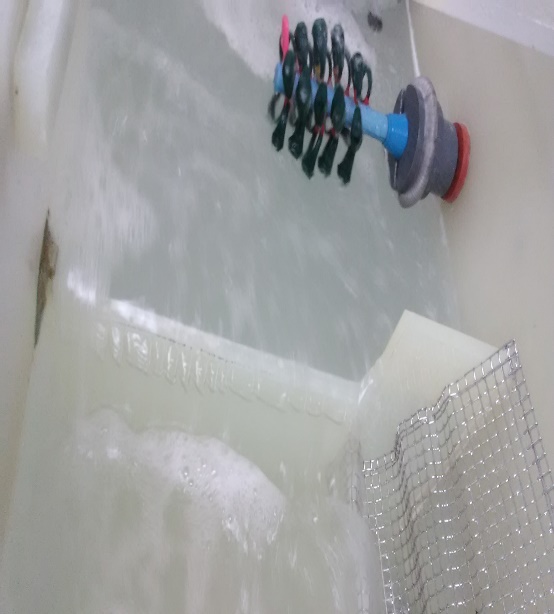
The team is manufacturing a machine that benefits the ring manufacturing company, Jostens. The machine is the combination of two of Jostens current machines that leads to an increase in efficiency and speed of the ring production. The machine cleans the tree rings by pumping hot water, 100°F, from a reservoir tank up to a set of PVC pipes, then out a set of spray nozzles. Any runoff water or loose sediment passes through a hopper into four filter bags. The remaining water returns to the reservoir tank and the cycle continues. The design process of this project consists of drafting, budgeting, sourcing materials, the first design, several redesigns and the final design.
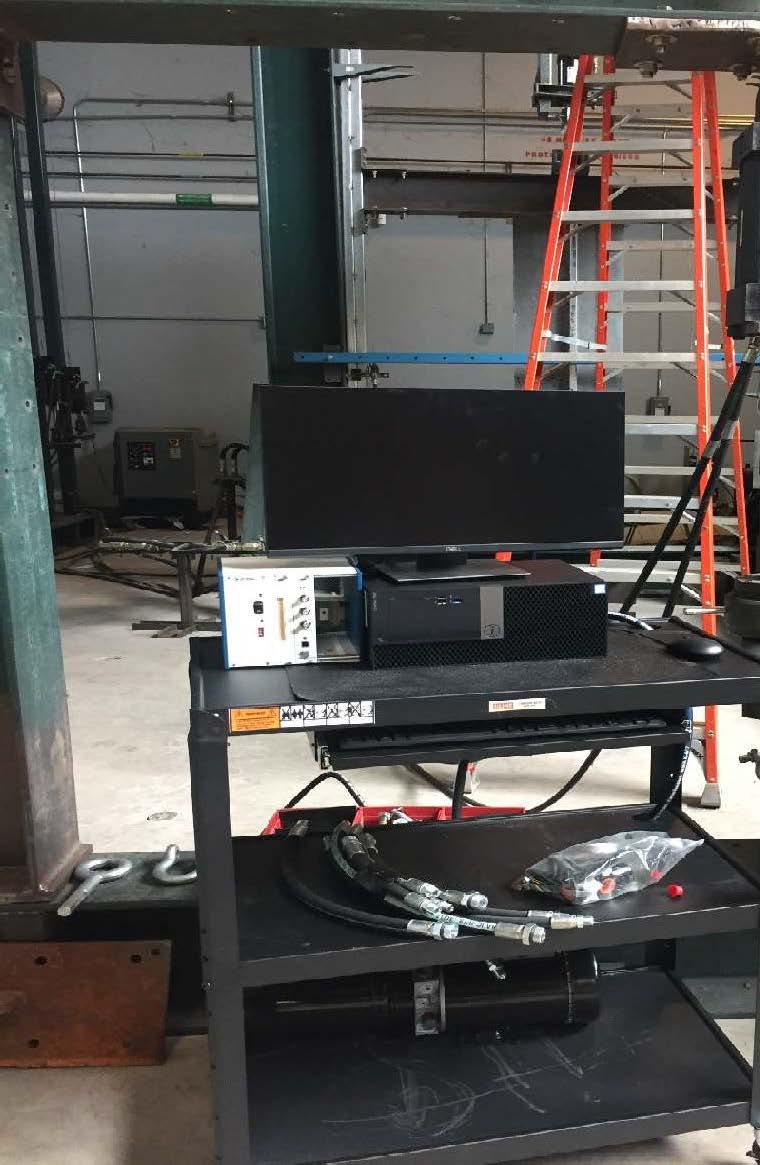
Hydraulic Modular Unit
Team Members
Aziz Haryani
Nicholas Ramos
Demetrius Robertson
Hunter Schwanebeck
Internal Sponsors/Mentors
Construction Engineering Technology
Dr. Cheng Yu
Abstract
The University of North Texas Construction Dept is expanding and improving its hydraulic unit to conduct structural testing’s and make the unit mobile. The hydraulic unit created by team will be more specific and more directed as per the requirement of the system comparatively. This system is not only beneficial for team to serve its learning purposes, but also it helps UNT structural testing lab, especially the construction major who can use this machine to conduct cold form related test. As we know UNT is well known for its construction engineering program in Texas and its structural testing lab has done multiple sponsored based projects. This structural testing system not only adds to the capabilities of the structural testing lab to cater the needs of outside projects but also aids students to be able to use it for their own educational gains. With the system requiring little to no human involvement apart from the setup, this system will be safe and easy to use.