 University of North Texas

Mechanical and Energy Engineering
Sanden Intl. Project
Team Name
9 ACES
Team Members
Ghithi Alkalbani
Mohamed Allafi
Tavyn Brooks
Edgar Gonzalez
Francisco Mendoza IV
Christopher Morel
Shaima Qaddoura
Runtian Tang
Robert Thomas IV
External Sponsor/Mentor
Sanden Intl. USA
Internal Sponsors/Mentors
Dr. Mark Wasikowski
Dr. Tae Choi
Robbin Shull
Rick Pierson
Abstract
Sanden Intl. is a company that manufactures refrigerant compressors for the automotive industry. Due to strict regulations, the metallic shavings created during the assembly process exceeded the maximum specifications.
Our goal was to reduce/eliminate the contamination found inside the compressors. Through our brainstorming and analysis we determined three potential solutions focused around the adjustment screw.
By solving this issue, we would drastically reduce the amount of time and money spent on cleaning and fixing the alignment in their current production line. The solutions we have designed so far are unlike anything previously thought of within the company and geared towards a very specific issue in the automotive industry.
Acknowledgments
Special thanks to Scott Worley & Greg Maurer from Sanden Intl., Dr. Wasikowski, Dr. Choi, Robbin Shull, Rick Pierson and the entire faculty and staff from UNT for their guidance, assistance, & support.
AlumaPower Project
Team Name
AlumaPower Tech
Team Members
Hunter French
Mary Njoroge
William Pena
Scott Wood
External Sponsors/Mentors
Paul Simpson
Goeff Sheerin
AlumaPower
Internal Sponsors/Mentors
Dr. Reid
Dr. Glaser
Dr. Wasikowski
Abstract
The AlumaPowerTech design team was tasked with developing improvements to metal air batteries by looking into designs of the cathode. To do this, the team designed and constructed a test fixture to control and test different cathode designs inside the cell as well as design and fabricate different methods of creating cathode.
Apogee Automatic Vise Adaptor
Team Name
Apogee
Team Members
Cody Beall
Abdallah Al Tobi
Ali Aldulaijan
Abdulrahman Alqahtani
Austin Engler
Joshua Kovach
External Sponsors/Mentors
All Axis Machining
Cristian Almendariz
Dave Perkowski
Internal Sponsors/Mentors
Dr. Wasikowski
Dr. Glaser
Abstract
A workshop that uses CNC/Milling machines to produce parts will use vises to keep the parts steady during operation. These vises are usually manually tightened by the operator/machinist. Automated options exist to replace these vises, but these options can be very expensive.
Our project aims to create an adapter that fits on basic “legacy” vises to turn them automated. This adapter would be operational with a simple USB or Ethernet connection to a computing unit. The ultimate goal being that a machine shop could get several adapters to help propel them into a fully automated future at a fraction of the cost.
Acknowledgments
We would like to thank our professors at UNT, everyone at All-Axis Machining and all of our fellow students and family who have helped us get to this point.
Energy Recovery Ventilator Coupled with Phase Change Materials
Team Name
ASHRAE
Team Members
Sidney Hartz
Sergio Turrubiartes
Marybeth Fuhlman
Matthew Rushing
Dacen Kinser
Parker Walvoord
External Sponsor/Mentor
American Society of Heating, Refrigerating, and Air-Conditioning Engineers (ASHRAE)
Internal Sponsor/Mentor
Dr. Weihuan Zhao
Abstract
Heating, ventilation, and air conditioning (HVAC) systems typically account for approximately 40% of building energy consumption. The goal of this project was to design an energy recovery ventilator (ERV) with enhanced heat transfer capabilities through the use of phase change materials (PCM). PCM is embedded in cylindrical spokes which are evenly spaced across an aluminum honeycomb matrix heat transfer wheel.
Acknowledgments
Team ASHRAE is grateful for Dr. Weihuan Zhao’s mentorship throughout the duration of this project. Furthermore, we would like to thank Dr. Mark Wasikowski and Dr. Radek Glaser for the guidance they provided as professors of Senior Design. We appreciate Dr. Xiaohua Li for allowing us to use some of his equipment for testing our design. Finally, this project would not be possible without the funding given to us by ASHRAE.
Team Fluids
Team Members
Juan Christiansen
Nicholas Brennan
Internal Sponsors/Mentors
Mechanical and Energy Engineering Department
Dr. Hamid Sadat
Dr. Wasikowski
Abstract
Our project creates a visual aid of fluid flow through a pipe network that demonstrates how the flow is affected by a sample of common pipe components and configurations by measuring the head loss and comparing it to theoretical value. In addition, the network allows for the visualization of the velocity boundary layer within the pipe through the use of food coloring, in addition with the comparison of it with a smooth vs rough case. The network is compatible to test the thermal boundary layer as well through the use of a heater, which the users can calculate theoretically.
Acknowledgments
We would like to thank Dr. Wasikowski and Dr. Glaser for their guidance in the process, in addition to Robbin Shull for his knowledge.
GE Bootleggers / Team 2
Team Members
Trung Nguyen
Mohamed Boualaoui
External Sponsors/Mentors
Luis Matos - GE
Geoff Faltot - GE
Internal Sponsors/Mentors
Dr. Radek Glaser
Dr. Mark Wasikowski
Abstract
- Solving the Air Caster problem from tipping on one side
- Find the new solution to move the Inverter from station 1 to 2 and 3 for final assembly
GE Bootleggers
Team Members
Diego Santos
Efrain Huerta
Charles Miller
Sakina Al Lawat
External Sponsors/Mentors
GE Transportation:
Luis Matos
GeofferyFaltot
Internal Sponsors/Mentors
Dr. Mark Wasikowski
Dr. Radek Glaser
Abstract
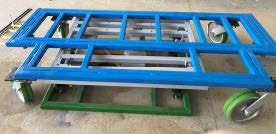
Inverters are navigated via air floats through a production line which may become stuck when passing over the seams in the concrete floor and create a safety hazard for workers operating the system. Our engineering team designed a prototype transportation cart to test 12” diameter twergocasters along with two 8” motorized casters to verify if the system is able to function with the required weight of 10,500 lbs. This transportation cart also includes an inverter frame, hydraulic frame, hydraulic rams and bottom frame. The hydraulic frame was tested by adding 8,625lbs of weight and verified the movement and the capacity of the frame. Another solution was to add pressure regulators for each airbag in current air float table.
Seed-Planting UAV

Team Name
The Math Magicians
Team Members
Hamza Hasham
John McEntire
Steven Molinaro
Andrew Renzetti
John Verret
Internal Sponsor/Mentor
Hamza Hasham - The Math Magicians
Abstract
Today, deforestation is taking place at an alarming rate. In 2017, enough trees to cover a football field were knocked down every single second. The Math Magicians propose aproject to build an autonomous drone with a pressure-chamber that plants seeds to help counter the global carbon footprint.
Acknowledgments
We would like to thank the entire UNT faculty and staff in being so helpful with the students. We would like to specifically acknowledge: Dr. Wasikowski, Dr. Glaser, Erin Allice, Rick Pierson, Robbin Shull, and the Student Lab Assistants for their dedication to the Capstone Projects.
Mountain Plumbing
Team Members
Sergio Gonzalez
Omar Aleid
Ahmed Al-Saadi
Abdul Al Sukaiti
Hussain Altaweel
External Sponsor/Mentor
Oran, Baldwin - Mountain Plumbing Products
Internal Sponsor/Mentor
Dr. Haifeng Zhang
Abstract
The problem with the garbage disposal is that it makes a loud noise of 73 decibels at start up. Our goal was to reduce the noise while still maintaining the lifetime warranty. This loud noise is caused by the impellers hitting the metal bump at a high speed. There were several different designs done to deliver a quieter result while still maintaining a lifetime warranty. A quieter sounding garbage disposal will disturb the customer less .People often call the company asking if its broken due to the loud noise at start up.
NASA CASMART
Team Members
Kelsa Adams
Jordan Barnes
David Evers
Michael Ayers
Robert Boone
Brittany Thurstin
External Sponsors/Mentors
CASMART
NASA - Dr. OthmaneBenafan
Fort Wayne Metals - Drew Forbes
Classic Steel LLC
Internal Sponsors/Mentors
Dr. Robert Wheeler
Dr. Marcus Young
Dr. Richard Zhang
Abstract
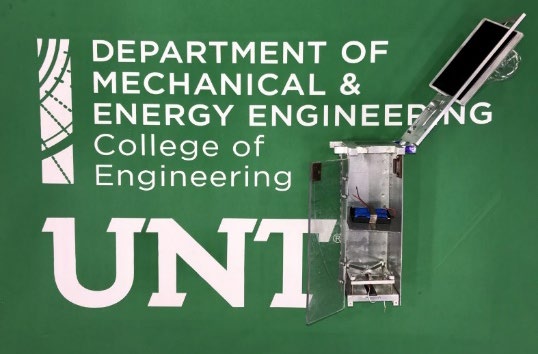
The purpose of our project is to design and fabricate a mechanism to passively orient solar panels on a CubeSat using shape memory alloys (SMA). A CubeSat is a shoebox sized satellite that can be used for a variety of planetary missions such as research, imaging, and surveillance. SMAs are smart materials that can be trained to remember a particular geometric orientation. If deformed, the material will return to its trained orientation upon heating above its transformation temperature. Redundant solar arrays are often attached to many or all sides of a CubeSat, but only one or two may be producing power at any given time; hence, more power can be supplied to the CubeSat using deployable solar arrays controlled with SMA actuators. SMAs provide a mechanical advantage over traditional motors by reducing design complexity, power consumption, volume, and weight. This reduction in size and weight coupled with increased available power to the CubeSat broadens the scope of possible scientific applications aboard the satellite. We designed and fabricated separate mechanisms for retention, deployment, and actuation of the solar panels in addition to a test apparatus and true scale model of a 3U CubeSat.
Acknowledgments
Dr. Radek Glaser and Dr. Mark Wasikowski from the MEEN Department, Sheldon Aminzadeh
Rivet Heads
Team Members
Garrett Blank
Katelin Dulack
Jacques Pantano
Blaine Ware
External Sponsor/Mentor
Triumph Aerospace Structures
Internal Sponsor/Mentor
Dr. Mark Wasikowski
Abstract
Currently, the aerospace industry installs ten of thousands of rivets by hand. Proper rivet installation requires a smooth, precise hole to be drilled prior to rivet placement. We have created an end effector for the UR10 that can (1) drill a hole for the rivet and (2) buck the rivet. Our design is unique in that it uses a pneumatic control system to stabilize the end effector as it drills through aircraft-grade aluminum. Our design will replace the mundane work of installing rivets by hand and will eliminate human error that causes an unstable drill and rivet gun.
Universal Jig
Team Members
Matt Loyd
Sam Giuffre
Brice Gabel
Anthony Le
External Sponsor/Mentor
Don, Surratt - Triumph Group
Internal Sponsor/Mentor
Dr. Hamid Sadat
Abstract
Universal Jig to house and rotate leading edges of Boeing 767 for polishing.
Triumphant
Team Members
Hunter Bolton
Bridger Planz
Fernando Duran
Joshua Sullivan
Elliot Nirider
Fawzi Obeidat
External Sponsors/Mentors
Triumph Group Aerospace Structures
Don Surratt
Gary Pekar
Internal Sponsor/Mentor
Dr. Cherish Qualls
Abstract
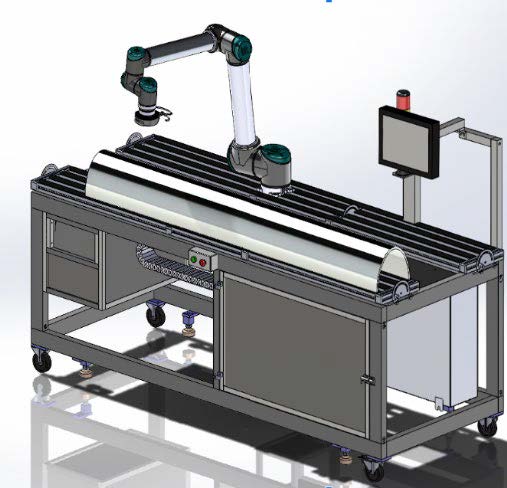
Triumph's current leading-edge polishing process takes between 4-8 hours per portion of leading edge of a Boeing 747 and is done manually. To automate the process our team used a collaborative robot (UR10) and have designed two end effectors to be used for a two-phase polishing process. The robot was then programmed for each end effector to polish the leading edge. The first phase end effector is a large drum polisher and is used on the entire piece to remove small imperfections and the second phase end effector is a small wheel polisher used for the edges and deep scratches. The goal of automating the process is to polish the leading edge to roughly 50% finish and cut down polishing time by half per segment. Implementation of this process will provide more time for the polishing overseer to work on other tasks and cut down cost.
Acknowledgments
Thank you to Rick Pierson, Boddy Grimes and TA's for guiding us in the fabrication process.
FSAE Ergonomics
Team Name
Mean Green Racing 2018-2019
Team Members
Adam Strouhal
Joshua Fumagalli
Salim Al Hamadani
SaifAl Harrasi
Ammar Salim Said Al Saidi
External Sponsors/Mentors
Peterbilt
American Waterjet Products
Internal Sponsors/Mentors
Mechanical and Energy Engineering Department
Dr. Hyeonu Heo
UNT Mean Green Racing
Abstract
SAE Ergonomics 2018-2019 is a team of five students responsible for conceiving, designing, engineering, manufacturing, and testing a package of components and systems required to create and operate a competitive FSAE racing car. The components we produce pertain to the steering, transmission, braking, and engine throttle control systems all of which are directly controlled or engaged by the driver. This year we are aiming to improve the manufacturability of components by simplifying designs, reducing part counts, and the number of milling operations and increasing the resilience of our parts to manufacturing defects. Designing the components we produce to be less sensitive to defects facilitates a broader scope and increases the permissible testing time; something our sponsor Mean Green Racing greatly appreciates.
Acknowledgments
We would like to acknowledge the Engineering Technology department for continuing its support and contributions to Mean Green Racing. None of this would be possible or feasible without the lab space that has been graciously allocated to the race team for the past 7 years.
FSAE Suspension
Team Members
Matthew Atkins
Adam Bragg
Matt Fehrle
Zachary Holmans
External Sponsors/Mentors
American Waterjet
Peterbilt
RBC bearings
QA1
Internal Sponsors/Mentors
UNT Mean Green Racing
Dr. Xiaohua Li
Dr. Hector Siller
Abstract
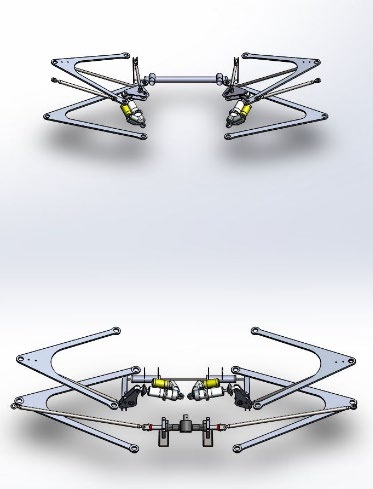
The University of North Texas Formula SAE team competes annually as part of SAE International’s Collegiate Design Series in Lincoln, Nebraska. This year the FSAE Suspension Senior Design team sets its sights on improving suspension packaging and kinematics, while also simplifying manufacturing processes and reducing weight. Expeditious fabrication and assembly will allow the team ample testing time and maximum opportunity to meet their competition goals. The parts designed for the project include suspension point jigs, control arms, bell-cranks, anti-roll bars, tabs, pull-rods, and tie-rods.
MEEN Green Thermoclean
Team Members
Samuel Bach
Brandon Kelling
David Avants
Luis Hernandez
Mahmood Al Shabibi
External Sponsor/Mentor
Nature Shield Co.
Internal Sponsor/Mentor
Dr. Cherish Qualls
Abstract
The main scope of our project was to take an outdated Thermoclean steam cleaning machine and to make it UL certified. A few things that were stopping the machine from being UL certified are that machine was using too much electricity, had incompatible electrical cords, and the machine case was made out of fiberglass which is not a UL approved material. The team found all of the errors with the machine that was keeping it from being UL certified and redesigned a new Thermoclean machine made out of aluminum that is more efficient and most importantly qualified to be UL certified.
Welding with a Twist
Team Members
Yousef Akil
Meagan Bunck
Juan Ibarra
Sheena Lindorm
Stephanie Lopez
Saul Morales
Alejandra Sifuentes
External Sponsors/Mentors
Michael Horn - AC Horn Manufacturing
Guillermo Herrera
Fernando Duarte
Addiel Sital
Liam Muhlholland
Internal Sponsors/Mentors
Dr. Radek Glaser
Dr. Mark Wasikowski
Abstract
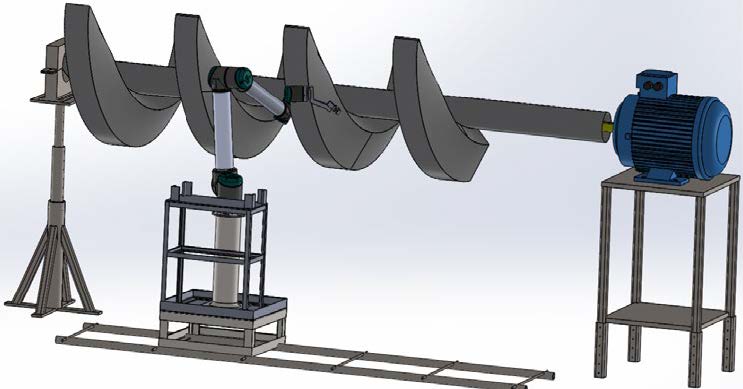
The purpose of Welding with a Twist is to create a program and mechanical system to facilitate TIG welding with a Universal Robot. By using a Universal Robot to automate the welding of spirals, our company’s lead time will be reduced by at least 60%.
Robotic welding has been around since the 1960's and is mostly popular in today’s automotive industry. The industry mostly uses MIG arc welding with robots, and it’s mostly only for spot welding. Our project is unique because it is applying continuous TIG welding, which requires a more complex design.
Acknowledgments
Special thanks to Rick Pierson, Sheldon Aminzadeh, Wyatt Verret
UNT Zodiac Seats

Team Name
UNT Zodiac
Team Members
Cullen Gray
Yousif Alnahash
Wes Burks
Joel Koo
Christina Rapert
Katelyn Sotello
Cody Stewart
Salim Al Tamtami
External Sponsors/Mentors
Zodiac Seats, US
Safran Seats, US
Internal Sponsor/Mentor
Dr. Mark Wasikowski
Abstract
Team UNT Zodiac was tasked with automating preliminary steps of the assembly of an airline seat. This is accomplished by utilizing two robotic arms. The first assembly steps involve placing 8 components together and screwing them together to meet specifications.
The project utilizes two Universal Robotics Co-bots, a CB-UR10 and a CB-UR3. The UR10
utilizes a 2F-85 gripper while the UR3 utilizes a HAND-E gripper, both from the robotics
company Robotiq.
The assembly of the airline seat is aided by a shadowbox that the frame of the seat
rests on. This shadowbox provides a base reference to start the assembly process.
In addition to the shadowbox, multiple organizers were manufactured to serve as stationary
reference points.
Custom gripper fingers were fabricated to better handle parts of the airline seat
frame.
Acknowledgments
Thanks to:
Robin Shull
Sheldon Aminzadeh
Erin Allice
Natarsha Hall