 University of North Texas

Computer Engineering
Securing IoT
Team Name
HED
Team Members
Chima Akano
Jorge Moreno
Justin K. Paul
Hector Tamez
Internal Sponsors/Mentors
Dr. Pradhumna Shrestha
Dr. Robin Pottathuparambil
Thomas Kanaby
Abstract
IoT devices are growing and have become an important part of embedded systems to handle data for interconnected communication networks. This brings up the importance of securing our IoT devices and maintaining the integrity of the data these devices manage.
The purpose of this project is to identify malicious attacks on a WSN (wireless sensor network) that will consist of four nodes (four raspberry pi’s) and a central node (HUB) to gather sensor data. We will then observe how the malicious attacks have infiltrated weak areas of our IoT network and apply countermeasures to resolve the attacks thus keeping our nodes and their data safe. Our proposed solution is to research solutions to secure our IoT network from attacks, and to produce countermeasures to future attacks.
Central Unit for CNC Machines
Team Name
Impulse
Team Members
Gabriel Costa
Michael Kahn
Rebecca Molnar
Alejandro Siller
External Sponsors/Mentors
Dave Perkowski & Cristian Almendariz - All Axis Machining
Internal Sponsor/Mentor
Dr. Pradhumna Shrestha
Abstract
All Axis Machining uses a handful of CNC machines for the production and testing of all of the parts their clients order. While this layout allows for the machining of uniform parts with a high accuracy, each of the machines needs to be monitored constantly by on site personnel.
Team Impulse will be working in conjunction with All Axis Machining to implement a central unit that will receive machine status and job progress reports from each of the CNC machines in All Axis Machining’s shop. The central unit will then display this information in a custom designed GUI in All Axis Machining’s central office. All Axis Machining’s employees can then remotely command the CNC machines through the same central unit.
While this information will be accessible at all times from a pre installed TV in All Axis Machining’s central office, management will be able to view this information from their personal mobile devices or computers by accessing All Axis Machining’s wireless network. The project will facilitate monitoring and managing the machine shop.
Smart Door
Team Name
M.T.E.K.
Team Members
Michael Thomas
EricNwokocha
Kennard Boykin
Trevor Hendricks
Internal Sponsors/Mentors
Computer Science and Engineering Department
Dr. PradhumnaShrestha
Thomas Kanabay
Abstract
Smart Home for Assisted Living
Team Name
Lannister
Team Members
Mitchell Clarke
Anmol Singh
Prajwal Waiva
Girard Roston
Internal Sponsors/Mentors
Dr. Pradhumna Shrestha
Thomas Kanabay
Abstract
Smart home technology is still fairly new, but it is becoming much more common in modern homes. Families are integrating this technology into their homes to provide better security and an improved quality of life. This technology has not yet branched out past common households yet, but it’s the next step for this growing technological innovation.
Team Lannister's smart home for assisted living centers takes smart home and IoT technology and integrates it into assisted living centers to improve the quality of life of each patient and simplify the jobs of every employee.
This system will include a temperature sensor, door sensors for the main doors and medicine cabinet, and a motion sensor inside each room. A smart watch with a fall detection system will also be worn by the resident, along with a Polar T34 heart rate monitor to monitor irregular resident movement and their heart rate.
Data will be sent to and stored in an online database that nurses can access for each patient, and SMS alerts will be sent out if any irregular readings occur.
Acknowledgments
- Adafruit.com for supplying all of the sensors and microcontrollers used in this project
- Dr. Pradhumna Shrestha for mentoring us and giving us guidance throughout the semester
- Thomas Kanabay for working with us during the parts ordering and design processes
MetroBand
Team Name
EyeD
Team Members
David Adeyemi
Gersom Adu
William Lewis
Luke Parks
Internal Sponsor/Mentor
Dr. Pradhumna Shrestha
Abstract
MetroBandis a smart watch poised to revolutionize the music performance, performing
arts, and synchronized sports industries.
The main components of the MetroBandwatch are:
- Metronome
- Instrument Tuner
- Metronome wireless synchronization across multiple watches (SmartConnect)
- Normal smart watch functionality (date and time, alarms and timers)
The SmartConnect metronome network will enable effortless collaboration and will synchronize multiple performers who are wearing the MetroBandsmart watch.
Project Status Report 3
Team Name
1A4
Team Members
Rad Wadud
Nasser Alquaihi
Laura Kent
Adesunkanmi Afolabi
Spencer Igwe
Internal Sponsor/Mentor
Dr. Pradhumna Shrestha
Abstract
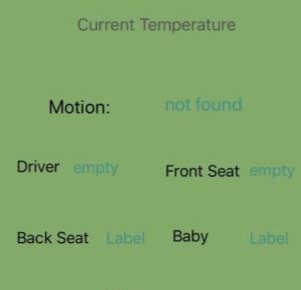
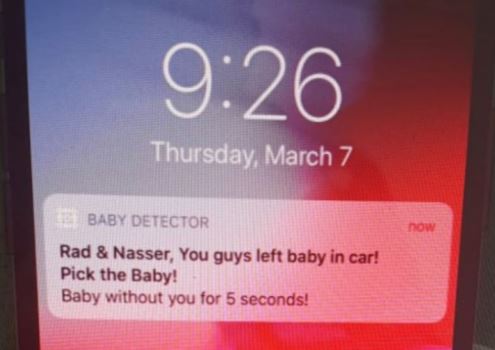
Our project serves to act as a presence detector within a car. The driver is notified when a living being is left behind in the vehicle.
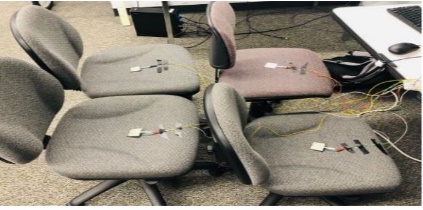
This is feasible through multiple connected sensors which send information to a microcontroller board in the event the received information has met certain conditions that suggest a presence. The board communicates to the app over a wireless internet connection to notify the user via cellphone app.
The app continues notifying the user over a certain period until the user selects to acknowledge the notification.
This can be “Accept” or “Reject” decision. On the chance that the event is a false-alarm, the user is able to select a Reject response to confirm that there is actually no presence. If a being is left alone in the car, the driver choose “Accept” and pick the baby.
Acknowledgments
We thank the Project Manager, our professor, Dr. Pradhumna Shrestha who conceptualized the project and piloted us through from beginning to the end. And Thomas Kanabay who supported us for needed parts on short notices.
Spacecraft Lighting Network System
Team Name
Avengers
Team Members
Jose Guzman
Gordon Fields
James Gonzalez
Samantha Akos
External Sponsor/Mentor
George Salazar - NASA Mentor
Internal Sponsor/Mentor
Dr. Robin Pottathuparambil
Abstract
The innovative use of network lighting systems has created a solution that prevents radiation from damaging current lighting systems in spacecrafts. In space, Crew members have been using switches and knobs to control the power and light intensities onboard the spacecraft. These components are comprised of parts that are susceptible to radiation and can lead to damage of the lighting system. This proposal is concerned with the design of a Spacecraft Lighting Network System that will use a touchscreen to control lighting intensities and will provide feedback on the lighting system as a whole. Along with an updated approach, fault tolerant features will be in place in case of failure within certain subsystems. These subsystems include the router and switch, the individual slave Pi’s, the sensors, and the GUI of the system. The system will also provide a health status of the lights and its life expectancy. With these innovations, our design aims to improve the current lighting systems by removing the conventional use of switches and knobs.
Acknowledgments
We extend our gratitude to last year’s team, 2B!|2B. We have built on their efforts and contribution to create our own vision on how to accomplish our project’s goals. We would also like to thank Dr. Robin Pottathuparambil for his guidance and helpful suggestions when we hit a roadblock. Furthermore, we would like to thank Thomas Kanabay for providing us with parts and equipment he had on hand.
Sleep Apnea Monitoring System

Team Name
CMBZ
Team Members
Chris Covey
Neil Mistry
Kahale Barnes
Damian Zubia
External Sponsor/Mentor
Dr. Edwin Simon
Internal Sponsors/Mentors
Dr. Robin Pottathuparambil
Thomas Kanabay
Abstract
Approximately 25 million adults in the United States of America alone suffer from obstructive sleep apnea, according to the National Healthy Sleep Awareness Project. Obstructive sleep apnea is a disorder that causes the patient to repeatedly stop and start breathing during sleep. Current diagnosis standards involve an in-lab sleep study that monitors multiple variables such as respiratory movement, airflow, body movement, heart rate, oxygen saturation, and snoring sound. The diagnosis standard is incredibly time consuming and labor intensive. It also puts the patient in an unfamiliar environment, which can have an effect on the patient’s ability to sleep for proper diagnosis. Our goal is to find a way to create a moderately low-cost portable solution so that a patient can administer a sleep study in the comfort of their own home. Our project is to create a patch with unified sensors that collects these pieces of data: Respiratory movement, airflow, body movement, heart rate, oxygen saturation, and snoring sound. Once the data is collected, it will be wirelessly pushed to a network that will then pass it to the cloud for post processing. This data will be collected, stored, and encrypted and will meet the current HIPPA guidelines for patient privacy. On completion, the system will have the ability to be used as the gold standard for the diagnosis of OSA and meet the standards for FDA approval.
Acknowledgments
Client & Subject Matter Expert: Dr. Edwin Simon
Faculty Advisors: Dr. Robin Pottathuparambil and Thomas Kanabay
Previous team members from Team Snooze
Vehicle Interchangeable Electronic Controller Networks System (VIEC)
Team Name
ERAM
Team Members
Edward Escamilla
Ryan Moye
Maria Pavloschi
Alexander Villalobos Quintanilla
External Sponsors/Mentors
George Salazar
TSGC Design Challenge
Internal Sponsors/Mentors
Dr. Robin Pottathuparambil
Thomas Kannabay
Office of the Dean
Abstract
As humans push the limits of exploration and the time duration spent in deep space, providing spare spacecraft components becomes more and more critical. While it is too expensive to ship unique spare components to space, nor is it feasible to send the spare components in the initial launch, there are other options.
Therefore, our goal is to create a system that permits interchangeability of vehicle controllers based on where the controller interfaces with the vehicle.
Our method of developing the system of interchangeable controllers is to configure the controllers via interaction with a network server providing information for each controller’s unique behavior. This is accomplished by downloading the appropriate files from the server and implementing the appropriate actions to minimize overall costs.
Silicon Wafer Sorting Machine
Team Name
JPJG
Team Members
Philip Hunsberger
Jack Durham
James Artacho
Garrett Gilcrease
External Sponsor/Mentor
Willie Scales - ATE Technologies, Inc.
Internal Sponsors/Mentors
Dr. Robin Pottathuparambil
Thomas Kanabay
Abstract
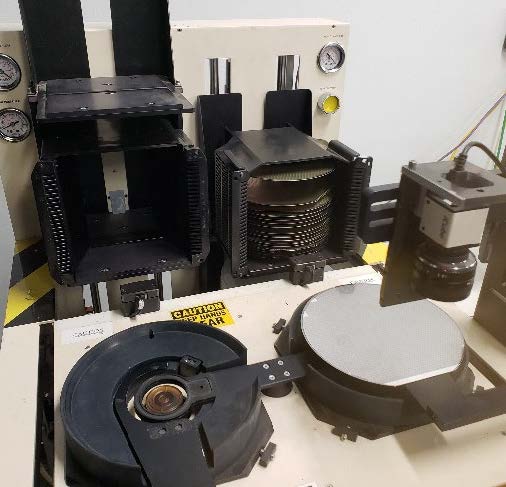
This projects’ goal is to refurbish a silicon wafer sorting machine by adding an Optical Character Recognition system that is capable of fully autonomously sorting up to 50 unsorted silicon wafers at a time. We are sponsored by a local Senior Field Engineer working with ATE Technologies, Inc., Willie Scales.
This machine is capable of moving, straightening, scanning, organizing, and storing wafers with minimal user input and interaction. It utilizes laser sensors, vacuum and air pressure manipulators, and electronic drill and motor pieces to complete its task, along with a sorting algorithm and user interface designed and implemented by our team at UNT.
Acknowledgments
We would like to thank both Dr. Robin and Mr. Scales, along with the entire Computer Science and Engineering department for their help in obtaining this unique opportunity to work hands-on with the coding and embedded systems skillsets we have developed during our studies at UNT. Go Mean Green!
Multi-sensor Crowd Flow Visualizer
Team Name
LyLAT
Team Members
Aaron Kennemer
Luke Hillard
Luke Peltier
Tony Phonglom
External Sponsor/Mentor
xRez Lab
Internal Sponsors/Mentors
Ruth West
Thomas Kanabay
Dr. Robin Pottathuparambil
Abstract
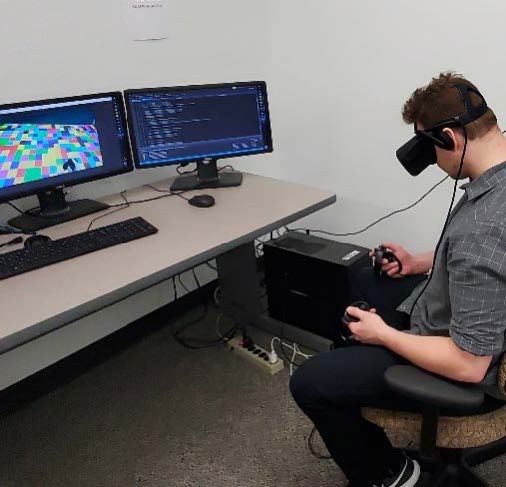
When a robotic/automated system “sees”, it does not perceive the same way as the human visual system does. This mismatch in human expectations of what a digital system perceives causes challenges in the integration of robotics/automated systems in human context; this problem originates from Bill Smart at Oregon State University. One such situation is in tracking the flow of individuals and groups in a crowd. This project, in collaboration with xRezLab, seeks to create an innovative system that uses many sensors to track the flow of a crowd and with this tracking data visualize it in a form truer to how the system “sees” the crowd. The system itself with the visualization will help improve upon current crowd tracking methods and will use pre-existing vision recognition algorithms to verify their accuracy. The novel use of Virtual Reality being the medium of the visualization will help immerse those who put on a headset and help give insight on what the system “sees”. The non-VR related part of the system itself will help in the design of surveillance, crowd counting, and dynamic emergency escape systems.
Acknowledgments
Cindy Grimm, Bill Smart, and xRez Lab @ UNT
Smart Canopy Lighting System
Team Name
W.A.C.C
Team Members
Jeff Anderson
Eli Cruse
Ben Cruse
Jared Westmoreland
External Sponsor/Mentor
Intelativ
Internal Sponsors/Mentors
Dr. RobinPottathuparambil
Thomas Kanabay
Abstract
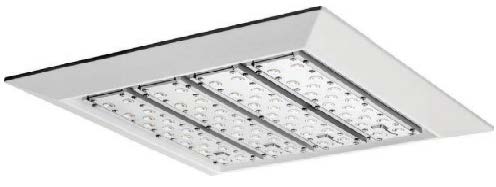
The goal of this project is to make an Internet of Things (IoT) based Smart Canopy Lighting utilizing Wi-Fi instead of ethernet based communication thus lowering the cost of the product. This should capture data from the canopy light through the followingsensors attached to the light: lux, temperature, camera, and NoIRcamera. Then send the captured data through a central hub to be viewed from the outside world. The user should also be able to send commands from outside the network to perform tasks such as: turning the light on/off, adjusting light intensity, view a live stream of each light, and download recorded videos from each light. Videos should be stored within the cloud and on a local backup drive. Each Smart Canopy Light will utilize the lux sensor and change light intensity thus saving on energy costs.