 University of North Texas

Materials Science and Engineering
Design of a Process to Solid State Diffusion Bond SiC to B4C
Team Members
Laura Mello
Neil MacDonald
Hunter Lide
Internal Sponsors/Mentors
Materals Science and Engineering Department
Dr. Thomas Scharf
Abstract
Current lightweight body armor distributes forces over a large area to decrease localized impact. A better way to reduce impact, however, would be to deflect forces laterally rather than longitudinally. By joining two ceramics of differing coefficients of thermal expansion, in-plane stresses will release forces laterally upon impact. This design utilizes the Spark Plasma Sintering (SPS) method to successfully bond a silicon carbide (SiC) pellet to a boron tetracarbide (B4C) pellet with minimal cracking. The in-plane stresses created by their different coefficients of thermal expansion have been optimized by inserting a refractory metal foil interface between the ceramics. The approach for designing the SPS process was to vary the processing parameters based on data from literature as well as the experimental results. The criteria for a successful bond consist of minimal cracking and meeting specific values for flexural strength and hardness.
Acknowledgments
Special thanks to William Rubink, Dr. Thomas Scharf, and Dr. Nigel Shepherd
Design of Materials for Firefighting Gloves for First Responders
Team Members
Kaylie Sheehan
Jessica Lanier
William Eiland
Internal Sponsors/Mentors
Materials Science and Engineering Department
Dr. Witold Brostow
Abstract
When on the job, firefighters are exposed to extreme heat and the possibility of punctures and cuts. While protecting the entire body from the elements is a necessity, the hands are the first parts of the body going into the flames. If not wearing appropriate protective equipment, the hands can burn and, at the extreme temperatures in flames, the hands can become permanently disfigured. The current gloves used are made of mostly Kevlar or leather. They protect hands from shrapnel, puncture, and tears; however, they do not protect the hands enough, as they are designed for dexterity and motion, with just enough heat resistance. The new glove materials, when used in a glove, will enable the wearers to save more people, land, and property, as they will give the wearer the ability to navigate more environments. The outer layer, being impermeable to liquids and abrasion resistant, will prevent toxins from getting trapped in the gloves.
Current gloves were reviewed and their properties were determined, then a literature review was performed to find materials or composites that were described to have desired properties. Once selected, the materials went through the same tests as the original gloves for comparison. This approach was successful, as the materials found work comparable to better compared to the current gloves.
Acknowledgments
Granowskifor helping us learn to use the machines in the lab, and the entirety of the Laboratory of Advanced Polymers and Optimized Materials (LAPOM) for allowing us the use of their facility. Additionally, we would like to thank Dr. Nigel Shepherd for his assistance throughout, and the guidance he provided us.
Design of a Plasma Based Oxygen Pumping Process for High Vacuum
Team Members
Simpson Garrett
Gruszecki Roman
Internal Sponsors/Mentors
Materials Science and Engineering Department
Dr. Nigel Shepherd
Abstract
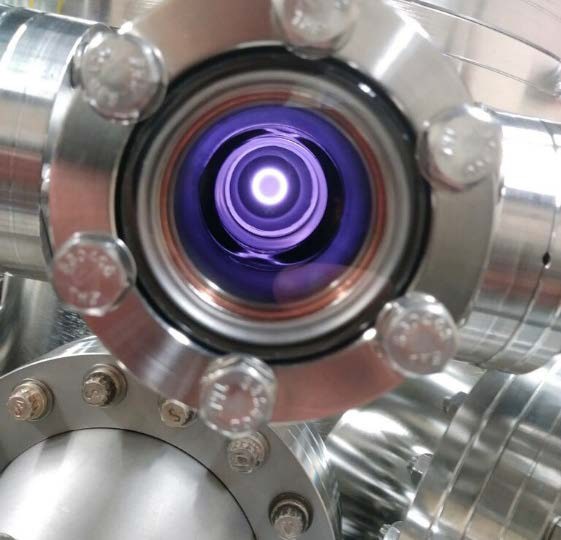
2-D transition metal Dichalcogenides such as WS2 could be the future of electronic transistor devices because of their tunable bandgaps, high mobility and 2D carrier transport. The problem is that these materials, having high surface area to volume ratios, undergo oxidation, including during growth, which alters their chemical structure and electronic properties. The current approach to create ultra-high vacuum uses turbo-molecular and ion pumps. Ion pumps work by ionizing gas molecules that are then accelerated toward a grounded Titanium cathode plate. When the gas ions collide with the plate, Titanium atoms are sputtered from the surface, forming stable chemical compounds with reactive gas particles. This pumping process is dependent upon the transport of gas particles into the ion-pump. Our design makes the Titanium more reactive and increases reaction collisions by creating a Titanium plasma using a magnetron sputtering gun. The plasma occupies the whole vacuum chamber and is able to react with the residual gas species, which more effectively and efficiently pumps the environment.
Acknowledgments
Dr. Nigel Shepherd provided the lab space, project components, and professional expertise required for this design project. Special thanks to the UNT Materials Science and Engineering faculty members for their constructive criticism, which was instrumental in the development of this design project.
Design of a Corrosion Measurement System of SiC at High Temperatures
Team Members
Adam Cunningham
Tyler Hunt
Samantha Zellner
External Sponsors/Mentors
Chris Yannetta, POCO Graphite
POCO Graphite
Internal Sponsor/Mentor
Dr. Rick Reidy
Abstract
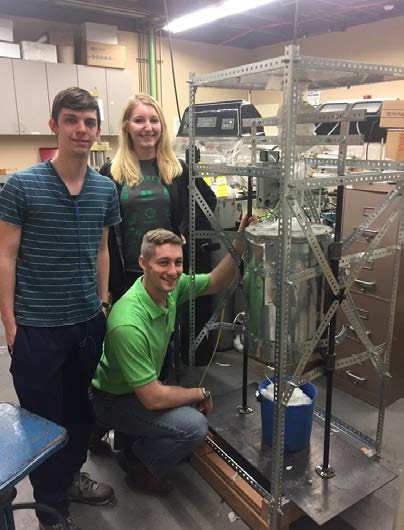
Ceramics can corrode in high temperature and gaseous environments. For example, SiC, which can be used for high temperature electronics as a high band-gap semiconductor, will form SiO or SiO2 in oxidizing environments. This corrosion will drastically reduce its electrical properties. To study the corrosion in certain ceramics and in certain environments (such as SiC in oxygen gas), it is crucial to measure the ceramic’s resistance to corrosion and oxidation as a function of oxygen concentration and temperature.
The goal of this project is to design an apparatus that will effectively measure corrosion and/or mass change of different ceramics (such as SiC) under a high temperature and gaseous environment. This project will study the oxidation reactions of SiC at high temperatures to determine the property changes as a result of corrosive reactions.
Acknowledgments
Our team would like to acknowledge and thank all of our sponsors and mentors, both internal and external. We would also like to extend additional thanks to the UNT College of Engineering, the Department of Materials Science, and the Materials Research Facilities for their support.
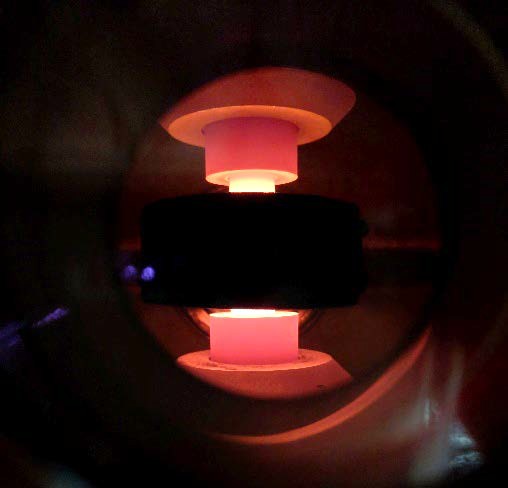
Growth of Wear Resistant UNCD Films
Team Members
Cotton Shomari
Callirgos Jon Vincent
Internal Sponsors/Mentors
Materials Science and Engineering Department
Dr. Diana Berman
Abstract
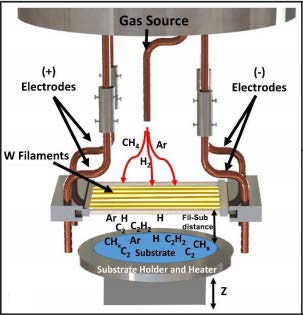
The wear of materials that are in constant contact with each other will require the replacement of parts. One way to slow the rate of wear is to apply a coating on the material to improve the product life, which decreases the cost ofmaintenance. Ultrananocrystalline Diamond (UNCD) films have been shown to greatly decrease the coefficient of friction during abrasive wear. UNCD is different from other diamond-like coatings due to its unique sp2 sp3 hybridization and smooth surface roughness. Our Senior Design is to create UNCD coatings by Hot Filament Chemical Vapor Deposition (HFCVD) and characterize the wear of the samples once a coating has been applied.
Design of Irradiation Resistant High Entropy Alloys
Team Members
Jessica Reeder
Sofia Sheikh
Sarah Williams
Internal Sponsors/Mentors
Materials Science and Engineering Department
Dr. Sundeep Mukherjee
Abstract
Nuclear reactors are used to produce and control the release of energy. Many nuclear reactors have a life span of 30 to 40 years due to the degradation of stainless steel. Therefore, there is a growing demand for irradiation resistant alloys to increase the life span of nuclear reactors. High entropy alloys (HEAs) are the new type of metal alloys that are being considered for next generation nuclear reactors, specifically for the reactor vessel. The alloys that we considered for the design are FeCoCrMnNi and Al0.1CoCrMnNiwhich were heat treated at 900 degrees Celsius for 24 hours. A matrix was used to compare the structure and properties of both these alloys and stainless steel before and after irradiation to determine which alloy is a better structural material for next generation nuclear reactors. The characterization techniques used to assess the structural and mechanical properties were scanning electron microscopy (SEM), X-ray diffraction (XRD) and nanoindentation hardness testing. The results showed that the HEAs were more irradiation resistant than the stainless steel, specifically the FeCoCrNiMn.
Acknowledgments
Our group would like to acknowledge Dr. Aditya Ayyagari for his help in ordering the alloy, helping with characterization testing and working with SRIM, Dr. Ovidiu Toader for helping the group understand radiation testing and provide the details of radiation testing as well as running the radiation testing, Ms. Ashley Parson for helping the group purchase items for the project, MTSE Faculty and Dr. Shepherd for giving us constructive feedback to help the group improve, Saideep Muskeri and Vahid Hasanneimifor helping with the nanoindentation testing and Dr. Sundeep Mukherjee for being a great advisor and helping us through the project.
Design of Bioactive Glass Coatings on Titanium Alloy-Based Medical Implants
Team Members
Brandon Ohl
Spencer Taylor
Ty Thomas
Internal Sponsors/Mentors
Materials Science and Engineering Department
Dr. Jincheng Du
Abstract
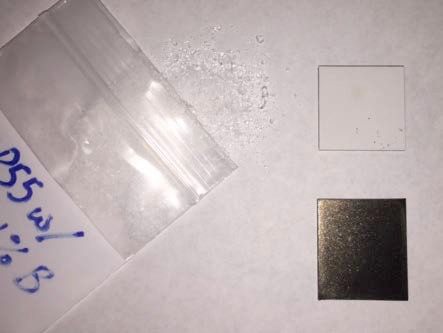
Current metal load-bearing bio-implants form a weak interface with bone, resulting in damaged tissue and inflammation at the interface. Coating these metal implants with a bioactive glass layer can solve this problem by creating a stronger interface between the metal and bone. Bioglass, the original bioactiv eglass, is not adherent to Ti6Al4V, a metal commonly used in orthopedic implants. Thus, bioactive glasses that adhere to Ti6Al4V are favorable to Bioglass in implant applications. In this project, bioactive glass 6P55 with the addition of 5 mol.% boron was adhered to a Ti6Al4V substrate. Ti6Al4V was coated with glass powder of particle size <20um via suspension coating, and an adherent glass layer was produced after sintering at 800C for 1 minute. The bioactivity of the glass composition was confirmed using FTIRATR and SEM after being submerged in a simulated body fluid (SBF), as well as molecular dynamic simulations. The successful bonding of bioactive glass to Ti6Al4V suggests that coating orthopedic implants may be aviable option in biomedical use.
Acknowledgments
A special thanks to Dr. Jincheng Du, Xiaonan Lu, Po-Hsuen Kuo, Dr. Lu Deng, and Roberto Recuero.
Designing a Processfor Laser Additively Manufactured Biomedical Alloys

Team Name
Big Boss
Team Members
David Flannery
Sheena Valentin
Whitley Green
External Sponsor/Mentor
Dr. Eugene Ivanov, TOSOH Corporation
Internal Sponsor/Mentor
Dr. Rajarshi Banerjee
Abstract
The future of biomedical alloys demands new materials that can satisfy the mechanical and chemical requirements of the human body for longer lifespans. TNZT (Titanium-Niobium-Zirconium-Tantalum) is one such alloy that has been shown to exhibit both good mechanical properties (low modulus, moderate strength and ductility) with good corrosion and biocompatibility properties. By designing a process that uses TNZT in a Laser Additive manufacturing process, custom parts with superior properties and wear characteristics can be made for the unique geometries of any patient. This process will use different travel speeds of the laser head which will directly affect the amount of laser energy directed to the localized area during deposition. Our aim is to positively impact both the biomedical and additive manufacturing communities by providing examples from which this Titanium based alloy can be better understood. We will show through tensile bar samples, electrochemical impedance results, and porosity measurements how our process affects the final built part.
Acknowledgments
We would also like to extend our thanks and acknowledge all of the supporting faculty and students here at the Materials Science Department of UNT. To include Dr. Sameehan Joshi and Dr. Thomas Ho.