 University of North Texas

Mechanical Engineering Technology
The Assisted Attic Lift
Team Members
Ian Wylie
Samuel Shelton
Chris Goodman
Abdulla Aljabr
Chris Hollingsworth
Jordan Robertson
External Sponsor/Mentor
Department of Engineering Technology (ETEC)
Internal Sponsors/Mentors
Professor Ali Nouri
Professor Leticia Anaya
Abstract
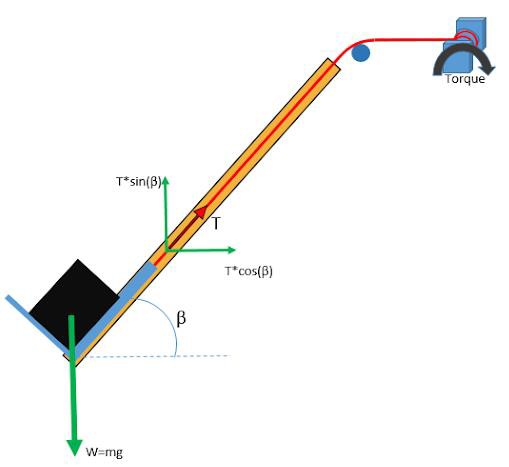
The Assisted Attic Lift is an attachable system that eases the process of raising heavy items into the attic space of any house. Using an existing attic ladder, the lift system bolts straight on to this ladder, and the push arm is assembled at the attic entrance.
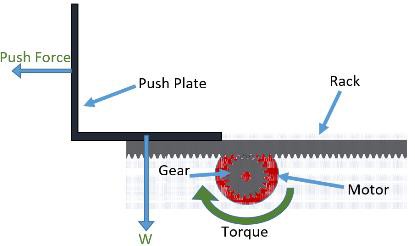
The way this system works starts with an object being placed on the lift cart at the base of the attic ladder. With the push of a button, a winch pulls the cart up the ladder on a track using a steel cable. When the cart has fully ascended intothe attic, a push arm pushes the object off the cart into anempty space into the attic with rack and pinion technology. One more push of a button will return the cart to the base of the ladder at its starting position.
Through the funding of the University and the effort givenby the students, the Assisted Attic Lift became possible. We hope to see this product be deemed useful and important by contractors, and have it implemented as a common household appliance to ease the lives of homeowners.
Project Turbo

Team Members
Benjamin Vetters
Tyler Luce
Sulaiman Aljurbua
Jose Valentino
Peter Caparelli
External Sponsor/Mentor
American Society of Heating, Refrigerating and Air Conditioning Engineers (ASHRAE)
Internal Sponsors/Mentors
Dr. Huseyin Bostanci
Dr. Leticia Anaya
Abstract
Project Turbo is a mobile lab test bench that will be used at the University of North Texas to assist students in understanding fluid mechanics and heat transfer principles. The proposed project is sponsored by the ASHRAE national organization and will consist of four hands-on labs for students to perform.
The test bench is a closed system that includes pressure gauges, thermocouple temperature sensors, a turbine generator, a pump, a control valve, a flowmeter, interchangeable tubing, and pipe insulation. Students willbe using Bernoulli’s, Darcy’s, and other power equations to determine power added to the fluid by the pump, pump efficiency, energy losses due to a temperature differences, frictional energy losses, power removed by the turbine/generator, and turbine/generator efficiency.
The main objective of Project Turbo is to help students understand hydropower concepts through auser-friendly, hands-on experience workbench.
Adaptive Kayak Lift

Team Name
Jabbr Industries
Team Members
Ara Amen
Brandon Ricky
Jackson Russo
Ryan Schwend
Ricky Villalobos
External Sponsor/Mentor
Turning Point Nation
Internal Sponsor/Mentor
Professor Ali Nouri
Abstract
Jabbr industries’ goal is to help people with limitedmobility enjoy outdoor recreational activities. We have partnered with Turning Point Nation which is an organization who assists disabled veterans enjoy outdoor activities. Together we can help everyone live life without obstacles.
The Adaptive Kayak Lift is a lift that is easily accessible for someone in a wheelchair to both load and unload the kayaks onto any level of the trailer. Eliminating this difficulty will allow for Turning Point Nation to achieve their inspiring goal of teaching those living with mobility impairments how to indulge in exciting outdoor activities without any obstacles.
Ozone Relief Systems
Team Members
Omar Aguirre
Meshal Aldulaijan
Andrew Bryant
Aaron Wilson
Jerry Young
Internal Sponsors/Mentors
Engineering Technology Department
Dr. Seifollah Nasrazadani
Abstract
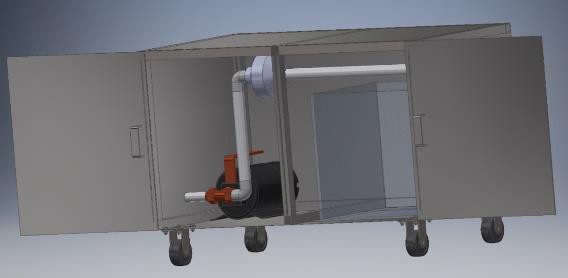
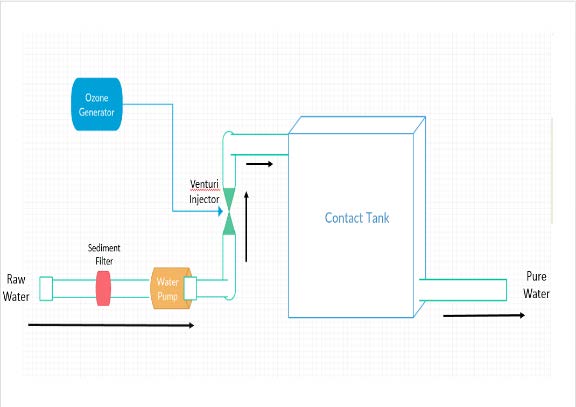
This project presents the design of a disaster relief water purification system. The design was developed with careful consideration of the operational problems experiencedwith most ozone generators available worldwide.
By keeping track of the water input, the ozone generator is able to cleanse and disinfect using an electrical discharge. In doing so, many special features have been incorporated which are reflected in the equipment’s proven performance and reliability. This design has several potential applications, including mobile water treatment systems which provide supplemental water to handle short-term water shortages or meet peak demand.
UNT Tolerance Analysis
Team Members
Terrance English
Nathan Peitzer
Nathan Schami
Justin Hollingsworth
External Sponsor/Mentor
Raytheon
Internal Sponsor/Mentor
Dr. Leticia H. Anaya
Abstract
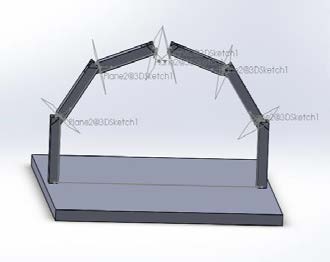
3D Tolerance Analysis of a mechanical assembly benefits manufacturers and engineers in every phase in the design process. The tolerance analysis of a product can predict a design’s functionality. However, a design cannot often determine its tolerances. Advances in technology have brought software that can perform these tasks so products with design defects can be tested before sending the final assembled product to be manufactured. Our team will gather various information about different tolerance analysis software, such as its strengths and weaknesses. The information will be used to create a matrix of product features to rank the functions of a product.
The team will also perform comparative analysis between the tolerance performance of a software designed robotics arms prototype and the tolerance performance of an actual physically developed robotics arms prototype. A two level six factorial (2^6) testing plan will be used to analyze certain gap distances created by the assembled prototype. In the 2^6 layout, a six bar assembly will be tested with each bar at two levels (maximum and minimum tolerance values) to determine the impact of accumulated variation on certain gap distances (or the response values) of the prototype.
The goal is to determine the discrepancies between the actual software results and the actual physical implementation. Variables such as (atmospheric heat, pressure, material, part lengths, etc.) that potentially affect the gaps will be not considered. It is expected that the location of the parts in the assembly will have an impact on certain gap distances.
The Outdoor Lift System

Team Name
Uplift Engineers
Team Members
Owen Griffin
Christian Veliz
Edwardo Chavez
Charles PriestII
External Sponsor/Mentor
Turning Point Nation
Internal Sponsor/Mentor
Dr. Hector Siller
Abstract
Uplift Engineers is a group of senior mechanical technology engineering students working together to create the Outdoor Lift system. The Outdoor Lift System is a hydraulic lift device that is used in outdoor environments to lift mobility impaired persons in wheelchairs in order to give them the ability to easily transfer from the ground to a vertically elevated surface or location while engaged in outdoor activities. The sponsor for this project is the Turning Point Nation organization.
Turing point’s mission is to encourage and teach mobility impaired persons the skills
to engage in outdoor activities through the use organized outdoor events hosted by
the company. To this extent we were asked to build this device to help facilitate
some of the activities engage in these outdoor events. Because one of our member’s
wife engages
with mobility impaired people on a regular basis and another one of our members was
in a severe accident. We as a group have a vested interest in this project and the
positive effect that this project can have on mobility impaired people who are trying
to engage in outdoor activities. As well as the opportunity it gives newer mobility
impaired people who want to learn and engage in these outdoor activities.
Infrared Chip Engraving Laser

Team Members
James Burg
Rojelio Cavazos
Brian Glass
Andrew Guidry
Andrew Murgia
External Sponsor/Mentor
L-3 Technologies
Internal Sponsor/Mentor
Dr. Maurizio Manzo
Abstract
The proposed project from L-3 Technologies is to change the current process of labeling infrared chips from placing stickers with barcodes to using an automated laser system to engrave the barcode. A laser engraved barcode is more permanent, cheaper, and reduces human error. The laser system will be used to engrave a 2D barcode that must be verifiable via an integrated reader after engraving by repurposing a soldering table.
The system must insure the integrity of the barcode, be as automated as possible, perform an automated process shutdown if read back verification fails, and allow for manual intervention in case of verification failure or safety issues. The barcode cannot damage the product, degrade the performance of the sensor, damage the focal plane array, block any infrared energy, or show as a blemish in the final imaging system. The system must adhere to all local, state, and federal safety requirements for low energy laser operation.
UNT Formula SAE - Power Integration

Team Members
Nick Kalil
Seung Cheon
External Sponsors/Mentors
Altus Well Experts
Solid Works
College of Engineering
Internal Sponsor/Mentor
Dr. Hector Siller
Abstract
The newly formed sub-group of UNT SAE, Power Integration, has been given the responsibility of being UNT SAE’s first ever research and development project for futureactive members. Power Integration’s first project is to find an applicable way to replace, or redesign, existing continuous velocity (CV) joints located on the rear axel of the racecar.
This team’s goal for their current Flex Plate and Coupler design is to create a cost and weight savings for the SAE team and provide any important limits of the prototype. SolidWorks, a type of computer-aided design (CAD) software, is used to precisely design the flex plates and coupler components to meet design specifications provided by other UNT SAE sub-groups. Extensive finite element analysis (FEA), and hand calculations are then used to test how the design responds to loads and torques and any other physical effects. This team was able to work with many sub-groups from UNT SAE’s Formula team to provide a strong foundation for future members to build off and implement on future UNT SAE Formula racecars.
Eagle Solutions - Proposal Stage
Team Members
Abdulsalam Alanazi
Yazeed Alanazi
Justin Brown
Leta McCabe
Christian Nelson
External Sponsor/Mentor
ATE Technologies Inc
Internal Sponsor/Mentor
Dr. Leticia Anaya
Abstract
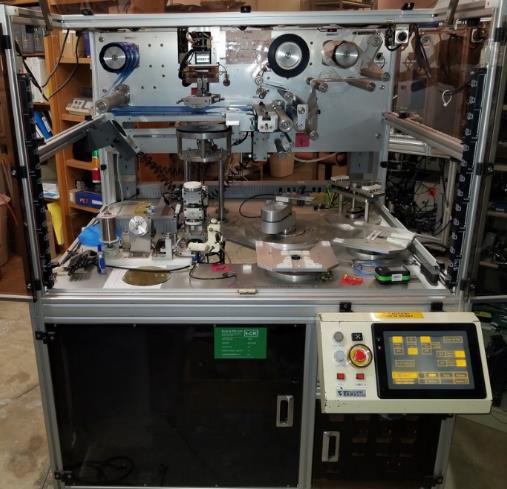
ATE Technologies processes semiconductor wafers. Currently, their laminator machine takes too much time and wastes too much materials during this process. Additionally, the location of the control panel and gauges can result in back strain and missed readouts.
Our team will be overhauling the cutting steps of this machine. Presently, stage one cuts the tape in a set diameter regardless of the size of the wafer. Stage two uses a spring-tension current wire to cut the tape to exact dimensions of the wafer. The new design will remove both stages and replace with a single, free-floating, cutter mounted to linear tracks. This will allow the tape to be cut to precise measurements on the first pass. Finally, we will be relocating the control panel and gauges to a more ergonomic position instead of below waist height.