 University of North Texas

Mechanical and Energy Engineering
The Auto-Trache presented by The Auto-Trache Partnership
Team Members
Robin Michaux
Mahdi Abu Hasirah
Marc Pasquale
Ryan Bishop
Cameron Garman
External Sponsor/Mentor
The Auto-Trache Partnership
Abstract
The Auto-Trache is an emergency medical device that trivializes the tracheotomy process, allowing for rapid implementation even by individuals with no medical training. The simple operation allows someone to use it on themselves if the situation demands.
A constricted airway encountered by choking individuals, anaphylactic shock sufferers, and other victims must be cleared immediately to prevent death. When the Heimlich maneuver is insufficient, the only alternative is a tracheotomy. Untrained individuals are likely to cause harm when performing a traditional tracheotomy. The Auto-Trache device reduces the chance of unintended trauma, increasing the odds of survival.
Blocked airways can occur during surgery, leading doctors to perform tracheotomies mid-operation. When oxygen is cut off from the brain, seconds matter. The Auto-Trache’s ability to breach the throat and open an airway near-instantaneously gives doctors an edge.
Auto-Trache, because every second counts.
BE Wind Turbine
Team Members
Dakota Miller
Abid Sardar
Mathew Ngao
Shuai Ju
Abayomi Adediran
External Sponsor/Mentor
Michael Berdan CEOBE-WIND
Internal Sponsors/Mentors
Dr. Mark Wasikowski
Dr. Weihuan Zhao
Abstract
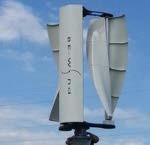
With an increasing interest within society in alternative energies, the BE-Wind turbine is a small vertical axis wind turbine that can fill some of the future need for energy production. The purpose of this project is to make modifications to the turbine that will make it more efficient.
By changing the aerodynamics of the front facing shield and adding a weather-vane to allow for a better turn speed of the turbine we hope to achieve this increase in efficiency.
The size of these turbines allow them to be placed in much more urban settings. With better availability for locations and an increased efficiency in power production, these turbines will be a good solution for those who wish to help with reducing the carbon emissions we currently produce.
Brewer Science Project
Team Members
Andy Chao
Loek Hartjes
Alex Powell
Matthew Thompson
Hayden Hendrix
External Sponsor/Mentor
Brewer Science
Internal Sponsors/Mentors
Dr. Mark Wasikowski
Dr. Haifeng Zhang
Abstract
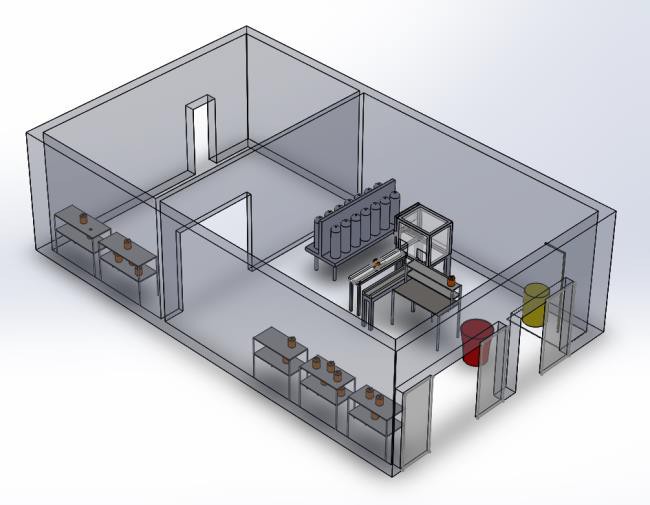
Our project with Brewer Science involves improving their lithography chemical bottling operation via automation. We are confined within cleanroom, OSHA, and physical constraints when considering improvements to their current process. The main goal of the project is to cut down on the amount of human input needed to perform the bottling operation. Brewer Science's current machine is designed to do three functions, decapping, filling, and recapping the bottle. However, only one of these functions are done in the machine that they use currently, which is filling. The other two operations are currently done by hand because they do not function properly, and therefore are very time consuming. The bottles must also be labeled and scanned prior to entering the machine. These two functions are also done by hand.
We have identified a number of points in the process where we believe that time could be reduced. Several solutions have been developed that we believe will be able to cut back on the downtime that the current operation faces in addition to proposing a parameter modification in the control system that oversees the operation. We hope that Brewer Science will utilize or improve upon the solutions that we have provided for their operation.
C & S Propeller / Race Cover & Oversized Bushing
Team Members
Majid Alotaibi
Logan Kurtulus
Michael Green
Danys Reyes
John Smith
External Sponsors/Mentors
C & S Propeller
Pacific Propeller International
Buddy Tobin (Vice President)
Brian Riffle (Engineering Contact)
Internal Sponsors/Mentors
Dr. Reid
Dr. Huo
Dr. Wasikowski
Abstract
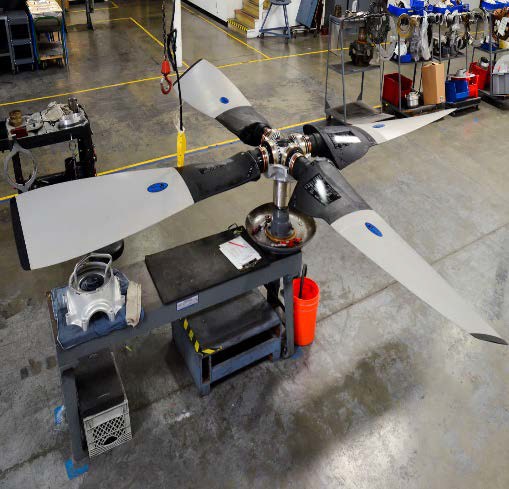
C&S Propeller specializes on maintenance, repair, and overhaul of the 54H60 propeller system. Our project consists of resolving two separate problems during the overhaul process. First, we must design a race protection cover that will resist etch and corrosive chemicals. Currently, the technicians are manually taping every inch of the ring, which is a very tedious and time consuming process. Our goal is to design a cover that is lightweight, easy to handle, and most importantly able keep the ring completely dry. With the use of this ring protection cover, we will reduce the time is takes to prepare the ring before FPI and anodizing processes.
Second, we must run stress analysis on the press fit bushing that transmits high torsional loads from the hub to the blade. Technicians are currently reaming the taper bore press fit area and scrapping the whole blade after becoming out of tolerance on critical dimensions. The goal of our analysis is to design an oversized tapered bushing that will meet all military/FAA standards. With the use of this bushing, wesave a very expensive blade from being scrapped and adding an additional flight life cycle for each overhauled blade.
Deer Blind
Team Members
Josh Kinnear
Clayton Lawson
Derrick ClintonII
Internal Sponsors/Mentors
Dr. Mark Wasikowski
Josh Kinnear
Abstract
The problem we are solving is making the Deer Blind Mobile and more accessible to the handicap or older hunters who may not be able to use a tall ladder. We also aimed to liftthe mechanical system as quietly as possible, while using less force to lift the scissor system than traditional lifts.
E3 Entegral Solutions Project
Team Members
Casey McKeever
Colton Hinnrichs
Erik Chavez
Hammad Abbasi
Matthew Pratt
External Sponsors/Mentors
E3 Entegral Solutions
Josh Combs P.E, VP of Engineering
Internal Sponsors/Mentors
Vish Prasad, Ph. D.
Mark Wasikowski, Ph.D.
Abstract
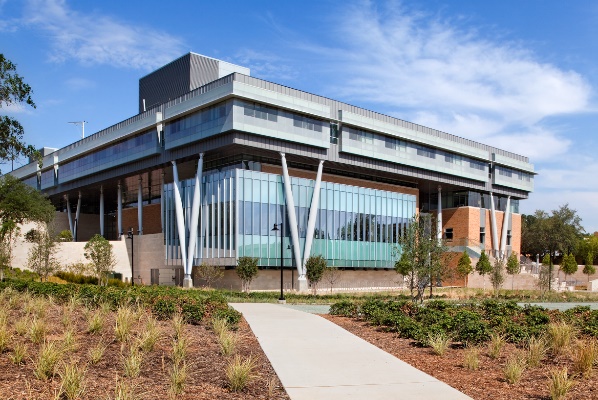
One may believe a building is always operating the most efficient way, however that is not always the case. Some facilities are not properly commissioned or do not have their energy data analyzed frequently. The result, the facility’s equipment becomes less efficient and continues to accumulate excess energy. One of the best ways to lower energy consumption and operational cost in a building is to perform an energy audit, and determine how a facility can become more efficient by implementing energy conservation measurements(ECM). Our senior design group was determined to help the University of North Texas by creating a utility assessment report (UAR). A UAR is a report which includes the facility’s current energy consumption, a list of ECMs that would benefit the facility, and the total energy saving after ECMs are implemented. E3 contacted the University of North Texas to discuss this senior design project and UNT agreed to provide the Business Leadership Building for this project. UNT assigned E3 the Business Leadership Building (BLB) due to its high energy usage and need for an energy audit. Our group created a base model using eQuest and an ECM model with ECM’s implemented. One of our goals is to demonstrate that a fairly new facility can consume an excessive amount of energy and become more efficient after implementing ECM’s.
Acknowledgments
E3, Josh Combs, and the entire E3 staff
Huber Engineered Woods: Testing Device
Team Members
Emily Brooks
Samuel Lawrence
External Sponsor/Mentor
Benny Green
Internal Sponsors/Mentors
Dr. Sheldon Shi
Dr. Mark Wasikowski
Abstract
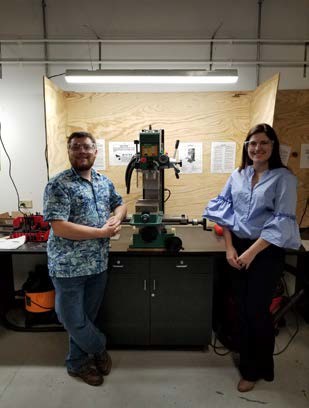
We worked with Huber Engineered Wood out of Broken Bow, Oklahoma to create a testing device for ASTM D1037 and PS2-10 Swell Tests that accommodate a larger range of Huber products. Currently the samples that do not fit within the current device are measured by hand. To fulfill the needs of Huber, we went about expanding upon the device that they currently use to allow larger variety of products to be tested. With this redesign, Huber can measure boards up to 2 inches thick with precision and accuracy. The device had to work with current lab set up while also being easy to implement. The Edge Swell testing device is useful to Huber as it allows them to have an elevated level of accuracy and precision for testing samples that have been previously out of size for the current means.
Roof Integration
Team Name
M.U.S.K
Team Members
Armando Alvarado
Hadi Al Hammam
Luke Garner
Estefany Lazo
Arnaud Ouedraogo
External Sponsor/Mentor
Simplified Roofing
Internal Sponsors/Mentors
Dr. Shi
Dr. Wasikowski
Abstract
There is an emerging problem in the world with the continuous rise of temperature, the planet is becoming warmer and thus the climate is changing. The burning of fossil fuels is the primary source of energy that is used to power the daily functions of our society. There are alternative paths that as a society can be used in order to stop or reverse the damage that has been caused by fossil fuels. The energy provided by the sun is an immense unexploited natural resource that can power the entire word; therefore, the purpose of this project is to help and contribute to emerging technological industries harvesting solar energy as a source of power. Our senior design team is in the process of integrating a solar cell into an existing thermoplastic roof material that is currently installed individually in commercial buildings. The main goal is to make the vast rooftop of commercial buildings harvest the solar energy.
Mechanical Vibration Analysis Demonstrator
Team Name
Vibrations
Team Members
Zach Biloff
Lisa Marie Eloriaga
Shayna Petersen
Juan Rojas
Lane Zupkov
External Sponsors/Mentors
AEK Technology (Bob Callender)
Internal Sponsor/Mentor
Mechanical and Engineering Department
Dr. Mark Wasikowski
Abstract
The purpose of our project is to create a four bar linkage system that will demonstrate vibration analysis while also demonstrating key mechanical engineering concepts like dynamics and machine elements. Our goal for our project is to be able to reduce the vibration within our system by at least 50%.
Our project serves twopurposes:
- One being that our end result machine will be able to show students 3D concepts MEEN students learn throughout our degree program in actual 3D view
- Show that within a given mechanical system that we may create in the future, vibration analysis/ isolating vibration within a system is key in the longevity of a machine as well as productivity
Micro Forms Project
Team Members
Alondra Pineda
Chris Hernandez
Moises Martinez
Onye Okezie
External Sponsor/Mentor
Micro Forms Inc.
Internal Sponsors/Mentors
Dr. Mark Wasikowski
Dr. Tae-Youl Choi
Abstract
Micro Forms purchased a camera system that will inspect every part produced. Due to their inefficient lubrication method, too much fluid is splattered onto these cameras, making them inoperable. The goal of our project is to design a lubrication system that can be accurately controlled and improve quality control. The design is innovative because we will repurpose vehicle fuel injectors to spray the lubricating fluid and control them using a programmable logic controller(PLC).
Project Vader
Team Name
MultiCam3
Team Members
Aaron Avellanet
Jose Deleon
Brandon Locklear
Ryan Maloney
Sergio Patino
External Sponsors/Mentors
Justin Cormier
Micah Janzen
Tony McGrew
Internal Sponsor/Mentor
Dr. Hamid Sadat
Abstract
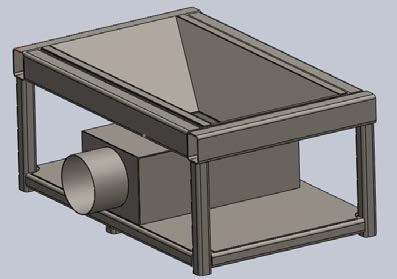
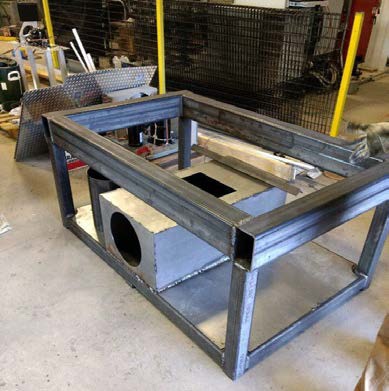
Our task is to redesign the Multicam3000 series CNC plasma cutting downdraft table and slag removal system.
When plasma cutters operate there are massive amounts of fumes and molten metal (slag) being thrown around. A downdraft table is meant to safely evacuate as much fumes from the work area as possible and to collect all the molten metal (slag) in one area for easy removal at a later time.
The current table that Multi-Cam uses has no issues but the design is over 10 years old. Project Vader is the pursuit to design/fabricate a downdraft table that can evacuate more fumes, provide a more efficient way to remove slag, and be more aesthetically pleasing.
Multicamcan then incorporate Project Vader in their current 3000 series CNC plasma cutting tables.
MultiCam Project
Team Name
Saturn
Team Members
Gabriel McAdams
Ryan McCarthy
Jessie Ross
Jonathan Shockey
Emily Smith
External Sponsors/Mentors
MultiCam
David Smart
Chad Hart
Internal Sponsors/Mentors
Professor Mark Wasikowski
Professor Xiaohua Li
Abstract
Team Saturn was responsible for redesigning MultiCam's 15 year old rotary tool changer for their 5000 and 7000 series routers.
The major problems with the current design were inadequate protection of tools from debris when the CNC cuts material and the position of the motor being on topof the cover leaves little room for the dust collector on the spindle carriage.
We first started off by brainstorming possible design solutions. We narrowed the ideas down to 2 possible solutions and chose the most feasible option. From there we used SolidWorks simulations to modify our design so that it would meet the design criteria.
Completing this project was important to MulitCam because many failures occurred when debris got inside the tools and the spindle tried to grab them. This is not good for production because a CNC router is supposed to be as automated as possible.
Acknowledgments
We’d like to thank MultiCam for supporting us through the design process and financing our chosen design. They were a big help in getting our project done on time. We’d also like to thank Dr. Li and Dr. Wasikowski for giving us new ideas to think about and teaching us new skills to complete theproject.
Level Jet Water-Jet CNC Height Sensor
Team Members
Corey Holmes
Nicholas Monroe
Brian Espinoza
Giang Phan
External Sponsors/Mentors
MULTICAM Complete CNC Solutions
Richard Carey
James Wright
Tony McGrew
Internal Sponsors/Mentors
Mechanical and Engineering Department
Dr. Li
Abstract
Currently there is no permanent solution for a height sensor on MULTICAM’s water-jet CNC machine.
The height sensor must be able to determine the standoff distance between the cutting tip and the material in which it is cutting. In addition all external components must be kept to a minimum and be easily replaceable.
The main issue tends to arise when cutting thin or cheaper metals. These tend to have built up stresses in themcausing the material to deform as it is being cut. Because of this the carbide tip runs the risk of impacting the material. Incorporating height and crash detection sensors are crucial to the design and development of this project.
A breakthrough with our design is the simplicity of the crash detection and its ability to be easily reset. This ensures continuous CNC operations with little downtime.
Introducing this design to MULTICAM’s water-jet will reduce production time and cost for the operator of this CNC.
Acknowlegments
Special thanks to Tony McGrew for giving us this opportunity, along with the mentorship from James Wright and Richard Carey.
We would like to thank Dr. Li and the MEE department for their help and guidance a swell.
Team Papyrus
Team Members
Orlando Rodriguez
Mohammed Rafiq Reaz
Ubayd Rabbani
Abdullah Alanazi
Edward Sean Gates
External Sponsor/Mentor
RichardBurke - VP of Optimization at Orora Visual
Internal Sponsors/Mentors
Dr. Qualls
Dr. Wasikowski
Abstract
Increased orders mean increased shipments which can exhaust a normal human crew. Our design is to use a cobot, the UR-10 model, to effectively supplement the packing lines to increase productivity. The scope of the completed project will be rather large and, if successful, would spread to the rest of the Orora facilities. Our objective was to automate the cobot on a mobile modular track system, that through later software development, could sync to a cloud to retrieve order information, scan packaging slips, while pick and placing products from a rack to a moving conveyor belt.
The cart concept is a rolling plate inside a slotting tray, which sits upon casters for mobility. The cart portion is interlocking for modular needs and elevated to be a similar height as the conveyor belt. Additionally was designed a counting end-effector to process large number of small sheets of product, allowing product to be quickly organized.
Acknowledgments
Hayden Winborn and Andrew Renzetti for going out of their way to assist our team.
UNT FSAE Car Suspension and Chassis
Team Name
UNT FSAE
Team Members
Aaron Partida
Chris Boucher
Mumtaz Farooq
Reece Loughmiller
Ryan Knight
External Sponsor/Mentor
American Water Jet
Internal Sponsors/Mentors
Dr. Richard Zhang
Dr. Mark Wasikowski
Abstract
The University of North Texas Formula SAE team is competing in the 2018 Lincoln event as a sixth year team. After placing 13th overall in 2017, the team set its sights on making changes to the systems of the car for weight reduction, increased strength, and higher degree of accuracy in manufacturing. The senior design system focus is the suspension and chassis of the car. The goal of this design project is to redesign and fabricate the suspension and chassis of the UNT Formula SAE car. The suspension is being redesigned a better lightweight geometry. The new suspension design will allow the driver have more control of the steering of the car. The three key changes in the steering systems were; a one piece double U-Joint instead of two single U-Joints, splined steering shafts as opposed to SAE Grade 5 cross bolts, a needle thrust bearing for the steering column support, and a premium quick-release hub. These changes resulted in significant reductions in steering systems play. The interaction of a vehicle’s suspension and chassis is crucial for producing a car that is predictable and balance when pushed to its limits. The chassis design goal was reducing weight and increasing torsional rigidity while complimenting suspension changes.
Solarity
Team Members
Jase Bailey
Viviana Guerrero
Conor Lambe
Aaron McEwen
Cathleen Trevino
External Sponsors/Mentors
UNT Facilities
Josh Lukins
Internal Sponsor/Mentor
Dr. Haifeng Zhang
Abstract
We are designing a solar canopy to cover most of theparking spaces on the top floor
of the Highland Street Garage. The energy generated by the solar panels will help
UNT save money on electricity, which will allow the canopy to pay for itself over
time, and the canopy will contribute to UNT’s image as being environmentally friendly
andsustainable.
Additionally, the canopy is expected to help UNT Transportation Services generate
more revenue, since people are more likely to pay to park on the top floor of the
garage if the parking spaces are covered.
Educational Wind Turbine
Team Name
STEMinist
Team Members
Roxanne M. Chavarria
Amanda Schneider
Nick Tomerlin
Nate Anderson
Jesse Sky King
External Sponsor/Mentor
Reynolds Advanced Materials
Internal Sponsors/Mentors
Dr. Mark Wasikowski
Dr. Russell Reid
Abstract
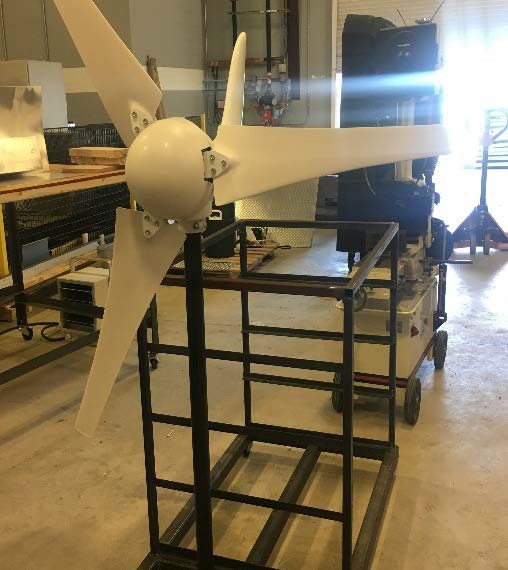
The primary focus of this study was to demonstrate how blade designs alter the power production of a wind turbine. The University Of North Texas (UNT) offers a wide array of engineering elective courses but most lack classroom models. For this reason, a wind turbine with four distinct blades was designed, engineered, and manufactured for the Alternative Energy (MEEN 4110) elective at UNT. The following four blade designs were chosen:
- Short Design
- Flat Blade
- Increased Tip Radius
- Wide Blade
Acknowledgments
The completion of this senior design project could not have been possible without the participation and assistance of Dr. Mark Wasikowski, Sr. Russell Reid, Robbin Shull, MEEN Department Staff and the University of North Texas.
We would like to convey our gratefulness for the invaluable guidance, suggestions, and support through the course of this project.
Team TLC
Team Members
Waleed Falltatah
Trevor Gomez
Darrius Green
Taylor Swanson
External Sponsor/Mentor
TLC Engineering for Architecture
Internal Sponsor/Mentor
Dr. Tae-Youl Choi
Abstract
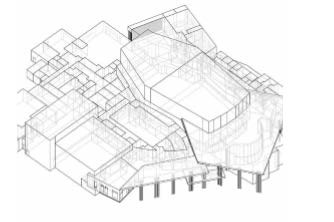
According to the U.S. Energy Information Administration, buildings make up 47.6% of the U.S Energy Consumption by sector. In order to reduce this large consumption, organizations have been put into place with the goal that every new building possess a net zero energy consumption by the year 2030. To achieve this goal energy modeling software is used in determining a building's necessary HVAC load. Energy models provide engineers an accurate real-life representation of the thermal properties within the building. From the Energy model data Engineers can size the mechanical system to be exactly what the building requires. HKS Architecture and the city of Arlington are in need of an HVAC system design for the new Arlington Performing Arts Center. To provide proper mechanical system drawings we utilized the energy model method to determine the necessary mechanical system and equipment sizing for the building. Thus reducing wasted energy from oversizing equipment and moving us one step closer to the 2030 goal. Alternative energy solutions, such as geothermal, do exist however there is a large limitations in professional engineers with experience in alternative energy solutions.
Team Trebuchet
Team Members
Michael Adams
David Ebert
Madison Hofmann-Molovich
Matt Reinhard
Internal Sponsors/Mentors
Mechanical and Energy Engineering Department
Dr. R. Zhang
Abstract
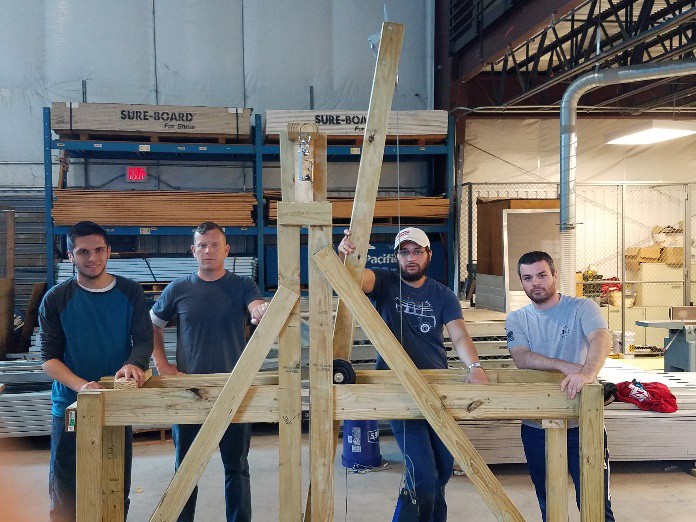
The purpose of our project was to take a medieval device called the trebuchet, used as a siege weapon in the 13th century, and improve the design. We approached the problem by deviating from the traditional design and using a floating-arm trebuchet (FAT) design. This design maximizes the kinetic energy of the counter weight by allowing the counter weight to freefall straight down instead of the traditional elliptical path. This allows more energy to be transferred to the throwing arm and thus throwing the projectile further. Therefore, we were able to use our engineering education to improve an old medieval weapon system.
Team Aerobots
Team Members
Jeremy Anunda
Bobbye Gentry
Brian Masinag
Meghan Rodriguez
Ryan Williford
External Sponsor/Mentor
Don Surratt, Triumph Aerospace Structures
Internal Sponsor/Mentor
Dr. Mark Wasikowski
Abstract
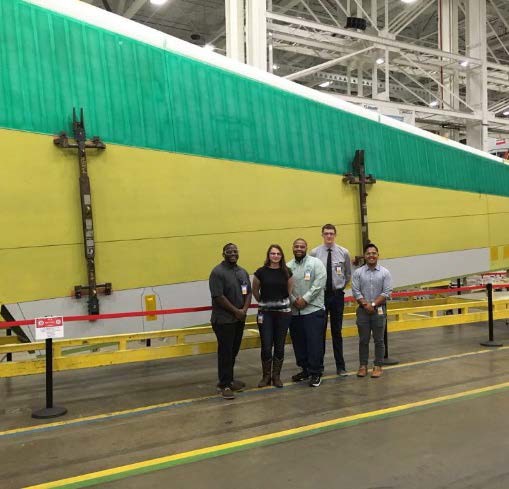
Triumph’s current fastener installation process in aircraft skin panels is mostly done by a human. A mechanic is required to place a “stencil/template” depending on the size and shape of these panels on the aircraft skin and mark fastener positions for thousands of rivets. After this is completed, the fasteners will be grouped/boxed together based on hole sizes by drawing boxes, lines, or symbols that denote countersink or not, or a combination of all three of these processes to aid in the correct hole size to be drilled by a human or by specialized autorivet machines. Not only is this process time consuming, human error can play a role in the accuracy of these markings causing repair and in some cases scrap the expensive parts. The position markings placed on the panels cannot be off by more than .030 thousandths of an inch, roughly ½ the thickness of a penny to stay within required engineering tolerances.
In order to reduce manufacturing time, cost and potential scrap, our team was given the opportunity to automate the fastener marking system. Our team is utilizing a UR-10 COBOT, a 60 pound collaborative robot provided by Universal Robots. This allows the same mechanic who would normally spend twice the time marking fastener positions and hole sizes to perform other value-added work while the COBOT performs this repetitive marking task. By doing this, the fastener process on aircraft skin panels is much more efficient, repeatable, accurate and reduces scrap costs.
Automated COBOT Stencilling
Team Name
Team GSD
Team Members
Morgan Blankenship
Aubri Frost
Zane Jackson
Benjamin Karten
Alexander Hayden Winborn
External Sponsors/Mentors
Triumph Aerospace
Don Surratt
Internal Sponsors/Mentors
Dr. Russell Reid
Dr. Mark Wasikowski
Abstract
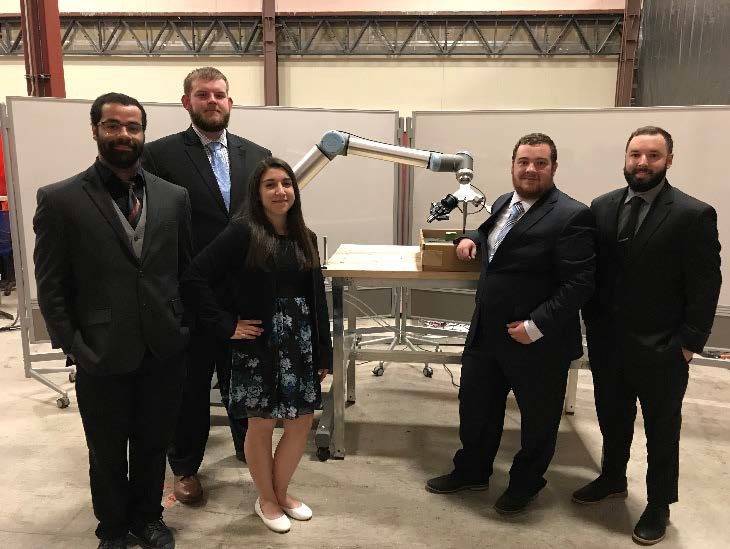
Mechanics working for Triumph Aerospace are currently having to mark parts by hand which leaves room for human error. They are required to reference drawings every time they make a mark which is tedious and time consuming. Our solution is to create a collaborative robot easily programmed to stencil parts. We were tasked with creating an end effector for a collaborative robot to mark small parts. The cobot will move parts to a new work space using suction cups or grippers, reorient to mark the part with a sharpie end effector, and place parts back to the original box.
Our team designed and fabricated three separate end effectors for moving and marking parts, a work space for parts to be stabilized on while being marked, and a jig for the box of parts tosit. Implementing this cobot into Triumph Aerospace will reduce error in part markings which will save time and cost.
Acknowledgments
Team Aerobots
UNT HVAC
Team Members
Kirk Plum
Devin Prosser
Dillon Novais
Mohammed Baqurayn
Jaclyn Van Hauen
External Sponsors/Mentors
Josh Lukins
UNT Facilities
Internal Sponsors/Mentors
Vish Prasad
Shaojie Wang
Abstract
We worked with UNT Facilities to design HVAC systems for the computer server rooms in Sage Hall and the University Services Building. Currently the computer server rooms for Sage Hall and the University Services Building are being served by HVAC systems that serve other parts of the building as well. Computer server rooms need to be served 24/7 as they are critical zones. Other areas in the buildings do not need to be served 24/7, so when they are unoccupied they are currently still being cooled and heated. This leads to extra energy and money being spent that could otherwise be conserved. If separate computer server room units were added then during unoccupied hours UNT could shut off the systems serving unoccupied spaces which would save energy and money. Through energy modeling we calculated the energy and cost savings that implementing separate computer server room units could provide. We then usedthe savings and the cost of adding new units to determine a payback well within the 7 year range.
Acknowledgments
We would like to thank Josh Lukins & UNT Facilities, Dr. Mark Wasikowski, Dr. Vish Prasad, and Dr. Shaojie Wang for their help in completing thisproject.
Shallow Water Bay Boat
Team Name
Z13
Team Members
Tim Drozd
Kody Wade
Brandon Phillips
External Sponsors/Mentors
Lakeview Marina
Johnson County Foam
James Propeller
Composite One
Internal Sponsor/Mentor
Dr. Nandika D'Souza
Abstract
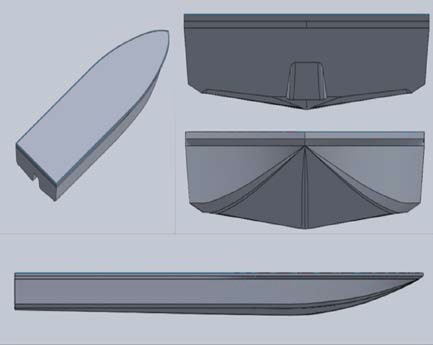
The problem that we were trying to solve is designing a shallow water skiff that would draft and run in less than 6-inches of water. Our solution to this problem is to implement a shallow water tunnel to help channel the water up to the prop without needing the prop to hang below the bottom of the hull. The tunnel allows us to achieve the 6-inch depth we were aiming for. Some of our design limitations are holding 2 people, weight, and the ability to haul 2 of these boats on a single trailer. This product was created using Solidworks to generate a 3D model, which then allowed us to have the company Johnson County Foam CNC the hull out of foam. One drawback of using foam was that the fiber glass resin would melt the foam, this meant we had to apply paper mache over the foam to protect it. After this we applied, fiberglass and sanded it down to create a smooth final product. This project is important for the fishing industry, as it provides a low-cost skiff with the ability to run in the shallow waters that bay fisherman would need.
Armrest Weight Reduction
Team Name
Zodiac Composites
Team Members
Mandhr Al-Alawi
Maadh Al-Badi
James Mairson
Luis Najar
External Sponsors/Mentors
Jeremy Green
Kevin Creed
Damian Diaz
Internal Sponsors/Mentors
Dr. Nandika D’Souza
Dr. Mark Wasikowski
Abstract
With the increasing use of composite materials in the aerospace industry, ZSUS tasked us with replacing a current metallic component of their seats with a redesigned lightweight composite, thereby making the seat more marketable to clients. We chose to modify the armrest core of their current Z-300 style seat, presently machined from 7075-T6 aluminum, with a high strength carbon fiber fabric and epoxy matrix to increase the structural strength and reduce weight.
In accordance with ZSUS safety standards and SAE aerospace standard AS8049A, armrests must be designed to meet handling and service load cases of 300lbf, 200lbf, and 150lb as well as fatigue loading without compromising seat safety.
After running FEA simulations our research shows the armrest core experiences high von misses stresses in the elbow region, which makes a complete carbon fiber piece unsuitable. Therefore, our project encompasses the bonding of anewly designed aluminum elbow with a carbon fiber sandwich structure to form an armrest core which is both lightweight and structurally sound. Using Solidworks, we redesigned the aluminum elbow with guide geometry that allows the carbon fiber beam-end to soundly bond to the aluminumguides. Further simulation analysis shows the bonded assembly will not fail and meets the listed load criteria.
Acknowledgments
Special thanks to Zodiac FEA engineer Ali Mohiti, who walked us through the Abaqussoftware and Dr. Hyeonu Heo who taught us to run simulations on the ANSYS workbench software! Also acknowledgements to Tonoy Chowdhury for helping us with composite property research and Lee Smith for Vacuum bagging demonstrations!
Zodiac Autobots Robotics
Team Members
Andrew Marien
Troy Nakagawa
Ismael Reyna
Muhammad Riaz
External Sponsors/Mentors
Zodiac Seats U.S.
Ronnie Dieter
Jeremy Green
Internal Sponsors/Mentors
Dr. Cherish Qualls
Dr. Mark Wasikowski
Mr. Robbin Shull
Abstract
Our client Zodiac Seats US is one of the biggest suppliers of the aircraft seats to plane manufactures and airlines all over the world.
This project details the automation of commercial aircraft seat assembly intending to reduce time, labor cost, increase seat production, and ergonomics. The automation is achieved by using Universal Robots. The UR3 and UR10 are programmed to coordinate with each other to pick and place parts, and torque in the bolts. Molds are manufactured to hold the parts in place while the robots torque the bolts with the help of custom end effector.
The requirements of this project is not only the torque specifications, but also weight that robot can hold, the reach of the robot, space available at the manufacturing facility, and the budget. Our project meets all torque requirements and weight requirements, but has yet to be tested to see if it can reduce cost and time. With further iterations and testing cost and time reduction can be achieved.
Acknowledgments
Thank you to all friends and family who helped us throughout our college experience.