 University of North Texas

Computer Engineering
PRiSM
Team Name
PRiSM
Team Members
PrajwalWaiva
Roshan Karki
Samantha Akos
Matthew Maddox
Internal Sponsors/Mentors
Dr. Robin Pottathuparambil
Clement Cole
Abstract
Stock plays a vital role in any company/country’s economy. It provides capital for companies and reflects financial health of any country. To be able to predict highs and lows of any company’s stock would help in profitable investment. Use of neural network as part of algorithm for prediction comes from two different source i.e. software and hardware for comparing the most precise values. This is hoped to create opportunities for economic growth.
Spacecraft Lighting Network System: 2b
Team Name
!2b
Team Members
TaylorShinn
Gladys Hernandez‐Amaya
John A.Todd
JorgeCardona
External Sponsors/Mentors
George Salazar, NASA
Internal Sponsors/Mentors
Dr. RobinPottathuparambil
Abstract
As mankind attempts to travel deeper into space, the need to have spacecraft with intelligent lighting systems is on the forefront. Lighting systems need to be reliable, use less power, compensate for outages or degradation of lights, and help astronauts be more productive by helping maintain their circadian rhythms. Longer missions will require sources of food for the crew members. We propose that we add the ability to grow vegetation, control system settings using voice control, and increase the networking abilities for the current lightingsystem.
Acknowledgements
George A. Salazar, Dr. Tim Urban, Talia Jurgens, Dr. Robin Pottathuparambil, Team Spatium Lucis, Thomas Kanabay, Zachary Simpson, Office of the Dean for the College of Engineering atUNT
Emergency Life Detection System
Team Name
ELD
Team Members
ShobinDavid
Justin Jacob
Abdullah Almofeez
HuyLy
Internal Sponsors/Mentors
Dr. Robin Pottathuparambil
Thomas Kanabay
Abstract
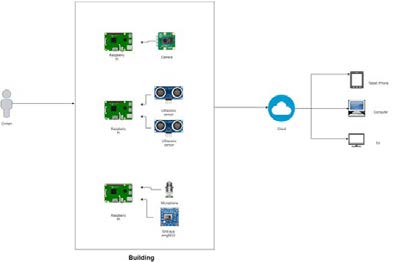
The Emergency Life Detection (ELD) system will aid first responders in detecting individuals inside a building. The ELD system will be a building installed service and composed of three main components: Building Entrance, Building Rooms, and Cloud data.
The entrance system will use facial recognition technology to track and recognize people entering and exiting a building.
The building room component of the system is able to monitor room activity and determine
the location of
people in the event of an emergency using a sensors system composed of thermal, ultrasonic,
and microphone sensors.
The final component of the system will involve the cloud to backup and process the data at all times. The sensor data will be analyzed and used to provide information on the location of individuals inside the building. The data can only be viewed by authorized personnel to ensure building safety.
Intelligent Lighting Control System
Team Name
Apollo’s Legacy
Team Members
Jesse Boswell
Cory Fairweather
Charles Goff
Scarlett Jones
External Sponsors/Mentors
George Salazar, NASA
Internal Sponsors/Mentors
Dr. Robin Pottathuparambil
Abstract
As mankind attempts to travel deeper into space, the need to have spacecraft with intelligent lighting systems is on the forefront. Lighting systems need to be reliable, use less power, compensate for outages or degradation of lights, and help astronauts be more productive by helping maintain their circadian rhythms. Longer missions will require sources of food for the crew members. We propose that we add the ability to grow vegetation, control system settings using voice control, and increase the networking abilities for the current lightingsystem.
Detecting Disease Contacts
Team Name
The Cavalry
Team Members
TravisShatto
DeepkumarMistry
JulianBugarin
PalBajwa
Internal Sponsors/Mentors
Dr. Armin Mikler (Sponsor)
Dr. Robin Pottathuparambil (Project Manager)
Abstract
The Disease Contact Detectives (DCD) team (UNT, 2016‐2017) accepted a proposal to create a research tool to assist in research directed by Dr. Armin Mikler from the University of North Texas. This research tool, known as the Detect Disease Contacts Initiative (DDCI) tool, is capable of measuring the number of contacts a person encounters in an average day. This is achieved by detecting the presence of an individual (or multiple people) within a 6 feet, 360‐degree field of view by using a variety of commercial components.
A volunteer will wear the DDCI tool for a period up to 12 hours. During this period the tool collects data on the contacts the volunteerencounters. Once the volunteer is finished with the tool the research data is collected by the use of two mobile Android applications; one mobile application is designed to transfer the research data to an AWS storage service while the other application is used to display the final results of the processed data. Ultimately this data can be analyzed by Dr. Mikler and his research team. To facilitate this functionality the tool sustains the power and data requirements for the 12‐hour period. This research data has many applications but it is primarily focused on the potential to identify where airborne illnesses are commonly spread.
Our team has improved the functionality of the DDCI tool by moving the post‐processing procedure to an online system using several Amazon Web Services (AWS), upgrading the infrared thermal sensor for greater accuracy, creating a more discreet and compact platform for the system to be placed, and developing two mobile applications capable of transferring raw data and viewing processed data.
Acknowledgements
Thomas Kanabay - Lab Manager
Hardware Based Trustworthiness System
Team Name
Computer Security Investigators
Team Members
JeremyYork
SpencerIgwe
EricSalas
CharlesRasmussen
Internal Sponsors/Mentors
Dr. Robin Pottathuparambil
Dr. Krishna Kavi
Abstract
The intent of this project is to create a hardware‐based computer security system. We are attempting this because we want to find a faster and more stable way to protect a computer. We believe that the current solutions are too slow and require too much power from the computer that it's protecting. We also believe that our way is much more difficult to trick because no new algorithms are required to check for any newviruses.
The project is designed around an external device (an FPGA in this case) that communicates with the computer using a USB connection. We created an application to push all relevant files on a computer to the external device to check whether any file has been modified. Each file will be passed through an algorithm in order to create a base "integrity measurement" that will be checked against in future scans. Our intent is to use the parallelism of the FPGA to create a much faster algorithm than a regular PC would allow.
Smart Home and Security System
Team Name
Eclipse
Team Members
AlejandroOlvera
GibranCastaneda
IsaAdeyemi
MiguelHernandez
External Sponsors/Mentors
Intelativ
Internal Sponsors/Mentors
Dr. Robin Pottathuparambil
Dr. Mark Thompson
Dr. Pradhumna Shrestha
Abstract
Currently, Smart Home and Security systems rely on third‐party software and hardware to function. An internet connection might also be required in order to process voice commands and other vital system information. This presents a risk since it exposes the system to outside attackers, and also compromises home security when internet or other services are unavailable.
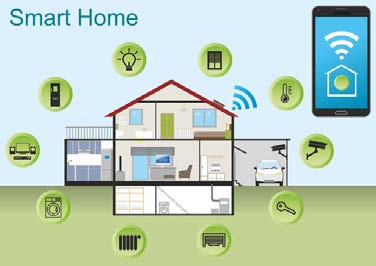
Our system aims to solve this problem by using a private secure network that processes voice commands locally. We have prototyped several types of sensors and controllers to demonstrate basic smart home functionality. Our system also includes the use of a console and an Android application to control the system. This project required working as a team of four, and we all used our skills in programming, networking, hardware, application and GUI design to complete it.
Medicine Minder
Team Name
FroZone
Team Members
Aaron Mayville
Andrew McAllister
Brian Pullen
Zack Watkins
Internal Sponsors/Memtors
Dr. Robin Pottathuparambil
Dr. Thomas Derryberry
Thomas Kanabay
Abstract
The problem we are trying to solve is being able to cool medicines portably in a timely fashion. Once the medicine is cool, our device will then keep the medicine at its desired temperature range.
The Medicine Minder will help preserve prescription drugs and ensure that medicines
are secure and consumable.
Our project is unique because of its portability, and its ease of use. Once the user
selects a medicine, the Medicine Minder does the remainder of the work. This makes
our device user friendly and easy to learn how to operate.
Enhanced Bike Safety System (E.B.S.S)
Team Name
Insomnia
Team Members
Arthur Aaron
Almond Brady
Reyna Edward
Rickey Proby
Internal Sponsors/Mentors
Robin Pottathuparambil
Thomas Kanabay
Abstract
There are many bicycle accident cases that happen every day, because either the rider loses balance or they are not focused on the road. Our goal for this project is to reduce the chance of an accident, and it improve the time for help to arrive when they do happen. We will accomplish this by having a built-in turn signal, and a crash detection system on the helmet. The turn signals will allow the user to signal without removing their hands from the handlebar, therefore allowing them to keep their balance better. The crash detection system will inform the user's emergency contacts that they were in an accident, which allows the emergency contacts to call help for them. The E.B.S.S also has a set of cameras to allow the user to always see what's going on behind them, and to record video so the user can use it if they get into an accident that was caused by someone. The bike will be self-powered to allow the user to ride without any worry of battery life. The user can also view his/her speed and heart rate while biking.
Rhyno
Team Name
Rhyno
Team Members
Rickey Dixon
Yessenia Ramos
Ryan Kaakaty
Hamdi Hmimy
External Sponsors/Mentors
Don, Triumph Group, Inc.
Internal Sponsors/Mentors
Dr. Robin Pottathuparambil
Abstract
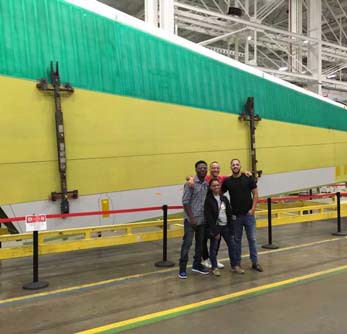
Large structures of aircraft like fuselage, wings, and other parts are built by riveting aluminum, steel, or titanium sheets together. These are very large structures and require 100s of rivets to combine and construct various structures needed for the aircraft. These rivet locations are marked by technicians using stencils and then verified and drilled to place the rivets. The markings needs to be very accurate, within .003 inches and a small error could make these large sheets unusable. The goal of the project is to automate the entire rivet process by using a robotic arm and a mechanical slide (designed and fabricated by the mechanical engineers) to precisely mark the rivet locations.
Sleep Apnea Monitoring & Diagnostic System
Team Name
Snooze
Team Members
Yale Empie
Tyler Anderson
Andrew Asdel
Jason Van
External Sponsors/Mentors
Edwin Simon, MD
Internal Sponsors/Mentors
Dr. Robin Pottathuparambil
Abstract
Approximately 25 million adults in the U.S.A suffer from Obstructive Sleep Apnea. This is an ailment that causes a person to cease breathing for small periods of time throughout their sleep. It is a large risk factor that can lead to development of other, worse conditions such as hypertension, coronary artery disease, stroke, depression, and even dementia.
Current sleep studies are done in‐lab in an unfamiliar environment, with diagnostic tools that cost upwards of several millions of dollars. It is also incredibly labor intensive and difficult for a patient to get into a sleep study for diagnosis due to the number of available sleep study locations in a region.
Our project set out to create a solution that would allow for a patient to do an effective sleep study within the confines of a familiar environment, such as their home, so that the patient can be properly diagnosed with Obstructive Sleep Apnea.
Acknowledgements
We would like to acknowledge the immense help that Thomas Kanabay has lent our team in making this project to completion.
VIEC Network System
Team Members
Marco Duarte
Richard Ervin Jr.
Kaothar Sowemimo
Alberto Olvera
External Sponsors/Mentors
George A. Salazar, P.E., ESEP
Internal Sponsors/Memtors
Robin Pottathuparambil
Abstract
Whenever a space shuttle goes into space, a number of controllers are needed to control the various systems in the craft. If a controller breaks, it will need to be replaced. One option is to send replacements, but for a shuttle far way from earth, this would be too time consuming. Taking extras of each type of controller is also an impractical option because they add to the weight of the cargo, which translates into a greater cost to get enough fuel to send it all into space. The Vehicle Interchangeable Electronic Controller(VIEC) Network System aims to alleviate some of this burden by creating a system of interchangeable controllers (IC) that can be interchanged into the network at any time. The server that manages this system loads the appropriate application IC whenever a new one has been plugged in. A universal connector will be used to interface the ICs with the corresponding input devices. The simulated systems will be a Habitat Lighting System, Environment Monitoring System, and a Reaction Control System.